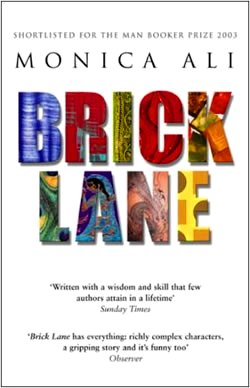
#bookaday What book do you have that doesn’t belong to you? Monica Ali’s Brick Lane


brick_lane


My Mother used to run a Guest House, and I found Monica Ali’s Brick Lane in amongst the bookshelves in one of the rooms. I still need to return it and explain that the spine was damaged long before I borrowed it (a sign that many readers have enjoyed the story long before you begin). It garnered a lot of attention for its Man Booker shortlisting in 2003 and I liked the clean, simple cover design. Beyond that, I really had no idea what to expect. What drew me in was Ali’s language, her ability to give you a sense of a room or of the emotional state of her characters in barely a few sentences. The opening line is one of my favourite book openings:

“An hour and forty-five minutes before Nazneen’s life began – began as it would proceed for quite some tine, that is to say uncertainly – her mother Rupban felt an iron fist squeeze her belly.”

This is a story of Nazneen; it is a tale of her her journey from a village in Bangladesh to a flat in the East End of London, and of her arranged marriage to a man who initially seems cold, indifferent. She knows no English and has to rely on her husband, spending her days tucked away sewing clothes, until she meets the radical Karim. The story of racial conflict and tension is beautifully portrayed, as is the love affair she eventually has with Karim, and her ultimate choices. It makes you question so many of your own ideas, and is an intimate picture of a life lived in a new culture with all of the conflicting messages and emotions.


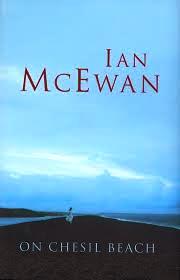
#bookaday One With A Blue Cover: On Chesil Beach by Ian McEwan

chesil beach


It is July 1962. Edward and Florence, young innocents married that morning, arrive at a hotel on the Dorset coast. At dinner in their rooms they struggle to suppress their private fears of the wedding night to come…

This is really all that’s needed for a book description of this gem of a novella, written by one of my favourite modern writers. It is a sensitively written but devastating portrayal of sexual awkwardness between a newly married couple staying in a pokey hotel in Dorset.

“This is how the entire course of a life can be changed – by doing nothing.”

These haunting words give you an idea of how McEwan plays with your emotions. His descriptions draw you in to the minds of the characters, Florence in particular, and her silence leaves you wanting to change the course of their lives. Her paralysis is partly what makes it work. The ending left me with a deep sadness. I don’t think a book has ever worked on my emotions in quite the same way. A huge feat of narrative genius.


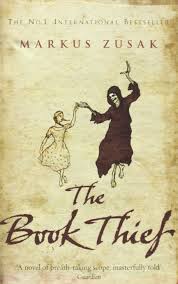
#bookaday Best Book Bargain: The Book Thief by Markus Zusak

book thief


I picked up The Book Thief soon after it was published and it was on offer. This is one of those books that draws you in and never quite releases you after you have finished reading. It had a great impact on me at the time, partly because it is a story of loss, but mostly due to the narration and the uncertainty of the fate of the protagonist. It’s a story about books, loss, danger, change, and the healing power of books. I’m sure I will go back and read it again and I’m even more certain that I won’t see the film. The descriptions of the scenes have carved such strong impressions in my mind that I never want them to come undone. I’ll leave you to find out the plot if you haven’t yet read it, and with the incredible fact that it spent over 230 weeks on the New York Times Best Seller list. Says it all!

#bookaday Favourite Book From Childhood: The Lion, the Witch and the Wardrobe by C.S. Lewis

The Bookseller has announced that Harper Collins imprint The Borough Press is launching a social initiative for booklovers to share books they love on Twitter and Instagram using the hashtag #bookaday. It will begin today, Sunday 1st June, and run throughout the entire month. Where has the year gone? How did we get to June? I will be blogging briefly on my book choices each day throughout June.

bookaday

I have many childhood favourites, but The Lion, the Witch and the Wardrobe sits at the top of the list. I’m sure you know the story but for those who don’t, it’s a fantasy novel for children (and adults!) The first of seven in The Chronicles of Narnia series, this one is probably the most well known. The setting is Narnia, a land of talking animals and mythical creatures that the White Witch has ruled for 100 years of winter. Four children are evacuated from London to an old country house in England during World War 2. Lucy, the youngest, discovers the land of Narnia through a wardrobe in a spare room. The others take some convincing but soon follow. TIME magazine included the book in its “All-TIME 100 Novels.” In 2003, it was listed at number 9 on the BBC‘s survey The Big Read. It has been published in 47 languages.

lion witch wardrobe

Why did I chose this one? I think there was something about the other-worldliness of the story that appealed to me as a child. The idea of a whole world on the other side of all that we know made me curious. I also related to Lucy’s difficulty in convincing her siblings that Narnia existed. There were times in my childhood where people I trusted didn’t believe me when I told them something important. I think a lot of children/adults can connect with this theme. Then there is the struggle between good and evil, between the White Witch and Aslan. Isn’t there always a struggle between good and evil in our minds and in our wills? There are so many themes in the book that I think anyone can relate to. Overall, it’s a magical tale of four children on a journey of discovery, who are willing to battle for justice in a land that not everyone can see. Their different characters and responses to the situations they encounter are, in my eyes, what make the story work. And the illustrations…

narnia

                     narnia 2

Have you read The Lion, the Witch and the Wardrobe? Join the conversation.

Narrative Arc: Shaping Your Story

story-arc

What is a story arc and why is it important?

story arc is the episodes within a storyline, the narrative structure of a book or a story (or a film, or TV series). It is the rise and fall of tension, as well as the pace and timbre of a plot. Shifts in the actions and behaviours of the characters, as they evolve and are changed by what happens to them, should force changes in tension.

Although an arc suggests a curve, most stories look more jagged. The image above is only one of the many examples of a story arc, with a fairly classic rise and fall of tension, and ending with a denouement, a resolution. Films often use a simplistic three act structure: Setup – Confrontation – Resolution. Short stories also have a story arc, unless you are Lydia Davis! Her short story, Children, is a mere two sentences.

The introduction draws the reader into a setting, the characters, their goal, and any potential. This is where the reader discovers what drives the protagonist and what might stand in their way.

A series of complications will often develop in the core of the text, leading to  a crisis or a series of problems. Each of these crises may be temporarily resolved, but the narrative will eventually lead to a climax. There is a rise and fall of tension with each crisis, with an overall rise in tension as the reader approaches the climax.

The denouement ties up the loose ends and resolves the conflict. Tension, at this point, rapidly dissipates, leading towards the ending.

The three act structure was used by Aristotle and in Greek tragedy.

The importance of a story arc lies in the need for structure, however varied. Without it, the reader will meander through the book, invariably getting lost and will want to put the book down. As a writer, you need to hook the reader to keep them turning the pages. Structure is an area of writing that I try to focus on, as I naturally tend not to plan too much of the plot. It depends on your genre and crime thrillers will demand many more plot twists and much higher levels of tension than literary fiction, for example, but the story arc should be such that the reader’s emotions rise and fall throughout the narrative. Too much high tension, and the reader will run out of steam, too little tension and you will lose the reader all together.

I’ll leave you with a humorous video of Kurt Vonnegut on Cinderella and the shapes of stories. It’s highly exaggerated but worth watching.

Kurt Vonnegut on the Shapes of Stories