Developing Conflict and Tension

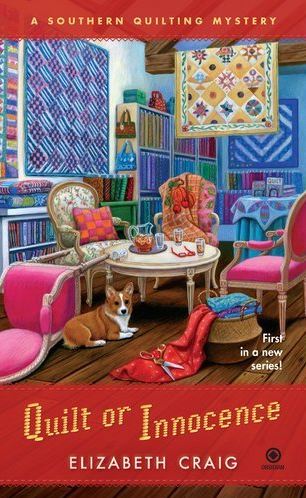
Today’s guest post is written by Elizabeth Craig who writes the Memphis Barbeque series for Penguin/Berkley (as Riley Adams), the Southern Quilting mysteries (2012) for Penguin/NAL, and the Myrtle Clover series for Midnight Ink.

She blogs daily at Mystery Writing is Murder, which was named by Writer’s Digest as one of the 101 Best Websites for Writers for 2010, 2011, and 2012. Her most recent releases are Quilt or Innocence (June 2012) , Hickory Smoked Homicide (a November 2011 release), and A Dyeing Shame a Myrtle Clover mystery (December 2011).  Her next release will be February 5, 2013–Knot What it Seams.

Elizabeth is active in the online writing community.  She shares writing-related links on Twitter as @elizabethscraig and posts on craft and the publishing industry on her blog, Mystery Writing is Murder. She and Mike Fleming of Hiveword also manage the Writer’s Knowledge Base–a free search engine to help writers find resources.

Developing Conflict and Tension in Our Story

Conflict is one of the elements of an interesting story.  As much as we love our characters, if everything goes smoothly for them, then it’s hard to keep our readers reading.  After all—if it’s just an ordinary day for our protagonist, then we really don’t have much of a story.

A few tips for developing conflict and tension:

Quickly introduce conflict into your story.  If it’s delayed too long, the reader might start flipping ahead through the set-up and back story to see where the story really gets started.

Use both larger conflicts and smaller ones.  A lower level of conflict can be easily maintained by introducing tension in our story.  Maybe we’ve got a character who lost his job and is struggling to make ends meet.  He finally snares a job interview—and it’s for his dream job.  His car breaks down on the way to the interview. He was in a hurry when he left, and forgot his phone.  This approach can resonate with readers, too—it’s realistic and relatable. It can also give us an opportunity for us to display a character’s personality to our readers…when we show how the character reacts to the problem.

Provide conflict through other characters.  Here we do need to watch our character motivation and know our character and what matches his personality.  Who rubs our character the wrong way and why can tell us a lot about the protagonist as well as the other character.  We could bring in an ex-wife, an overprotective father, an annoying neighbor, or a backstabbing co-worker.  Every time we have a scene with one of the troublesome characters, we have the opportunity for tension.

Use both internal conflict and external conflict. What are our character’s inner demons?  What’s our character fighting with himself over?  Consider how his internal conflict can shape the story and his reaction to events. What external conflict prevents him from obtaining his goal?

Raise the stakes to create a faster pace.  Raising the stakes and making the conflicts and outcomes increasingly dire for the protagonist is one way to increase our story’s pace and keep readers turning pages.

Try to delay resolution. One thing that’s been difficult for me as a writer is delaying resolution of the protagonist’s problems.  I’m a problem-solver in life and I want to solve my character’s problems, too.  But letting problems spiral out of control and allowing them to gnaw at my protagonist can add excitement and tension to a story.

Give readers some breathing room.  Some of this is personal taste, but as a reader, I really enjoy having breaks in the tension and conflict.  This break can be accomplished through humor, or a subplot that’s moving along the path to resolution when hope in the main plot seems to be lost.

Make the protagonist’s external conflict and internal conflict collide.  What if our character had to sacrifice what’s most important to him in order to accomplish his main goal?  What if he’s got to face his inner demons to save the world?

Tension and conflict are two ways to keep readers turning pages.  What tips have you got for developing them in a story?

Writer’s Knowledge Base–the Search Engine for Writers

Twitter: @elizabethscraig

Plot, Characters, Homeland, and What You Need to Achieve to Keep Readers Engaged

Are you hooked on Homeland? Yes? Great, we’re on the same wavelength. No? Give it a go, I’m sure you’ll be waiting for the next episode as soon as you have watched just one. Try it and let me know what you think. There is a trailer at the end of the post. I love espionage and secret service dramas. I was hooked on Spooks, set in the UK and now Homeland, a US  TV series which was released in October 2011. I watched the latest episode last night and my final thoughts before I drifted off to sleep, and my first waking thoughts, were what makes it so gripping?

There are many good dramas, films, and books that will keep you wanting more – books that will keep you up all night, films that leave you glued to your seat long after the cinema has emptied, drama series that will leave you waiting for the next episode, but how and why does this happen? Like all of you, my life is full and busy, there isn’t much time to watch TV, get to the cinema often or read a book right through in one sitting. So it has to take a pretty good plot and compelling characters to make me want more. These are the two key elements of a good storyline. You can have a great plot with two-dimensional characters and the reader/viewer won’t engage or feel anything, apart from maybe the need to go and make a coffee. Similarly, you might have engaging characters but if nothing happens to them, then there is no tension or suspense, nothing to stay for, nothing to come back for.

I’ll fill you in quickly on the Homeland plot:

Homeland is an edge-of-your-seat thriller, following Marine Sergeant Nicholas Brody (Damian Lewis), an American soldier returned to the US from years of captivity in Iraq, and Carrie Mathison (Claire Danes), a Central Intelligence Agency operations officer who conducted an unauthorised operation in Iraq and is put on probation. She is warned that an American prisoner of war has been turned by al-Qaeda. She believes Brody is not an American Hero, but part of a sleeper cell planning a terrorist attack. The only person she can trust is Saul Berenson. The two must now work together to investigate Brody and prevent another terrorist attack on America. Homeland was named Best Drama Series at the Emmy Awards, with stars Claire Danes and Damian Lewis winning Lead Actress in a Drama Series, and Lead Actor in a Drama Series, respectively.  The series also won Outstanding Writing for a Drama Series and Outstanding Casting for a Drama Series.

So, what is it that has made the series so successful, and why am I taking up your time in sharing all of this? Because it is important to learn what makes  the viewer keep coming back, and what keeps people reading.

Good Plot

A story has to have some element of conflict – conflict of desires, conflict of interest, conflict between characters. Without it there is very little tension. Not all books are thriller/espionage/action adventure, but even in a romance or historical fiction novel you’ll find some good areas of conflict which propel the plot forwards and drive the action. In Homeland you never really know which side Nicholas Brody is on. There are moments when you believe he wants the best for the US government and the country, and times when he wants to support the terrorist group who he became entwined with during his years in prison. He has allegiances to both sides for various reasons. As the viewer, you never know what he really believes.

Compelling Characters 

Sol Stein, author of nine novels, poet, screenplay and TV drama script writer, and creative writing lecturer, has said this of characterisation – ‘When I used to teach creative writing, I would tell the students to make their characters want something right away even if it’s only a glass of water. Characters paralyzed by the meaninglessness of modern life still have to drink water from time to time.’ He says that we are driven through life by needs and wants, that these desires are the driving force of characters. If a character does not want something enough, the reader or viewer will have a difficult time getting behind them, and will lack the emotional experience that they are looking for. Carrie, in Homeland, is constantly trying to prove her belief that Brody has been turned and is a ‘threat to national security.’ It is this drive in her, despite the obstacles, that keeps you hooked. You want her to succeed.

What have you seen, read or written recently that builds tension? Do you have any examples of good plot or compelling characters?

I’m off to see Skyfall on Wednesday! Enjoy the Homeland trailer…

http://youtu.be/_0ycbdFqWPw