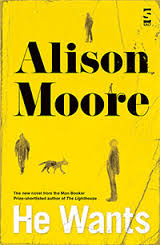
Retired teacher Lewis Sullivan always imagined living by the sea.
He lives instead in the Midlands village in which he was born. His grown-up daughter visits every day, bringing soup. He does not want soup. He frequents his second-favourite pub, where he can get half a shandy, a speciality sausage and a bit of company.
When a childhood friend appears on the scene, Lewis finds his life and comfortable routine shaken up.
In the wake of Moore’s award-winning first novel, The Lighthouse, and her debut short story collection, The Pre-War House (which I reviewed here), my expectations were high and this book did not disappoint. With Moore’s typically sparse plot, her attention to the minute detail of everyday occurrences, and her use of quiet tension, I sunk into this and did not resurface until I reached the end. At 182 pages, it is a short novel but needs no further chapters; its impact lies, in part, in its brevity and in its silences.
I appreciated John Oakey’s clever cover design, and the irony of the brightness of the yellow against the protagonist’s rather dull existence. It is possible that the colour yellow is scattered throughout the text for this very reason. Lewis Sullivan’s reserve and quiet desperation is painful at times, but he also resists change in the same way that a child might stamp his feet. Although, Lewis’s determination to keep a routine existence is done quietly and without a fuss. His occasional need to break out or to experience something new, something shocking, touches on the natural curiosity in all of us, and reminds us of the idea that there is always more beyond the borders of our existences. There is something inherently Freudian about the focus on Lewis’s loss, his inhibition and self-absorption.
Moore’s skill lies in lulling the reader into a comfortable, but temporary, sense of experiencing the ordinary, before she shocks the reader with an aggressive and threatening outside force through language which makes the character feel uncomfortable, or a dry expression and a sense of foreboding. Without giving away the ending, the whole story builds up to an unexpected climax, leaving you replaying the story to see where the clues may have been buried in the pages, if at all. Lewis Sullivan’s routine existence, with daily visits from a daughter with whom he shows no real connection, is shaken up when his old pal, Sydney, resurfaces, causing unexpected disruption to Lewis’s days. The fact that Sydney is also a far-flung destination is not lost on the attentive reader.
The book title is followed through with chapter headings beginning with an ominous, He does not want…, He wants…, or He wanted to… There is a combined sense of anticipation, regret, fear and uncertainly in each chapter – with much of the tension rising from what is left unsaid, in the unspoken sentences – in as much as his life is made up of the things he did not do and the places he did not visit. And then there is the matter of the dog who is weaved through the pages, a dog whose ownership is unclear. At one point we find ourselves in the company of the two characters and the dog in the kitchen, and it is unclear for a while to whom both the dog and the kitchen belong: “The man, who has been looking at him, looks at him some more and then says, ‘Your house?’ ‘Yes,’ replies Lewis. ‘You are in my house. This is my kitchen. You are sitting in my wife’s chair at my kitchen table. I thought for a moment that this was my dog.'” In the following lines Lewis wonders if he is being burgled. I can’t help thinking of Goldilocks and the Three Bears as we wonder about the intruder. There is an almost surreal element to the book, a sense of other-worldliness.
The themes of religion and eternity are well expressed with their uncertainties and extremes, in particular in the chapter, He wants to fly, where we are drawn back in time to Lewis’s father taking him to see Billy Graham in Manchester at the age of eighteen. His concerns about baptism focus on whether or not a person would need to be clothed or naked, and whether it would require a clean pair of pants. He lists some of the Thou Shalt Nots of the Bible, with which many are familiar, in a way that may threaten to close his life in even further.
The narrative is beautifully layered, with generational links and well-planned time frame jumps. So many elements of the book feel familiar, yet much is also unexpected. Themes of loneliness, memory and loss are unfolded with a deep originality. Lewis is, at times, an unreliable narrator and I sense that Moore enjoys this element of surprise. This book is not for those who want a fast paced thriller, but there are dark aspects to He Wants and an intensity of emotion that will pull you in until the last page.
I’m off to buy myself a new suit and travel the world!
















 F C MALBY
You must be logged in to post a comment.