Which Books Would You Take With You if the House Burnt Down?

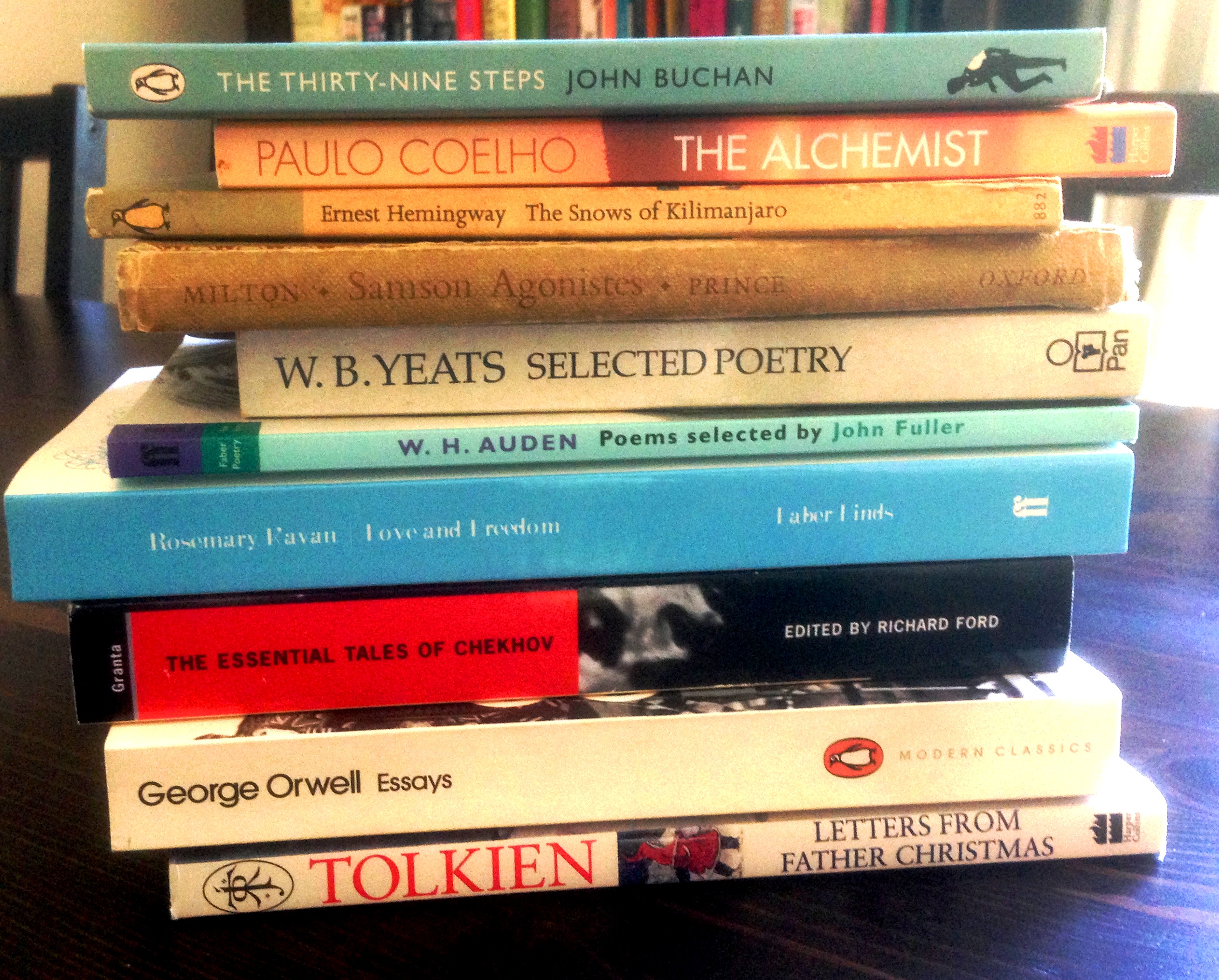
A dramatic title, isn’t it? Inspired by a wonderful post I came across this morning from Maria Popova’s Brainpickings blog, entitled The Burning House: What People Would Take if the House Was on Fire, it wasn’t so much the eye-catching title which caught my attention so much as the photographs: images of people’s treasured possessions, from camera lenses and photographs to pets, cigars and underwear! One six year old boy added a Lego helicopter, a great choice. What I found intriguing was the inclusion of many books in people’s in people’s collections. A literature teacher from Germany had included her Great Aunt’s violin, along with two letters, a journal, a New American Standard Bible, Rilke’s Book of Hours and T.S. Elliot’s Collected Poems. Popova’s own collection includes a 1935 edition of Ulysses with sketches by Henri Matisse, and a 1993 edition of Gertrude Stein’s 1938 children’s book, The World Is Round. It made me wonder which books I would take with me if I had to leave in a hurry. In an age of eBooks many of us still treasure rare or familiar paperbacks and hardbacks, books with inscriptions or notes, books with illustrations and photographs. I have compiled a collection of books:

photo 5

It’s quite a mix of authors, fiction and non-fiction. Each book has its own reason for sitting on the pile, each book its own place in memory.

The Thirty-Nine Steps was the first book I couldn’t put down. I had finally found a book which kept me up at night until I had read the last page. Originally published in 1915, this spy thriller is set in the wild mores of Scottish, a place which holds great memories and partly the reason for the story’s resonance. I’m sure you’re familiar with the plot: On the eve of World War I we meet Richard Hannay, bored with his London life until he finds a body in his flat. Before long, Hannay finds himself in possession of a little black book that holds the key to the conspiracy, and on the run from the police. The books has inspired many films and plays since, including Alfred Hitchcock’s classic adaptation. Read it!

The Alchemist holds its place in my mind for the very reason that my husband read it to me on our honeymoon. This is not a regular occurrence but it is a memory I treasure. Set in the exotic locations of Spain and the Egyptian desert, Coelho tells the magical story of Santiago, a shepherd boy who dreams of travelling the world to seek treasure. The otherworldliness of this story, with its magical realism and folklore, inspires you to dream and to think beyond the boundaries we create in our lives.

“The simple things are also the most extraordinary things, and only the wise can see them.” 

The Snows of Kilimanjaro and Other Stories was given to me by a dear friend with an inscription in the front. It is a 1964 reprint. Hemmingway’s short stories are raw and sharply observed.  I think that’s all I need to say.

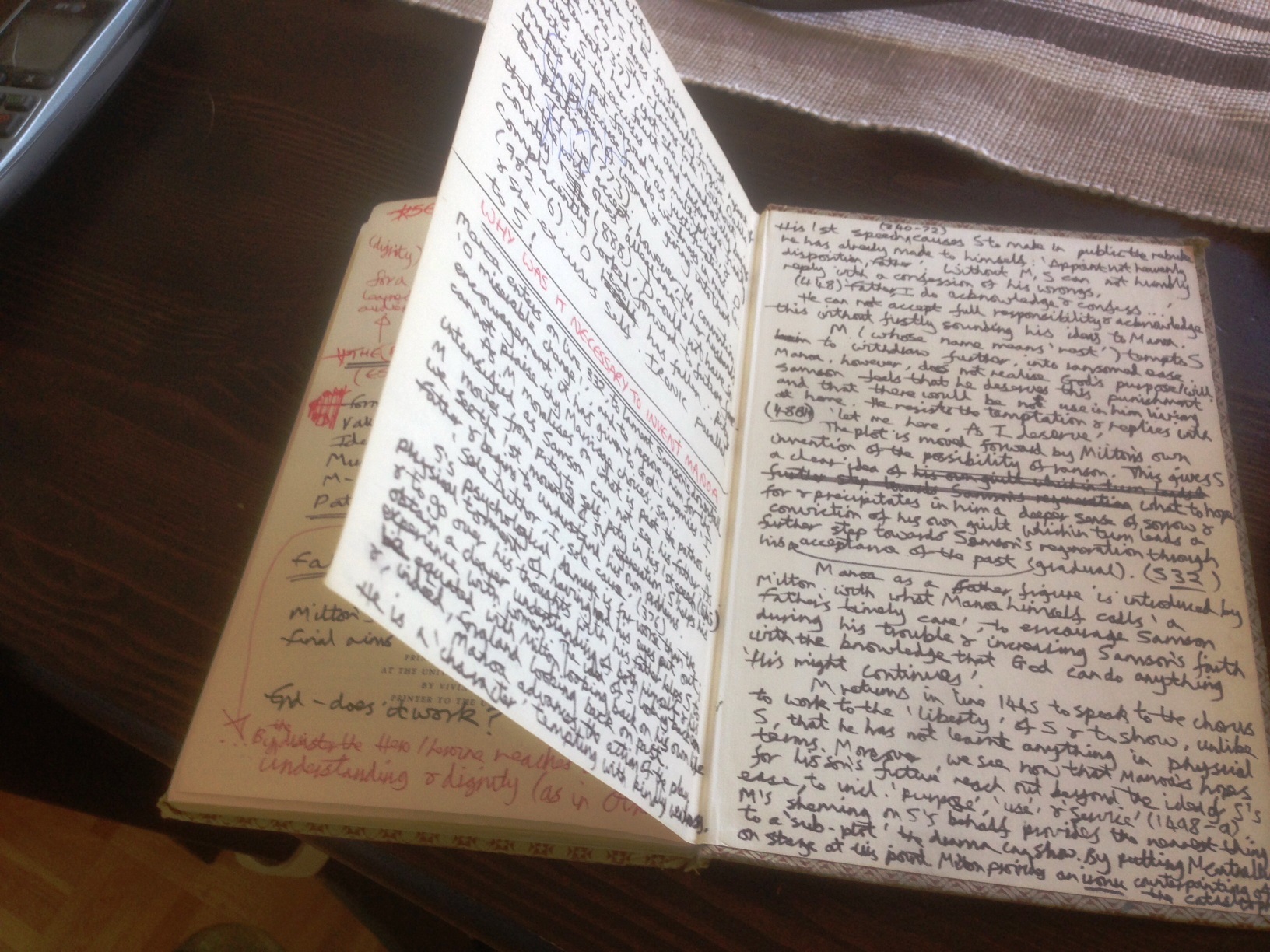
Samson Agonistes might seem an unlikely choice, but this battered version has been on my bookshelf since my schooldays. Milton was taught with great enthusiasm by my English teacher, and at a point where I began to understand the many layers within a text. My copy is full of notes in a variety of colours with underlining and asterisks. I will hold on to this one.

photo 1

W.B. Yeats Selected Poetry forms a part of my long history of collecting poetry. I have been fascinated by poetry since childhood, and Yeats is a writer whose work I enjoy because it is mystical, melancholic and full of questioning. The first line of To A Young Beauty is a great example of his style:

“Dear fellow-artist, why so free

With every sort of company,

With every Jack and Jill?”

W.H Auden Poems selected by John Fuller is here for the same reason, although he is possibly my favourite poet. Most notable for Funeral Blues, beginning with Stop the clocks, his lesser known works are just as lyrical and beautifully crafted. I really enjoy the wit and irony which runs through much of his writing. Epitaph on a Tyrant is scathing and applicable to any dictator you choose to name.

“Perfection, of a kind, was what he was after,

And the poetry he invented was easy to understand.”

Love and Freedom is a book I have mentioned in a previous post, so I will just say that I am so glad it is back in print. A rare gem that was originally used for research and has become one to keep. This memoir set in post-war Prague is electric; a beautiful, honest account of a life lived under communism.

The Essential Tales of Chekhov was also a gift and has an inscription in the front. I am a big fan of Chekhov’s stories. They need no explanation but this collection is really good. Edited by Richard Ford, is comes with a lengthy introduction on Why We Like Chekhov.

George Orwell Essays has been added to a list which is reasonably filled with non-fiction as well as fiction. I probably shouldn’t say this, but I almost prefer his essays to his famed 1984 and Animal Farm, to hear his unfiltered thoughts, than through the lenses of dystopia or allegory. I haven’t yet read his other fiction novels, so I should reserve judgement. His essay, Why I Write, might appeal to writers. He has also written on Kipling, Yeats, Tolstoy and Wodehouse, which I found interesting. He has bravely covered many political topics, although I think he would rather call it honesty.

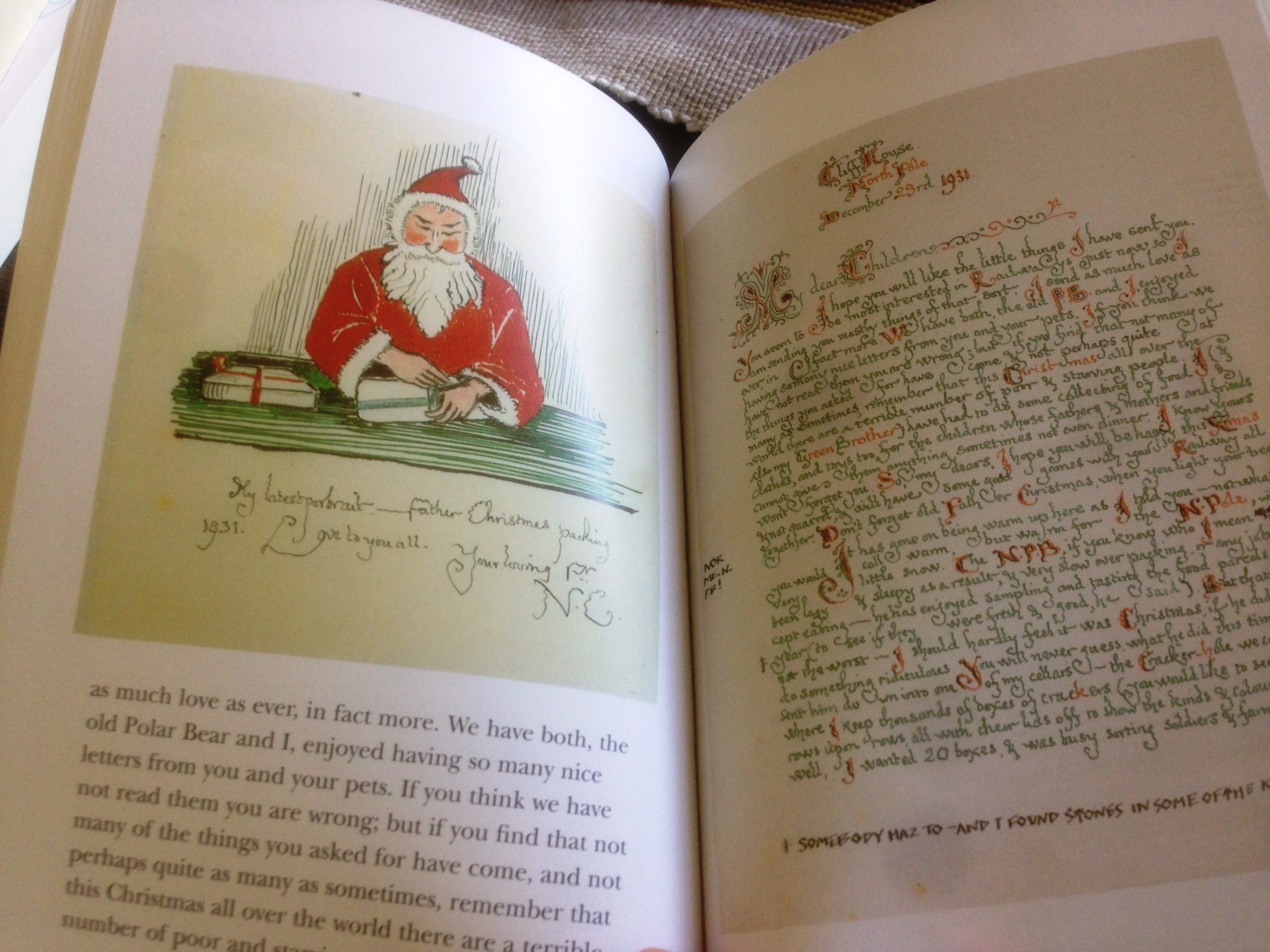
Letters From Father Christmas is a wonderful find. I discovered it whilst searching for Christmas presents last year. It is a collection of letters written and illustrated by J. R. R. Tolkien between 1920 and 1942 for his children. They were released posthumously and received a warm response from critics. It has been suggested that elements of the stories inspired parts of Tolkien’s Lord of the Rings. The stories include descriptions of the massive fireworks that create the northern lights and the illustrations are inspirational. 
photo 2

Interview with Scriptwriter and Lecturer, Russell Gascoigne

I’m pleased to welcome Russell to the blog today. Most of his work has been in television drama. As a scriptwriter he has written for the BBC, ITV, Channel 4, Channel 5 and S4C, his credits ranging from soap through to A Touch of Frost. He has worked as a BBC Drama script editor and script reader/consultant for numerous TV and film companies including The Movie Acquisition Corporation, the European Script Fund, LWT, TVS and the BBC. His first YA novel, Rebels, set during the English Civil War, was published in 2004 and he is now working on another, as well as developing other TV projects. He also teaches scriptwriting and runs the Scriptwriting Workshop Online (offering long distance e-learning support to writers working on their own scripts) at Cardiff University.

 gascoigne 2


“The highs since then? Getting 16.85 million viewers for A Touch of Frost would certainly be one of them.”


What have you found to be the key differences between the skills needed for scriptwriting and Young Adult fiction writing? Do you have a preference for one particular form?

I’m not sure that it’s a different set of skills that’s required so much as an understanding of the very different parameters within which you’re working. With both story is paramount, of course, but especially so where scriptwriting is concerned. Beyond that scriptwriting also has a number of really quite strict principles to which you must adhere or, at the very least, remain closely mindful. I recently read an interview with a Hollywood screenwriter in which she described the process as being like writing haiku poetry. I think that’s right. It’s an extremely exacting form which demands control, economy, subtlety and nuance but in which so much can be expressed visually. With fiction you have much more freedom but are forced to describe things. You can also employ devices such as the interior monologue through which to explore your characters. However you can also end up running away with enough rope with which to hang yourself. A particular skill that scriptwriters (should) have is to write good dialogue. Not all novelists have that. Even some otherwise well-regarded novelists are capable of writing slabs of dialogue that would make any scriptwriter wince. Not only because of their length but because they’re often shorn of subtext, any sense of a character’s individual voice and are stuffed to the gills with exposition. As for which particular form I prefer: I really can’t choose one above the other. It’s all writing. Making up stories. I love both.

How did you get into scriptwriting and what have been the highs and lows so far?

I honestly can’t remember if the first script I wrote was for stage or radio. Either way, I started out writing for those. Mainly radio. Short stories and, eventually, drama. My first television commission came about when a writer friend invited me to a meeting an independent production company had set up with the BBC. Having come through the selection process, I was one of the writers invited to write a couple of episodes on the series – a police drama. I was writing novels at the time and had a literary agent. The producer suggested I moved to an agent who worked in film and television. I took his advice. The highs since then? Getting 16.85 million viewers for A Touch of Frost would certainly be one of them. Alongside that: having several of my own, original projects commissioned. The lows? Seeing some of those projects fast-tracked only to be derailed a little further down the line for one reason or another. I still have a note from a BBC exec framed on the wall next to my desk. ‘I think the word is out we should make (name of project) with or without (name of famous person).’ That’s one of them. It wasn’t made in the end. In that particular case because a Head of Drama left their post and the project was sidelined (enough train metaphors now, I think). Not that much of a low really. That’s how it is writing for television. Much more gets picked up than ever gets made. It’s just that when you get close… it hurts that little bit more. You need to accept the disappointment and move on to the next idea. It’s the same for everyone.

Have you ever had specific actors in mind for a role within your scripts and why?

For existing series etc you know who you’re writing for. Otherwise, unless a particular actor has been suggested or is actually attached to the project (which has happened to me on a few occasions), I’ve never really written anything with a specific actor in mind. I’ve simply written for the character(s) in my imagination. Either way, some actors and characters are easier to write for than others. I wouldn’t say it’s necessarily better to write for the character(s) in an existing drama or to invent them. I’ve enjoyed doing both.

You have also written drama, documentaries and short stories for BBC Radio 4 and other stations. How different is this to scriptwriting for television? 

You have to create pictures in your listeners’ imagination. You haven’t got the luxury of being able to show things visually. At the same time, you do have the luxury of being able to take them wherever your imagination wants. You can jump from continent to continent – any location you like – with no additional expense. Beyond that, it is – in my experience, at least – a more relaxed medium for which to write. TV productions are on a much larger scale. Accordingly, there’s much more pressure.

What drew you to writing Young Adult fiction and what were your key influences when you were younger? 

My agent was approached by the publisher and I pitched an idea that was originally a proposal for a TV series. It had gained quite a lot of interest but hadn’t gone into development largely due to the expense and the fact that there was another project with a Civil War setting already in production. I had written a couple of unpublished novels before getting into TV drama but I hadn’t thought of writing YA fiction up until that point. A key influence on that particular project – Rebels – was Mark Twain. I loved reading Tom Sawyer/Huckleberry Finn when I was younger. Adventure stories in general. And that’s what Rebels is: an adventure story. It was later optioned by the BBC for film development. It didn’t happen – then. But who knows, maybe another time?

Can you tell us about the Online Scriptwriting Workshop which you run at Cardiff University?

The Scriptwriting Workshop Online is open to writers at all levels of experience and ability from across the UK – and beyond. It isn’t a ‘course’ – I run one of those separately. What I do is help writers develop their scripts on a one-to-one basis via email, providing feedback, guidance and advice on as many rewrites as people want to undertake during the process (which lasts approximately ten weeks). The fact that I am a working writer with a variety of scriptwriting credits does, I think, give me a particular empathy with writers working on their own material. I know what it’s like to get script notes. I know what it’s like trying to incorporate them into a script. At the same time, having been employed on the ‘other side of the fence’ as a script editor and script reader/consultant I also understand the demands and pressures there. Clearly, if you’re working as a script-developer/consultant you want to have accumulated some good scriptwriting credits or dealt directly with scripts at production level within the industry. I’m fortunate enough to have done both. It’s not a bad combination. Most recently one of my students reached the full-read stage of the BBC writersroom script-window. Others have gone on to gain representation and full TV drama commissions, to win and be shortlisted in various scriptwriting competitions and to make their own short films. I’ll be running the next Scriptwriting Workshop Online in September. Details will be posted here http://www.cardiff.ac.uk/learn/choices/humanities/creative-writing-and-media sometime towards the end of June if anyone’s interested.

What would you do if you weren’t a writer and a lecturer?

If I wasn’t involved in scriptwriting (or any other form of writing) I can only imagine I’d do something similarly unhinged, obsessive and lacking in security. Your guess is as good as mine. The fact is, I couldn’t imagine not doing it.


Russell Gascoigne is represented by Frances Arnold at Rochelle Stevens (Film & TV) Ltd.

IMDB: http://wwww.imdb.com/name/nm1397925/

Linkedin: linkd.in/1d8jfMB

Twitter: @RussGascoigne1

Don’t Be Afraid to Throw Away What Doesn’t Work

shoes

I have a pair of shoes that are so comfortable I hardly feel I’m wearing them. But they are falling apart, to the point that they really need to be thrown out. This morning a new pair arrived at the door. I ordered online to save time shopping, and to spend more time this week writing. I opened the box, unwrapped all the paper, et voilà – a new pair of shoes. They were different, except for the fact that they were actually the same! Yes, I ordered the same pair. So the first pair presumably once looked much like the second, although I can’t remember them ever looking that fresh and zippy!

I tried on the new pair, shuffled, took them off and tentatively put my feet back into the old pair. But something stopped me: a voice inside my head that said, ‘You’ve just ordered a new pair. Why are you going back to the old ones? They need to go in the bin.’ Hmm. I took them off and tucked them away. They have yet to reach the bin. As I type, I’m wriggling my toes inside the new ones. When I look down they look great, but they are not as comfortable. ‘It’s OK,’ I tell myself. ‘You’ll just take time to get used to them. Keep them on.’

Isn’t that what’s it’s like with writing that doesn’t work? Some of it is scruffy but comfortable. You cling on to it in the vain hope that it might work, but you know deep in the pit of your coffee-and-biscuit-filled stomach that it won’t. You know the reality is that you will need to cut, ruthlessly, until your work is, in places, almost unrecognisable. You will need to throw away the holey parts, the frayed edges, the parts with missing pieces that will never be filled.

It’s amazing how much emotion or sentiment is attached to some pieces of work, which is why you need good beta readers and good editors and an open mind. As you write, and as you reread, you have to develop the ability to see your story through the eyes of someone with no emotional investment in your work, someone who is prepared to throw out the parts that you want to keep. It is possibly one of the toughest parts of the process. Sometimes whole stories need to be thrown out, sometimes its beginnings or endings and sometimes it might just be sections.

What can you throw away that isn’t working? What can you cut to make your writing tighter?

Why Bother With Social Media?

images (19)

Social Media: A phrase that strikes up a series of emotions in each one of us. Some people enjoy using social media sites, thriving on the information they can gather and the contact with others, while others avoid it through fear or a lack of time or motivation. Many people have a love/hate relationship with it. Why does it cause so much consternation, when the aim has always been to connect and to share information? Each site takes time to navigate and to get used to, much like a new relationship or friendship in some ways! At first you post and respond to others, gradually gaining the confidence and understanding of how it all works. Each site has a different character and set of expectations. You step up your communication, post, wait, wonder. Sound familiar?

The earliest forms of social media were not electronic, but took the form of cave paintings. These were the earliest known signs of humans trying to communicate, to leave their mark. Now, we leave our mark, our knowledge and some of our personality, on sites like Twitter, Facebook, Google+, Pinterest, LinkedIn, WordPress, Tumblr or other blogging sites. We strike up connections with others and share information, often collaborating in a way that would have been difficult before the age of social media.

So, why take the time to engage with social media?

1. You meet an amazing range of people, both within and outside your field of expertise.

I have met some fantastic readers, writers, bloggers, editors, agents, marketing experts. Meeting people within the fields of writing and publishing have helped me to learn about the industry. Other authors have been a great encouragement to me along the way (which is something we all need). Readers have contacted me through my website and found me on other social media platforms. If they enjoy your work and like who you are as a person, chances are they will want to engage and follow what you are up to. I have also gained a great deal from others outside this group. I follow journalists and people who are interested in some of the things I enjoy outside writing: music, art, travel and skiing.

2. Sharing resources

The online community are a generous bunch! I find that people share information on writing competitions, tips on writing and publishing (both self-publishing and traditional publishing). It’s also a great way to find out about writing courses or retreats. I first heard about the Arvon Foundation through Twitter. They offer residential writing courses with a range of authors who teach specific courses throughout the year. Interviewing other authors on your blog and hosting posts is a good way of networking and sharing new work with your readers. You can also approach other bloggers and offer to write posts on their blogs (see my post on Optimising Facebook on 30 Day Books).

3. Finding books

Many people share books they have read and enjoyed. There are a few editors whose tastes are similar to mine and I almost always enjoy the books they suggest. Book bloggers are a great resource, reviewing books and giving honest opinions on popular or recent books, and often on classics I might have missed. I also review books as well as hosting interviews and posting about writing. Literary salons and author events in bookshops are also advertised on social media sites. Don’t miss these if there is one near you.

4. It keeps you up to date with what is going on in the publishing industry.

Within the publishing industry I have learned a great deal from people like Jane Friedman (former publisher of Writer’s Digest, who writes about the future of the publishing and media industry), Porter Anderson (journalist and publishing consultant) and The Future Book, a blog founded by Sam Missingham (formerly working for The Bookseller Group). If you are interested in a traditional publishing deal, social media sites are a good way to find agents who might be a good fit for your work. Follow the #askagent hashtag on Twitter for agent tips and #MSWL for individual manuscript wish lists. If you are self-publishing, there is a plethora of blogs and sites with all the information you will need.

5. It helps to develop your writing skills on many levels.

Blogging is a good extension of your writing. I wrote a post on blogging with a list of resources. It helps you to learn how to engage readers and to put forward your ideas in an interesting way. This is particularly useful for non-fiction writers who might need evidence of a platform before approaching an agency, and to connect with readers of your particular subject area. As far as fiction is concerned, there has been advice not to write about writing, but I find that these posts have a high level of engagement and readers often write to tell me that these have been helpful. I would run with what works, what you enjoy and what helps others. Social media is an important place to be a helpful resource for others. If you use Twitter it will keep your writing to a succinct 140 characters! This can be a challenge if you tend to over-write or over-describe.

6. You are available for people to contact you and find out about your work.

I have deliberately left this point until last because promoting your work should not be your primary focus on social media. It is called ‘social’ media for the very reason that you interact with people respectfully and share your ideas. If you are interesting and thoughtful, and readers like your style, they will often then look into your work. But you would not sit in a cafe or a bar with a friend saying “Buy my book, buy my book.” So, don’t do it online. It is one of people’s greatest bugbears. Leave an option for people to sign up to your newsletters and to follow your blog posts. I promise you this is enough. No one likes a hard sell and if you treat social media with the same approach as a double glazing salesman, you’ll get the same response.

What are your thoughts on social media? Are there sites that you use more often and why? Are there some sites you haven’t yet got to grips with? Share your ideas. I’ll leave you with some interesting stats:

social-media-networks

Fiction Winner – Litro Magazine (Environmental Disaster Competition)

litro


A recent piece of short fiction, The Air is Still,  has just won the Litro Magazine Environmental Disaster competition, and is published online at Litro.