Living on the Edge of Confidence and Self-Doubt

I was at the Camp Mighty retreat a few weeks back, and one of the best talks was given by Ben Silbermann, co-founder and CEO of Pinterest.

He talked about a journey that I think would be extremely familiar to any novelist. He embarked on many false starts as after he quit his job at Google and built several semi-successful sites before finally arriving at one of the most influential designs in the last five years: Pinterest.

In his talk, he mentioned something that really felt familiar to me as a writer, which was that even after all the success he has had with Pinterest he lives at the intersection of terror and joy.

This struck a chord with me because it gets back to how you have to live as a writer. You have to be strong enough to put yourself out there, brave and confident as you share a part of yourself with the world. You do it because you love it so much you’re willing to risk everything negative that can possibly come your way.

But you also have to be self-critical enough to edit your work and fear failure and be worried that your best might not be good enough, which pushes you just that much further. You have to be scared of what will happen if you don’t do your best. You can’t ever get comfortable.

Terror and joy. Confidence and self-doubt. The best artists live right in that uncomfortable middle.

Reblogged from nathanbransford.com
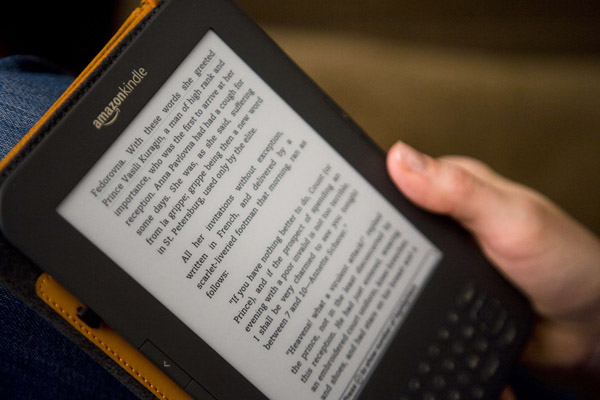
One of the most effective ways of editing your work

Kindle

So, you have painstakingly crafted a novel, left it to rest, edited and re-edited. What next?

There are many different recommendations for editing, especially during the final stages of your work. Most writers recommend using a different medium, which is more likely to flag up any issues with sentence structure and grammar. You can read aloud so that you are hearing, rather than seeing your words, you can read it on the screen, print it out, or there is anther method, which I have found really effective. A method that has, for me, picked up the most issues with the manuscript…

One of the most effective ways of editing your work is to read it on your kindle or any other eReader device. Follow these simple steps, and you might also want to try it for blog posts:

1. Make sure you are happy with the text as a whole.

2. Download Mobipocket eBook Creator and import your word document. Mobipocket will generate and save a kindle ready file. This keeps the formatting clean.

3. Send the document as an attachment to your kindle email address, which will probably look something like clairesmith_26@kindle.com.

4. Make sure the wireless setting on your kindle device is switched on and then click ‘check for downloads.’

5. Don’t worry too much about formatting yet if it feels overwhelming. You can do this at a later Stage. The less carriage returns you have inserted, the better. You will need to use page breaks when you get to the formatting stage as kindle, at least, does not recognise the return key.

6. I would advice stepping away from your computer for a while and having a change of scene. You are removing your writing hat and putting on your reading hat. In other words, you are approaching your work as a reader would. It might, in some cases, feel as though you are reading someone else’s work.

7. You can either make the changes by using the ‘Add Note or Highlight’ function on the home menu of your kindle or you can print out a hard copy and annotate directly onto this. I find that there is more space and it is quicker. You can then go back to the computer when you have finished, to make the changes needed. Happy reading!

There is something about reading your work on an eReader that helps you to see the text in a different light. You will probably find issues which you might have missed on screen (partly because the manuscript is too familiar) will jump out of the page…..sorry, screen!

Although I tend to use a kindle, you can use any device. Here are some useful videos for editing on kindle, NOOK, and iPad:

Editing and the overuse of words – make each word count

Edit Ruthlessly

I don’t know about you but I find book editing so much more difficult than the actual writing process. It feels as though you are dissecting the life out of your creativity and destroying your story. If you are a good writer, it doesn’t necessarily mean that you will also make a good editor, entrepreneur or (add any other hat).

If you self-publish then the amount of head-spinning changes that you will have to make throughout the writing, editing, publishing and marketing process are phenomenal and at each stage you are wearing a different hat. It is a cycle that many writers resist until they can get to the stage of writing again and beginning the next book.

At the editing stage there is one issue that has played on my mind recently, the overuse of words. After having put my book through beta readers, two professional edits and many, many of my own edits – I’ve lost count – there are still issues popping up, mainly the overuse of words. I obviously have a penchant for certain words, which I’ve used on multiple occasions, we all do. For example, I found ‘somehow’ more than ten times. What purpose does the word serve? Not much, exactly! So I either slashed or replaced it. You can use the ‘find’ function on word, as it speeds up the process, but don’t automatically replace one word with another. Think about the flow of the sentence, the context and the grammar.

Have a look at these words, all on the top of the lists of overused words:

Awesome

Unique

Interesting

Basically

Literally

Really

What do they tell you? Not a lot. The point is that every word needs to drive the plot forward or give the reader a better understanding of a character, which in turn drives the plot forward. Many writers use ineffective words as padding and it derails the pace. If you want to keep the pace going you need to keep your writing tight.

If I wrote ‘The scene of the crime was literally a swarm of reporters, all really hoping for a snap’ would you keep reading? Would you still be awake?

How about ‘The body lay inside a ringed fence, flash-bulbs lit up the scene.’  Better? These are basic but give you the idea. I would also advise against using words like ‘little’. I found that I’d used the word ‘perched’ twice  for a character who would never ‘perch’. It’s not even an appealing word. What about ‘very’ and ‘get’? It’s easy for these words to go unnoticed but it is important to make each word count.

Which words do you use too frequently?

3 things to remember when editing your book

Leave it to rest

Once you have finished your manuscript it’s really important to put it down and have a break from your ‘world’ of characters and plot. If it’s a work of non-ficiton this rule still applies. You have spent years, or at the very least months, working on this book and it needs time to settle – much like a good red wine: open the bottle, let it breathe, and drink. Mmm…I can smell it but let’s not get distracted by wine. If it’s on paper, which is unusual these days, tuck it into a drawer, preferably where a dog or small child can’t reach! If it is electronic then back up, back up, back up. Did I say back up? I can’t over state the need for this. You don’t want to spend precious hours re-editing your work. It’s a tough enough job as it is. Use external hard drives, USB sticks, email, cloud, dropbox– anything you feel comfortable with. Don’t assume that because it is on your computer that it’s safe. Trust me, my mac has crashed completely during the writing of my book and it is almost ready for publication. It has needed two new screens and a new chip and it’s not that old. I love it but they are not foolproof and things do go wrong.

A glass of red wine. Photo taken in Montreal C...

Read it aloud

Reading your work out loud helps you to pick up on any awkward words or uneven and over packed sentences. Try it with just a page of your writing – honestly, it helps. Sometimes when you read the words in your head you miss things which won’t sound right to a new reader. Your writing needs to flow and to do this it is important to hear how it sounds. You have read these sentences over and over but hearing them will give you a fresh perspective. If you can find a kind soul who will read at least a part of it to you this will help.

Edit in stages

It’s up to you how you do this  and everybody edits work in different ways. There are different levels of editing which need looking at:

1. The fine detail of spelling – check for consistent spelling. Are you writing for a UK or American market? Pick the spelling your target readers are used to and stick to it.

2. Grammar – I can’t recommend highly enough the book  The Elements of Style by Strunk and White. This little gem should be in the pockets of every  writer, and anyone who uses words for their job. It contains the best of every critical grammar rule and the authors’ writing on style is timeless.

3. Style – this brings me back to the book above. Strunk and White stress the need to avoid over writing with this quote: ‘If the sickly-sweet word, or the overblown phrase are your natural form of expression, as is sometimes the case, you will have to compensate for it by a show of vigour, and by writing something as meritorious as the Song of Songs,which is Solomon’s.’  The issue of style is important. Your style needs to be consistent. For new writers it takes time to find your voice. Holly Lisle writes a great article about this here.

4. Structure – are you plot and characters believable? Does your story hang together tightly? Is your story arc smooth? Here is a graph to show story arcs for TV and graphic fiction. Does your main character or characters move through different stages and conflicts? Is there tension in the plot? Do they face opposition to their desires? These questions are endless but it is important to check that the structure of the book works. If you are writing non-fiction have a look at this for structural pointers.

Happy editing and enjoy a glass of red (or whatever you fancy) when you’ve finished for the day. I wouldn’t recommend doing both together, although some people manage it.