
Nick Black’s stories have been accepted by literary magazines including Open Pen, the Lonely Crowd, Severine, Funhouse, Firefly, Spelk and Litro. They’ve also won various flash contests and been listed for the 2015 and ’16 Bath Flash Fiction Awards, Land Rover/GQ/Salon House Short Story Competition and the Spread the Word Prize.
1. Your short fiction is intense and atmospheric, what do you think draws a reader into a moment in a story?
I think the right entry point is essential. I read some advice once to try chopping out your story’s opening when revising, which has often been a wise move for me. It might take a few lines or paragraphs for the writer to find their feet, feel where they’re going, but the good stuff (for the reader) might not start until that’s done. Start the story there. You don’t always need a lead in. Get in quick with a good hook.
I think a strong premise can be as important as beautiful language, much as I love the latter when used well. I read a lot of chin-strokingly admiration-worthy zingy lines and images these days but don’t see as many big short stories that I’ll remember… the next day. I read an Arthur C Clarke story one time, when I was 13 or so, that I can still remember to this day. I could paraphrase the plot now and it would still stand up. Roald Dahl, Somerset Maugham, Saki, Shirley Jackson, Kipling, du Maurier… they could write stories like that, too. I’d love to be able to do that, come up with plots strong enough to work re-told, even with all the original effort and style and craft taken away. Which has wandered a little away from your question, sorry.
2. What inspired you to write and do you have any key influences?
I had a hugely encouraging English teacher at secondary school who’d make me read my stories aloud to the class. Every weekend we were set Creative Writing homework and I’d churn out three, four times as many pages as we were asked to do, my own takes on Stephen King, the ‘Dune’ books, Ray Bradbury, the Bond film ‘On Her Majesty’s Secret Service’, Bowie’s ‘Ashes To Ashes’ video… A few years later, I studied English and American Literature at university, mostly the latter. As far as short stories went, this meant ‘The Complete Stories’ Flannery O’Connor, ‘Winesburg, Ohio’ Sherwood Anderson, Ann Beattie’s first collection ‘Distortions’, Bukowski ‘The Most Beautiful Woman In Town’… Also Hemingway’s short stories and ‘The Stories Of Raymond Carver,’ those two were ruinous for my own writing for years. I started stripping out everything I possibly could, but it really didn’t suit me, and I ended up barely writing at all.
Then I went the other way after discovering Isaac Bashevis Singer and Saul Bellow, and I started writing long multi-claused sentences with – to me interesting, to everyone else unreadable – syntaxes and rhythms. My friends would tell me they’d enjoyed what I’d shown them…. but that it was slightly hard work. I’ve tried wearying people less in recent years.
At the end of the day, I’ll always credit Stephen King and Ray Bradbury for torching my fuse in the first place. They both talked about the thrill of getting early stories published in magazines, being paid for their crazy fever dreams, and that seemed so exciting, and possibly one-day do-able…
3. Do you have any advice for new writers who are wanting to submit to literary magazines and writing competitions?
Definitely do it. Success, if and when it comes, is the best fuel! For a long time, I was writing a story a year, if that, for friends and family until I was flicking through GQ magazine in a supermarket one day and saw they had a short story competition. I wrote something, sent it in, ended up shortlisted and printed in a little pamphlet they produced. The following year, I saw another competition advertised I’m not even sure where, wrote a story, etcetera etcetera, and ended up at a launch party for the Spread the Word Prize, now the London Short Story Prize, as one of the shortlistees. I spoke to a few people who asked about my writing habits before telling me theirs, and I was really embarrassed to confess to my one-story-a-year sloth, so started writing more, and submitting more. You wouldn’t even be sending me these questions if those two competitions hadn’t woken up my teenage dream.
Advice? Not that I’m in a position to give any, but from my experience… Accept that you’re going to get a lot of rejections and no-shows. A lot. Don’t take it too much to heart, these judgements are entirely subjective, and that same piece may well succeed elsewhere. Or at the place you try after that. Or the one after.
Find out what the people you’re subbing to seem to enjoy. Competitions can be an expensive hobby so, unless you’ve got unlimited funds, target them well. I’m still trying magazines and competitions that are well above my punching weight, so this is a lesson I’m still learning.
Try and identify what your strengths are and work on them, make them work for you. I have a friend called Kate Jones, for example, who writes incredibly fast but her stories always come out well shaped, well proportioned, everything in the right place. CG Menon’s a writer who somehow manages to pick words that almost audibly pop off the page. I wish I knew how she did that! I’d rip it off faster than a plaster! Sara Lippmann’s an American author who sneaks readers into her characters’ privatest desires and feelings to an almost uncomfortable degree – I’ll read anything by her. So, see what you can bring to the table that other people aren’t already, and write what you want to read, that other writers are failing to supply.
Finally, be prepared to fall off the horse. Get back on the horse.
4. How did you find it speaking at the London Short Story Festival and how valuable do you feel it is to do readings and speak as an author?
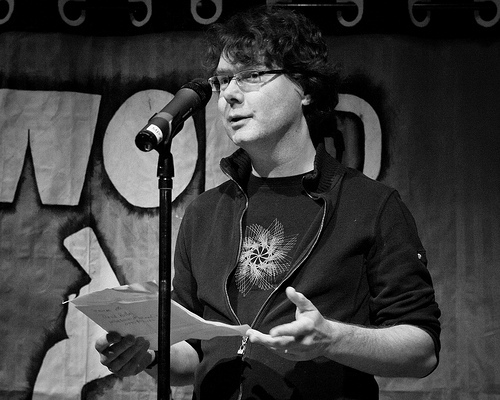
It was in the beautiful art deco foyer of Waterstone’s Piccadilly, Europe’s largest bookshop, though, so people were wandering past, looking over. One gentleman stopped and stayed for the whole thing, and spoke to me afterwards… I really enjoyed the experience, even if ‘I was invited to read at the first London Short Story Festival’ sounds more impressive without the full facts. I did my second reading, for Open Pen, just over a week ago, to a bar full of people half my age, … which ages me…. and it was interesting to see which parts of a story I thought I knew ‘worked’, and which lines maybe weren’t as funny as I’d thought they were. I though that might have been down to my delivery. I might slap my thighs more next time.
5. You spoke at the festival about your favourite American authors. Can you tell us more about them and what you think is different stylistically?
I was interviewed by a two-person roving camera crew, and on the spot named a lot of American authors… I think there are cultural differences, – or certainly have been, until recent years – where America has a tradition of Creative Writing courses we simply didn’t have in the UK, affecting the sorts of stories being produced. I went to the University of East Anglia, late ‘80s, which I wanted to go to because they had this country’s first Creative Writing MA programme. Now I was the first member of my family to study anything beyond secondary school, so I didn’t have a clue what the difference between a BA and an MA was, suffice to say the closest I got to the Creative Writing programme’s Malcolm Bradbury was holding a door in a corridor open for him once.
I did take an undergraduate Creative Writing module for one whole term, and the interesting thing was that 99% of the class’s students were American. I don’t know if nobody else fancied it, or didn’t take it seriously. Anyway, whether it’s because more American writers have done such courses, analysing writing, having theirs tested and supported and hot-housed in that kind of environment, or if it’s a difference in national psyche, personality, but American short stories often feel far more ambitious, confident, visceral, uninhibited, rude,energised, sexualised, hyper-clever, super-steroided… Which can be daunting if you want to submit to US magazines or competitions.
6. Is there a short story that you return to and why?
For ruthless efficiency and memorability, ‘The October Game’ by Ray Bradbury. For its elegance and tenderness and incredible dialogue, Salinger’s ‘A Perfect Day For Bananafish’. Somewhere between the pulpy cheap nasty thrills of the former and the wit, sophistication and emotional depths of the latter you’ll find the story I’m always aspiring to write.
7. Give us an interesting fact about yourself.
Sometimes I’ll think of an old song and it’ll come on the radio within hours or even minutes of my thinking of it. I can’t control it or make any money from it, or impress anyone but myself with this wild, mysterious gift, but I hope I never lose it.

 F C MALBY
You must be logged in to post a comment.