Review by Jon Wilkins of “Dead Drop” by F. C. Malby

Monday, 12 December 2022
Reposted from Everybody’s Reviewing

I cannot recall ever reading a book with such a sensual, sense-ful, scent-ful opening. The tastes and sights and sounds enveloped me as a reader drawing me into Vienna and its streets, cafes and churches. I can smell espresso, then I can taste the Guglehupf. I feel the wind on my cheek and the bustle of people on their way to goodness knows where. It is enchantingly delightful. Malby should be asked by the Vienna tourist board to promote their city. And that is only after the first two chapters!

I haven’t even mentioned the dead body, found by our protagonist Leisl, on Stephansplatz underground steps, as if it were the most natural of things to discover. Well it was where she was told it would be. But who by? And what of the broach and the note she took from the body? Art thief by career, Liesl finds herself in a terrifying world of murder and deception in this well-researched, beautifully written thriller. She is a hero we root for, despite her criminal behaviour, as she goes on an adrenalin-running-high escapade as she seeks the truth. To Malby’s credit. I found myself in the streets and buildings of Vienna, described with the minimum of fuss, but described in such a way that I felt I was part of the city, part of the chase and totally enmeshed in the plot.

I hope this is the first in a series as there is room for so much more.

About the reviewer

Jon Wilkins is 66. He is married to the gorgeous Annie with two wonderful sons. He was a teacher for twenty years, a Waterstones bookseller and coached women’s basketball for over thirty years before taking up writing seriously. Nowadays he takes notes for students with Special Needs at Leicester University. He has had a work commissioned by the UK Arts Council and several pieces published traditionally as well as on-line. He has had poems in magazines and anthologies, art galleries, studios, museums and at Huddersfield Railway Station. He loves writing poetry. For his MA, he wrote a crime novel, Utrecht Snow. He followed it up with Utrecht Rain, and is now writing a third part. He is currently writing a crime series, Poppy Knows Best, set at the end of the Great War and into the early 1920s.

You can read more about Dead Drop by F. C. Malby on Creative Writing at Leicester here

See original post at Everybody’s Reviewing

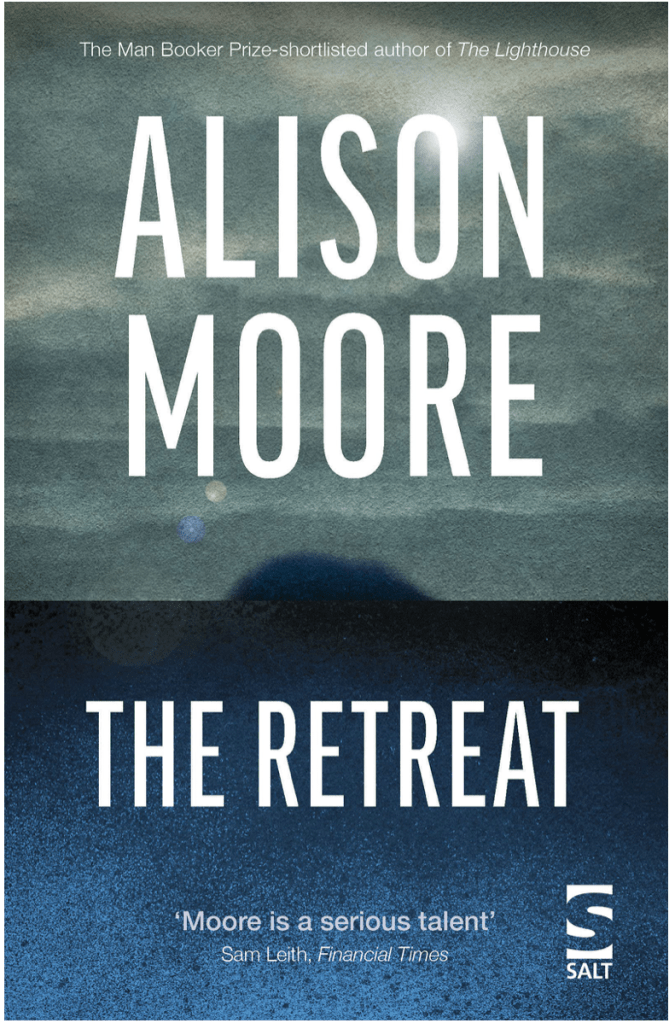
Review: The Retreat, Alison Moore

SALT Publishing, 2021

Since childhood, Sandra Peters has been fascinated by the small, private island of Lieloh, home to the reclusive silent-film star Valerie Swanson. Having dreamed of going to art college, Sandra is now in her forties and working as a receptionist, but she still harbours artistic ambitions. When she sees an advert for a two-week artists’ retreat on Lieloh, Sandra sets out on what might be a life-changing journey. 

Since reading Alison Moore’s Man Booker shortlisted novel, The Lighthouse, and subsequently her collection, The Pre-War House and Other Stories, her work has drawn me in with its tight prose and an unnerving sense of foreboding. She has a gift for honing in on fine detail, memory and doubt, creating a sinister unease. There is tension even in the simplest of details and a layered story, where realities shift and doubt creeps in. An other worldliness fills her writing in a way that leaves you questioning and searching for what might be and what might not.

“Sandra wants to be inspired, just like Angie was inspired by the chapel and wrote that poem that everyone said was beautiful. She wants to paint something that she can be proud of, something the others will admire, something she could bear to hand on a wall.”

A sense of isolation is created so well in the mind of Sandra, a thread that runs through many of her characters and books. In The Retreat, this is thrown into the fore as the chapters alternate between what is going on in the mind of Sandra against a narrative that weaves in the actions of the other characters, some of whom the reader will begin to detest. She writes with subtlety, each sentence punching with the weight of a skilled storyteller.

“Carol had understood that the students had arranged to shoot the whole film on the island, sleeping in the house, which had running water and electricity and so on – but something had not worked out, although Carol is not clear what that something was.”

As the chapters shift between Carol, who is alone in a seemingly haunted house on another island and trying to write a novel, and Sandra, who becomes increasingly ostracised by the other artists in the sparse house that they are staying in for an artists’ retreat, many of Carol and Sandra’s thoughts repeat and expand, reflecting the minds of introverts that Moore cleverly creates. You feel an increasing sense of disconnect and longing in Sandra, as she walks to a spot each day to paint the island where Carol is staying, at one point finding someone else in her spot. You expect, and almost hope, the two will meet.

“She wonders what the hell she is doing here, naked at night on the rocks; she is no longer sure that she wants to jump, but she is here now, and she will do it.”

So much of the power of this novella lies in the details: the missing glove, the disregard of Sandra’s needs by her fellow artists, the sounds that Carol hears in the night, the misplaced objects in both of their realities. It’s a gripping book that I read in one sitting on the day that it arrived! Moore creates something that leaves you trying to grasp what is just out of reach. The weight of the story will resonate with you far beyond the end of the pages.

Alison Moore’s short stories have been published in various magazines, journals and anthologies, including Best British Short Stories and Best British Horror, and broadcast on BBC Radio. The title story of her first collection, The Pre-War House, won the New Writer Novella Prize; her second collection, Eastmouth and Other Stories, will be published in autumn 2022.

Her first novel, The Lighthouse, was shortlisted for the Man Booker Prize and the National Book Awards, winning the McKitterick Prize. Both The Lighthouse and her second novel, He Wants, were Observer Books of the Year. She recently published her fifth novel, The Retreat, and a trilogy for children, beginning with Sunny and the Ghosts.

Born in Manchester in 1971, she lives in a village on the Leicestershire-Nottinghamshire border with her husband, son and cat. She is an honorary lecturer in the School of English at the University of Nottingham and a member of the National Association of Writers in Education.

Find her at https://www.alison-moore.com

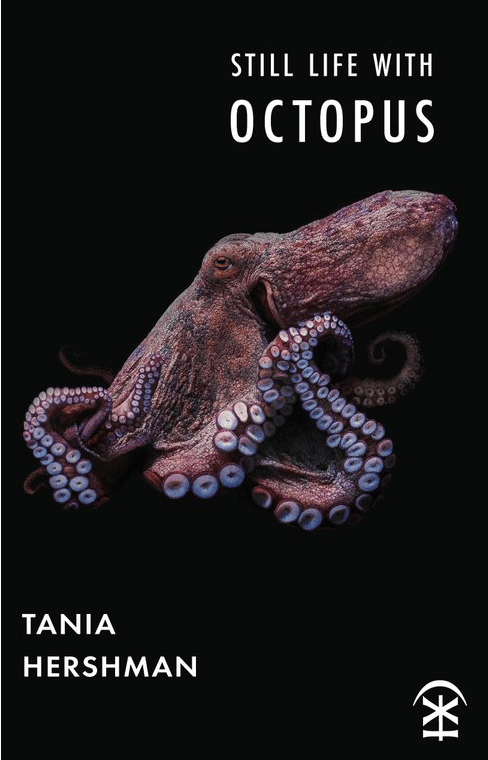
Review: Still Life With Octopus, by Tania Hershman

Tania Hershman’s second collection of poems, published by Nine Arches Press, explores the boundaries between animal and human, the worlds in which they live and the spaces they inhabit. Tania has this innate ability to find words that rest in the liminal spaces, almost like entering a Moroccan Souk, travelling through mazes of interlinking pathways, where you find intriguing treasures around each corner. It’s a journey into the unknown, the unexplored, and is a place that’s hard to leave, where the things you discover will remain in your mind long after the poem ends. It’s a magical, mystical experience.

‘What if you didn’t know what night was, landing here. What if you’d never heard of light.’

This enticing opening line, a questioning of reality, sets the tone for what is to follow. We explore time and space, the space within which and octopus can enter, remain, shape shift or escape. These poems explore the edges of mind and body, and the connections between the two in ways that will leave you resting on a particular word or phrase. She challenges our ideas of reality and meaning, our thoughts and feelings.

‘And what if the octopus could talk. And what if they turned to us and said, Enough with all the jars, and the tests of what we can get into and get through. You’ve seen what we can do.’

Each poem shifts the way an octopus changes its colour, reflecting its mood, yet there is a thread that connects many of the poems – the nature and shape of the heart, all that is hidden, the confines of space and the way that some things need to be released, or remain hidden.

‘And the body, too, has things it will never tell.’

The indefinite changes of the octopus are mirrored in the shifting of poems across the pages. There is something almost tidal about the ebb and flow of patterns. That the octopus is able to escape from a closed jar with such ease engages the reader with the idea that words can change and move within the confines of the structure of a poem. The fluidity of the words aid the journey as you travel through the pages.

I worry about where my heart is now, did it even reach you? Let go, whispers the octopus in my chest. These things are not in your control.’

The title poem, Still Life With Octopus, made me catch my breath, the words, ‘let go’, echoing through my mind. There is a literal and metaphorical letting go of expectations and of the boundaries you thought you understood. She creates a freedom with words and worlds where anything seems possible, exploring new possibilities and leaving the reader to ponder where the journey will take them.

A gifted writer and a wonderful short fiction teacher, her skilful mastery of words and her eye for the unseen reaches new heights in this stunning collection. With an extensive background in Science, including an MSc in Philosophy of Science, Tania’s research naturally seeps onto the page and into the words and worlds that she creates. This book is a thing of beauty; it’s a pure treasure and a collection that you will want to re-explore again and again.

Tania Hershman’s second poetry collection, Still Life With Octopus, will be published by Nine Arches Press in July 2022 and her debut novel, Go On, by Broken Sleep Books in Oct 2022. Her poetry pamphlet, How High Did She Fly, was joint winner of Live Canon’s 2019 Poetry Pamphlet Competition and her hybrid particle-physics-inspired book ‘and what if we were all allowed to disappear‘ was published by Guillemot Press in March 2020. Tania is also the author of a poetry collection, a poetry chapbook and three short story collections, and co-author of Writing Short Stories: A Writers’ & Artists’ Companion (Bloomsbury, 2014). She is co-creator of the @OnThisDayShe Twitter account, co-author of the On This Day She book (John Blake, 2021), and has a PhD in creative writing inspired by particle physics. www.taniahershman.com

Review: A Passage North, Anuk Arudpragasam

“The present, we assume is eternally before us, one of the few things in life from which we cannot be parted. It overwhelms us in the painful first moments of entry into the world, when it is still too new to be managed or negotiated, remains by our side during childhood and adolescence, in those years before the weight of memory and expectation…”

The opening lines of Anuk Arudpragasam’s stunning book, A Passage North, Longlisted for the Booker Prize, draws us into a world of post civil was Sri Lanka, capturing the suffering through Tamil narrator, Krishan. The story begins with a call to let him know that his grandmother’s former carer, Rani, has died unexpectedly. He is also grappled with a recent email from a lost love, Anjum, an activist he met in Delhi four years previously.

As Krishan journeys by train from Colombo to the Northern Province for the funeral, he begins a journey through his own soul. The story is beautifully written, with flowing sentences that weave the reader through his thoughts and longings. A Passage North is a memory of the lost, the missing and the dead, casting a light on the ravages of war through the eyes of Krishan, a PhD student, living in Delhi as he watches the news unfold in 2009.

The book is meditative, a stream of consciousness in some respects, and an illustration of the impact of the connections we make and how it affects the human psyche when they are lost. Inspiration for the rhythm and style of the book is taken from Thomas Bernhard and Javier Marias.

What struck me most, was Arudpragasam’s insight into the way that men can intimidate women through a gaze or certain body language…

“In Delhi and many of the Hindi-speaking states more generally male stares were different, were intensely unselfconscious and intensely unrelenting, so that even when you weren’t being harassed in more explicit verbal or physical ways you still had to use all of your psychological resources to resist these gazes in the course of each day, to prevent these men from trying to enter your soul through your eyes, like strangers who enter the privacy of your house without permission and without even bothering to take off their shoes.”

The sensitivity with which he tackles the subject of Anjun’s sexuality in a culturally oppressive environment, is both powerful and subtle.

I would liken the book in some ways to being lost inside a painting, a weaving of colours and shapes. If you enjoy literary fiction, I highly recommend this. It’s slow in pace, so don’t expect snappy twists and turns, but if you want a journey into Tamil culture and an insight into love and loss through the ravages of war, this won’t disappoint.

Arudpragasam is a bright, insightful writer, with much to share from his internal world. The sentences are sharply observed and intensely hypnotic. It will be interesting to see how it fares as the shortlist is put together. A compelling and thought-provoking read.

A Review: He Wants, Alison Moore

he wants


Retired teacher Lewis Sullivan always imagined living by the sea.

He lives instead in the Midlands village in which he was born. His grown-up daughter visits every day, bringing soup. He does not want soup. He frequents his second-favourite pub, where he can get half a shandy, a speciality sausage and a bit of company.

When a childhood friend appears on the scene, Lewis finds his life and comfortable routine shaken up.

In the wake of Moore’s award-winning first novel, The Lighthouse, and her debut short story collection, The Pre-War House (which I reviewed here), my expectations were high and this book did not disappoint. With Moore’s typically sparse plot, her attention to the minute detail of everyday occurrences, and her use of quiet tension, I sunk into this and did not resurface until I reached the end. At 182 pages, it is a short novel but needs no further chapters; its impact lies, in part, in its brevity and in its silences.

I appreciated John Oakey’s clever cover design, and the irony of the brightness of the yellow against the protagonist’s rather dull existence. It is possible that the colour yellow is scattered throughout the text for this very reason. Lewis Sullivan’s reserve and quiet desperation is painful at times, but he also resists change in the same way that a child might stamp his feet. Although, Lewis’s determination to keep a routine existence is done quietly and without a fuss. His occasional need to break out or to experience something new, something shocking, touches on the natural curiosity in all of us, and reminds us of the idea that there is always more beyond the borders of our existences. There is something inherently Freudian about the focus on Lewis’s loss, his inhibition and self-absorption.

Moore’s skill lies in lulling the reader into a comfortable, but temporary, sense of experiencing the ordinary, before she shocks the reader with an aggressive and threatening outside force through language which makes the character feel uncomfortable, or a dry expression and a sense of foreboding. Without giving away the ending, the whole story builds up to an unexpected climax, leaving you replaying the story to see where the clues may have been buried in the pages, if at all. Lewis Sullivan’s routine existence, with daily visits from a daughter with whom he shows no real connection, is shaken up when his old pal, Sydney, resurfaces, causing unexpected disruption to Lewis’s days. The fact that Sydney is also a far-flung destination is not lost on the attentive reader.

The book title is followed through with chapter headings beginning with an ominous, He does not want…, He wants…, or He wanted to… There is a combined sense of anticipation, regret, fear and uncertainly in each chapter – with much of the tension rising from what is left unsaid, in the unspoken sentences – in as much as his life is made up of the things he did not do and the places he did not visit. And then there is the matter of the dog who is weaved through the pages, a dog whose ownership is unclear. At one point we find ourselves in the company of the two characters and the dog in the kitchen, and it is unclear for a while to whom both the dog and the kitchen belong: “The man, who has been looking at him, looks at him some more and then says, ‘Your house?’ ‘Yes,’ replies Lewis. ‘You are in my house. This is my kitchen. You are sitting in my wife’s chair at my kitchen table. I thought for a moment that this was my dog.'” In the following lines Lewis wonders if he is being burgled. I can’t help thinking of Goldilocks and the Three Bears as we wonder about the intruder. There is an almost surreal element to the book, a sense of other-worldliness.

The themes of religion and eternity are well expressed with their uncertainties and extremes, in particular in the chapter,  He wants to fly, where we are drawn back in time to Lewis’s father taking him to see Billy Graham in Manchester at the age of eighteen. His concerns about baptism focus on whether or not a person would need to be clothed or naked, and whether it would require a clean pair of pants. He lists some of the Thou Shalt Nots of the Bible, with which many are familiar, in a way that may threaten to close his life in even further.

The narrative is beautifully layered, with generational links and well-planned time frame jumps. So many elements of the book feel familiar, yet much is also unexpected. Themes of loneliness, memory and loss are unfolded with a deep originality. Lewis is, at times, an unreliable narrator and I sense that Moore enjoys this element of surprise. This book is not for those who want a fast paced thriller, but there are dark aspects to He Wants and an intensity of emotion that will pull you in until the last page.

I’m off to buy myself a new suit and travel the world!