Disgrace by J M Coetzee: A Review

disgrace

There are books which stay with you for months and years beyond the final page; there are books which draw you in to the point where you cease to feel time; there are books which transport you to a different time and place, yet keep you rooted fully here in the present. This book achieves all of these with a masterful use of imagery and language. This is one of the most powerful books I have read, partly because of its timeless themes and wholly for its ability to get inside the mind of its main character and his daughter, and of course for the delicate insight into human nature, with its brutality and desires. I was utterly captivated.

Set in post-apartheid South Africa, J. M. Coetzee’s searing novel tells the story of David Lurie, a twice divorced, 52-year-old professor of communications and Romantic Poetry at Cape Technical University. He has an impulsive affair with one of his students, Melanie Isaacs. The affair sours and he is denounced and summoned before a committee of inquiry. Willing to admit his guilt, but refusing to yield to pressure to repent publicly, he resigns and retreats to his daughter Lucy’s isolated smallholding. For a time, his daughter’s influence and the natural rhythms of the farm promise to harmonise his discordant life. But the balance of power in the country is shifting. He and Lucy become victims of a savage and disturbing attack which brings into relief all the difficulties in their relationship.

Among many accolades for the book are the Man Booker Prize (1999),

National Book Critics Circle Award Nominee for Fiction (1999),

Commonwealth Writers’ Prize for Best Book Overall (2000)

Coetzee delves into the darkness of the human condition, making this an uncomfortable but compelling read. His descriptions are often harsh and gritty, but somehow satisfying: ‘The skull, followed by the temperament: the two hardest parts of the body.’ His insight into the mind is beautifully reflected in sentences such as this: ‘His own opinion, which he does not air, is that the origin of speech like in song, and the origins of song in the need to fill out with sound the overlarge and rather empty human soul.’

I will hold on to my battered copy, treasure it, reread it, and enjoy the fact that I have finally managed to read it, although late in the game. Have you read it? What did you think? I’d like to hear your thoughts.
Swimming Home

swimming home

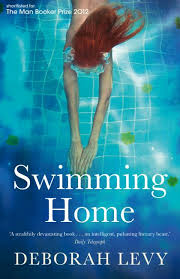
Deborah Levy’s Swimming Home is a book that has been on my to-be-read pile for far too long. I managed to reading it, amongst other books, while I was away last week. Shortlisted for The Man Booker Prize in 2012, I was expecting great things from this book and it did not disappoint.

As he arrives with his family at the villa in the hills above Nice, Joe sees a body in the swimming pool. But the girl is very much alive. She is Kitty Finch: a self-proclaimed botanist with green-painted fingernails, walking naked out of the water and into the heart of their holiday. Why is she there? What does she want from them all? And why does Joe’s enigmatic wife allow her to remain?

Both the unusual cover and the concept grabbed my attention from the start and I knew that this would be an allegorical journey in many ways. Levy’s use of visual constructs and rich symbolism retains a powerful hold over the reader’s experience. The wording is lyrical and enticing, wasting nothing. She casually underplays the devastating story as it reaches an unexpected climax. It has been described as a ‘literary beast’ of a novel and, although initially skeptical, I can understand why; I would agree. Reviews have been mixed, understandably, as her style is highly specific and will not appeal to all. Her power to draw in and to shock is almost a surprise and I found myself rereading parts of the text in disbelief. She uses subtle repetition to great effect and the prose has a circular narrative in that it ends almost where it begins. The outcome? Well, you’ll have to read it and decide what you think. I would highly recommend it to those who enjoy literary fiction and a short, sharp shock. I look forward to reading her newer short story collection, Black Vodka.

Asunder by Chloe Aridjis: A Review

download (1)

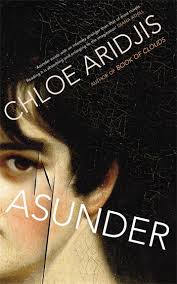
I was recommended this book by a friend and am so grateful to have read it. The rich language and the palpable tension in the narrative kept me turning the pages in one sitting until I reluctantly reached the end. It is a book I will go back to and reread at some stage. The similarity with what I am currently writing was also striking, so the read was timely.

“They call us guards, warders, invigilators, room keepers, gallery assistants. We are watchmen, sentinels, but we don’t polish guns, shoes or egos. We are custodians of a national treasure, a treasure beyond value stored behind eight Corinthian columns of a neoclassical façade, the dreams of the ancients stuccoed to our building.”

Marie’s job as a museum guard at the National Gallery in London offers her the life she always wanted, one of invisibility and quiet contemplation. But amid the hushed corridors of the Gallery surge currents of history and violence, paintings whose power belie their own fragility. There also lingers the legacy of her great-grandfather Ted, the warder who slipped and fell moments before reaching the suffragette Mary Richardson as she took a blade to one of the gallery’s masterpieces on the eve of the First World War.

After nine years there, Marie begins to feel the tug of restlessness. A decisive change comes in the form of a winter trip to Paris, where, with the arrival of an uninvited guest and an unexpected encounter, her carefully contained world is torn apart.

The book has a depth to it that pulled me in immediately. There is a magical darkness to her prose and the author’s descriptions and sharp eye for detail were compelling. It is powerfully and creatively written through the eyes of Marie, the museum guard. Her world and her insights into the people and places around her give you a sense of claustrophobia and of the parallels between the fragility of life and of the valuable paintings in the gallery. I have a particular interest in art and have spent many happy hours in various galleries around the world, so her research into the technical aspects of the topic were interesting.

A passage I really enjoyed describes the character’s feelings as she lies in a bed in Paris in the home of a couple who have recently separated and left the flat empty. There is a sense of the reader intruding on the intimacy of the the lives of the unknown couple:

“Yet almost immediately this darkness began to curdle into something viscous and heavy. As I lay in bed I began to speculate about the couple who’d slept in my spot for who knows how many years. I tried to imagine their faces, their bodies, their voices, whether they slept on their sides, stomachs or backs, whether intertwined or at separate ends of the bed, about whatever moments, fraught or transcendent, they’d lived out where I lay, what conversations, what passion or frustration. I began to worry I might inherit their dreams, that I’d find myself in ragged environments populated by ragged figures without knowing how to fend them off.”

There is something very abstract about Aridjis’ writing. She creates a world that is both surreal, yet very real. There is something of Nabakov in her style and she hones in on the idea of destruction and decay brilliantly, without overwriting.

This is an absolute must-read for anyone who enjoys literary fiction and the world of art. There is a strong psychological element to the story which gives it wide appeal. This book almost flew below the radar and I am so glad not to have missed it.