‘Red’ by F.C. Malby in Roi Fainéant Press

Shirley checked her bag twice to see if she’d put tissues inside. The kitchen windows needed cleaning. She could do that when she returned home later. The visit would be quick. She went into the downstairs bathroom, applied some lip gloss, post box red, bared her teeth like a lioness, rubbed them with her index finger, added a liberal smattering of perfume, and left the house, double-checking the front door before getting into the car. Charles had only been in the hospital for two days, but how she looked would matter. She couldn’t work out whether she missed him or the idea of him. It was easier at home without him there; she could hide her need for life to be ordered, along with her penchant for a glass of Pinot Grigio. It was never more than a glass or two, but the way he curled his lips to one side said enough. The cat would have to find something wild to eat tonight, she thought, as the lights turned red at the end of the street.

Roxanne blasted out of the car radio, seeping out through the open windows. Summer nights like these felt hot and sticky. She glanced at the man in the Mondeo next to her, assessing her, and she turned down the dial. Dialing down was something she had become skilled at, she’d spent her whole life doing it. The Mondeo man had a gray beard and round glasses. He wouldn’t approve of red lights or selling your body to the night. He wouldn’t approve of her lip gloss, either. She had wanted to make the effort for Charles, whatever state he was in. She’d been taught to keep herself free of makeup or wild impulses, in keeping with her Mormon upbringing, but it went against her nature. Now she would take it out on the bathroom, scrubbing and cleansing, bleaching every inch of the surfaces. Her own body, though, would no longer be subjected to the same disciplines.

I know my mind is made up, So put away your makeup, Told you once I won’t tell you again. It’s a bad way. The street thrummed with music; sounds from the fairground in the park up the road threatened to drown out her own. She could hear the screams. That much fear is bad for your heart, her father had told her. It’s the thrill, she had said at the time, but he’d already walked away. Charles had walked away when she talked about the cat or the children. The only thing that interested him these days was classic cars or some current news item, as long as it didn’t involve global warming, because it didn’t exist. She had learned to stick to frivolous subjects that did not involve the non-existent warming of the planet, the cat or the children. The latter had already left home. It made her heart feel weak. He never talked about them, as though they didn’t exist, either.

The lights went green and a young boy, about the same age as her Brian, floored it down the street towards the edge of the city, hair all slicked back, music louder than hers. He wouldn’t have heard of The Police. What she wouldn’t give to go back to those days with her whole life ahead of her. The hospital was a street away. The sun lowered over the tower blocks. Children lined the pavements with chalks and footballs; carefree. The scent of charred red meat rose up between the houses in bellows of smoke. The hospital car park created the usual fiasco of digging around for the right change, Or you’ll be towed, M’am, the parking attendant had told her when she’d gone in to visit Jan, from her book group, who was Just in for a small procedure. Shirley had never found out exactly what it involved.

Inside, staff swirled around like the beginnings of a storm with the swooshing and circling of currents, picking up things as they gathered speed. Patients were being pushed about on beds and in wheelchairs. Doctors moved swiftly and without looking up. A lady at reception was telling someone to Please come in to see a doctor. She hated the accident and emergency department. It reminded her of her brother, Ronnie, breaking his ankle in football at school. The smell of disinfectant made her queasy.

“Can you tell me where the cardiology ward is, please? I haven’t been before,” she said, as a nurse passed her with a tray of meds.

“Take the lift up to the fourth floor and it’s on your right.”

Shirley nodded, but the nurse had already gone, talking as she moved, her voice disappearing off down the corridor. The lift was empty. It stopped on the second floor. A lone man got in and stood away from her on the other side, didn’t look up, checked his watch. She always felt safer when people didn’t look directly at her, although she felt ridiculous thinking this as a grown woman. The lift juddered to a halt on the third floor. He got out. An elderly lady was waiting with a nurse, and holding a walking frame with a crocheted bag hanging from the top. They stepped in gently. Shirley pressed the button to hold the lift. The nurse nodded, put her arm on the back of the lady, rearranged the drip that was attached to a stand. Moving all of this metal between a fixed floor and a moving floor looked precarious, but she suspected that they were used to it. She had probably seen too many horror films, expected something to be severed. These were the kinds of thoughts that she couldn’t share, not with Charles, not with anyone. She turned to look in the mirror behind her, pulled out the red lip gloss, and reapplied it liberally. She pursed her lips together, got out on the fourth floor, and turned right.

The corridor was long and stark, with insipid green walls and a fire extinguisher with a ‘break glass press here’ sign on a red box on the wall just above. Charles did not appear to be in any of the rooms, which were mostly filled with older men, much older than him. In one room, a whole family had gathered and machines were beeping. She wondered whether he was, perhaps, nearing the end of his life, partly because she had seen a priest hovering in the corridor. In another, a lady sat knitting, watching a man sleep. She stopped to look at Shirley as she passed. It was a soulless place, not somewhere you would choose to be. Where was Charles? Had he left? Continue reading in Roi Fainéant Press.

FC Malby is a contributor to Unthology 8 and Hearing Voices: The Litro Anthology of New Fiction. Her short fiction won the Litro Magazine Environmental Disaster Fiction Competition. She was shortlisted by Ad Hoc Fiction, Lunate Fiction and TSS Publishing, and her work has been nominated for Non Poetry Publication of the Year in the Spillwords Press 2021 Awards. Her work is forthcoming in the Reflex Press Anthology, Vol. 5.

Twitter/Instagram @fcmalby

Tips for Submitting to Literary Journals and Magazines

I had the privilege of being invited by Reflex Press to be a reader for their Autumn International Flash Fiction Competition. I hugely admire them as a publisher of, ‘long, short and very short fiction,’ and have been fortunate enough to have had work published with them previously.

What I gleaned from the many entries sent my way, was inevitably going to find it’s way into a blog post. There were several things that struck me, which I think might be helpful for writers in submitting work to journals. Every reader or editor will have a different take, but this is mine:

  1. Think about your title

Writing short fiction requires that you grab the reader’s attention fairly swiftly, and the title needs to do some of the work for you. It should do the heavy lifting of piquing and reader’s interest, before they begin to read the contents. The Association for Psychological Science says that a series of experiments by Princeton psychologists, Janine Willis and Alexander Todorov, reveal that, “all it takes is a tenth of a second to form an impression of a stranger from their face, and that longer exposures don’t significantly alter those impressions.” (Their research is presented in their article “First Impressions,” in the July issue of Psychological Science, if you want to find out more.) I would say that the title of your story will have a similar effect. You may have a great story, but if the title is weak, or even irrelevant to the story, the rest will fall flat. The title is key to a good story and can be the difference between an acceptance or a rejection. Make sure you take time to think about what you want the reader to know. What is the point of your story? What’s the context? And, what do you want the reader to find out? In short fiction every words counts, and this very much applies to the words in your title.

2. Read the guidelines

It’s an easy thing to skip past, but don’t. The guidelines are there for a reason, and you absolutely have to stick to them in order for your story to even get past first reader. Reflex Press has two readers for each story – this is quite common. Those that reached me had followed the guidelines, but there will be many that didn’t reach any of us, because they were too long, in the wrong genre, or highly offensive. If a journal states in the guidelines that they do not accept racist or homophobic content, don’t send it, although I’d question why it’s been written in the first place. If they say, do not send in work over 1,000 words, you may have a gem of a story that is 1,003 words, but it will not get past the first reading, because it’s too long. Cut it or find another place to send it. Have a look at the font and size required. Editors really dislike fancy fonts or multicoloured submissions. You wouldn’t sent a CV off like this, so don’t send in a story that looks like a poster. The most common requirements are Times New Roman 12, but check. I can’t stress this enough. Most journals will tell you they only want one submission at a time and whether or not they will accept simultaneous submissions. Follow these guidelines. It’s important. Find out whether it’s an email submission or an online submission, which format is required, a Word or PDF document, or pasting the story into the body of an email, and take the time to find out the name of the editor. Don’t misgender or mislabel. Do not be tempted to just fire out a load of submissions to different journals in the same format. It’s generic and editors can see that it’s not specific to their journal. At the very least, begin with, Dear *insert journal name* Editor. Make it personal, but keep it professional.

3. Read stories that have already been published

Familiarising yourself with their work, and with the kinds of stories that they publish, will increase the chances of your work being accepted. Don’t send in a love story, if they like dark, twisty stories. There may also be a request to add trigger warnings for certain content, so again, back to the previous point, read the guidelines. Does your work fit what they are looking for? Do you know what style of work they publish? If not, read some of their publications. It really shows when a writer sends in work that clearly doesn’t fit either theme, if there is one, or the type of work that the journal publishes. Some journals will give you ideas of what they are looking for, like SmokeLong:

4. Consider your narrative mode: Tense, person and point of view

We’re highly influenced by what we read, so be careful not to just plump for the familiar. Do experiment, but make sure you’ve got a handle on it before writing and submitting your work. Choosing the right narrative mode for your story determines the perspective and the way that your reader experiences the story. It establishes the relationship between the narrator, reader, and main character, if you have one. This may need a separate blog post at some point.

  • tense (past, present, or future). There are six different tenses in the English language, but only three are generally used in fiction. Past and present tense are the most commonly used. Future tense is rare and difficult to sustain, but as with any rule, there are exceptions.
  • person (I – first person, You – second person, or They – third). Third person narrative is the most commonly used, followed by first person. As with the future tense, a second person narrative is rare, but I’ve used it for some of my favourite stories to create tension.
  • point of view (omniscient or limited). This really comes down to who is narrating the story. Take The Book Thief as an example: Death is the omniscient narrator who switches between first person and a third person point of view, describing all the characters’ thoughts as well as his own. It’s powerful and works in this context, but won’t work with every story.

The best advice I can give is, don’t keep jumping about. Find your tense, person and POV, and stick to it. So many stories begin well and start to flounder because there’s a lot of jumping about and the story unravels. Unless there is a clear reason to keep changing, stick to what you’ve chosen. Changing tense can be one of the most frustrating things for a reader, unless it’s needed and expertly done. The Book Thief is written in the past tense, with flashbacks and occasional flash forwards, but unless you’re Markus Zusak, leave it alone.

4. Don’t underestimate your reader and don’t attempt difficult themes unless you feel confident you can handle them

There is a tendency for many, and particularly new, writers to tackle either assault or suicide. These are important subjects, but they are often badly handled and over described, with heavy writing and a blow by blow account. Assume your reader is intelligent, because most of them are. Don’t give them every detail and keep the sorded details out of it. Some of the most powerful stories I have read on these issues are the ones where what has happened is only hinted at. Don’t hit the reader over the head with a sledgehammer. They’ll pass out. Even journalists won’t give you all of the details in an article, so don’t do this in fiction. It will really kill a story and make the reader wince.

One of the best pieces of advice I can give is, find the space between the words. Some of the power of what you write will be in what you don’t say. Toni Morrison explains this brilliantly in an interview in The Paris Review on ‘The Art of Fiction’ (no.134):

“The difficulty for me in writing—among the difficulties—is to write language that can work quietly on a page for a reader who doesn’t hear anything. Now for that, one has to work carefully with what is in between the words. What is not said. Which is measure, which is rhythm, and so on. So, it is what you don’t write that frequently gives what you do write its power.”

Holding on to Life, FC Malby, Spillwords Press

My flash fiction, Holding on to Life, has been published with Spillwords Press

HOLDING ON TO LIFE

written by: FC Malby

@fcmalby

I imagined him to be tall and dark, my twin brother, when she told me; similar personality, more confidence. Ma told me she’d bled heavily when she carried me, thought she’d lost me, ‘till her stomach kept growing after the doctor ordered bedrest. Didn’t have scans in them days, she said. Aunt Connie had been drafted in to help. Then I arrived after what I’m told is the longest and worst labour, like it was somehow my fault, that I’d been difficult or might have been responsible for his loss. She looked startled in most of my fading baby photos — the ones in tartan albums, labeled in biro —like she’d birthed an alien. There was an awkward distance between us that looked nothing like Madonna and Child. Ma thought she’d told me once, but with most of her stories, I’d heard this one on numerous occasions by the time I carried my own bairns.

The constant, gnawing gap in my life, the longing, the loneliness, it had always been there. I found his face in a few male friends over the years, the ones that were silly and funny and kind. But, I lost him as time unfurled, wondered whether he might have been a doctor, like my Pops, or a vet, maybe a teacher. Sometimes I would reach out a hand to see if he caught it, or hear his voice in a stranger’s. I’d look at men my age and wonder what it would feel like to have him here in the flesh, if we’d fight the way siblings do. I imagined he’d be a better version of me. We look for better all the time. They tell us in school to do better, be better. Better… (continue reading at Spillwords Press).

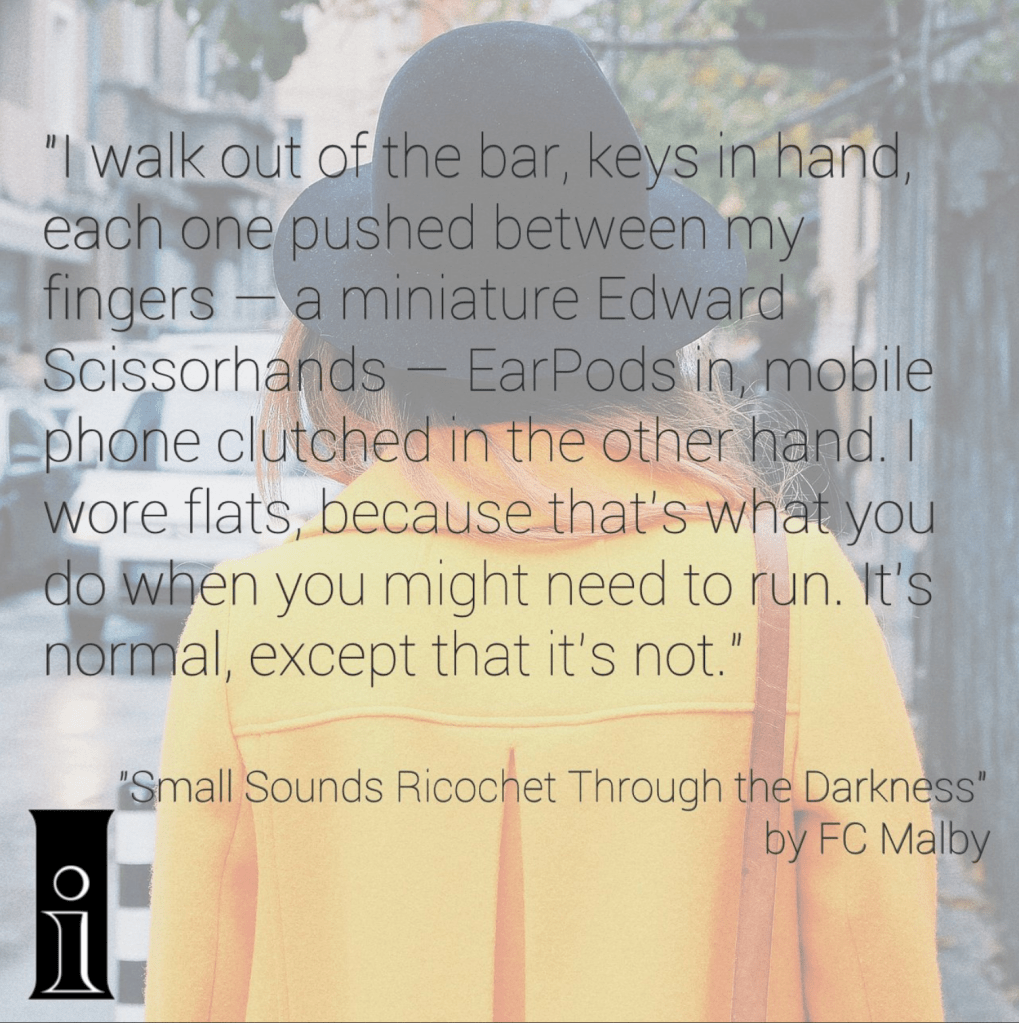
Small Sounds Ricochet Through the Darkness by FC Malby

My story, Small Sounds Ricochet Through the Darkness, has been published in Idle Ink today. It was written in memory of Sarah Everard and anyone who has been affected by violence against women.

Don’t walk home alone, not at this time of night, my friends say, waving at me from a table of empty cocktail glasses, flapping like a gaggle of geese. I’ll be fine, I say, I’ll text you when I’m home. Are you sure? they ask, but it’s more a way of allaying their own fears. Yes, I’ll be fine.

I walk out of the bar, keys in hand, each one pushed between my fingers — a miniature Edward Scissorhands — EarPods in, mobile phone clutched in the other hand. I wore flats, because that’s what you do when you might need to run. It’s normal, except that it’s not. Normal is wearing what you like, not thinking about when you might need to run or who you would need to call, it’s not turning the music down in case there’s a Come over here, Love. Oi. You. I’m talking to you.

Normal is a regular heartbeat, a regular pace to your stride. It’s not hovering under a streetlight where people see you before crossing the stretch of darkness. It’s not scanning a route for places to hide, or rounding a corner and sprinting like a triathlete because the footsteps behind are picking up speed.

The girls will go home later in a taxi, but I need to get back for the babysitter, pay her, get into my pyjamas and sleep, having kissed the cherubs on the forehead, checked their breathing. Every parent checks the rise and fall of their child’s torso, especially when it is still.

Like the still of the sea without wind, nights like this make me nervous, nights where I get followed or shouted at with no one around, where the air is thin, where small sounds ricochet through the darkness. These are the nights when men get too close, gaze for too long, howl like a pack of hyenas… continue reading at Idle Ink.

Interview with EllipsisZine Editor, Steve Campbell


Ellipsis Zine is an online and print literary magazine for beautifully written fiction & creative nonfiction.

How and why did you begin Ellipsis Zine, and how long has it been running?


I set up Ellipsis Zine in June 2017 and initially wanted to create an online space for flash fiction I liked to read. I hadn’t been writing flash very long and thought that a website with a mixture of work I enjoyed reading would help improve my own writing, while also offering a new space for writers to submit to. I wasn’t sure how well that was going to be received but pretty soon I was swamped with great submissions. Following on from the wave of excitement during the first month, I took the plunge and opened a call for work to be published in print and I was completely overwhelmed with the response.

What have you learned from your experience as Founding Editor?

It’s all subjective. I’ve declined work that has almost immediately been snapped up by other publications and reading them again, it was clear I was wrong to pass on them. There can also be any number of factors for a piece being declined, it’s not always because the piece isn’t ready. The magazine may not be the right fit. Timing can also be important – and not always something that a submittor can do anything about. If a piece submitted deals with the break up of a relationship, for example, I would generally pass on it if I’ve published a similar piece recently.

What do you do with your time outside working on the Zine?

I work in a marketing department, with a background in design, and so the setting up of the magazine and print zines has been a fairly smooth process.

The editorial team has expanded. Can you tell me who is on the team and how or why they were chosen?

I have a great team of flash writers helping me behind the scenes. Stephanie Hutton, Amelia Sachs, Richard De Nooy, Helen Rye, Jennifer Harvey and Christina Dalcher. It was Richard who first suggested putting together a team, to help strengthen the website and have a team to help compile the zines, and as a sounding board for ideas and advice. Working in a bubble can be difficult at times, so having a team of writers to work with has been invaluable.

What are you looking for in a piece that you hope to publish?

We want to publish stories that make us forget where we are, stories that introduce us to people, places and things we’ve never seen before and stories that stick with us long after we leave them. In the same way a great song, novel or film, hangs around with the audience. We want a great piece of flash to be something that will be read again and again, and something that will linger.

Can you tell us about the process from submission to publication in the online and print zines?

With print online submissions, I try to get back to everyone within seven days. If selected, I may put forward minor edit suggestions and then provide a date for publication. This is usually scheduled around a month or so later, depending on the time of year. With the print publications, the time between submission and selection is a little longer. With the last few zines, I’ve had one or more of the editorial board compile the list of published work for me. Again, once chosen, we ask for minor edits to the work. Once the zine is compiled, I will send page proofs to all writers, to ensure I’ve copied everything over correctly. At this point, writers have the opportunity to make any last minute changes. This is usually a week or two before publication.

Do you have any advice for authors sending you submissions?

That’s a tough question, because I tend to want to publish a wide mix of work, but it is important to note that it is all subjective. I’ve published sci-fi, horror and humour and I do notice trends with submissions. I sometimes get a batch of work that hasn’t made the longlist/shortlist of a competition, because they are all on the same theme. I’ve also noticed that I can receive a large amount of work based on death, relationship breakdown, dementia etc. I have written pieces on these subjects myself, and although, individually they are brilliantly written, when I receive a lot of them, they can lose their impact. I’d suggest that anyone who approaches these subjects to think a little differently. This will help set the work apart from others.

Can you tell us a little about the expansion into areas such as the Novella-in-Flash, collections, and zines celebrating LGBTQ writers?

Much like everything with Ellipsis, the expansion into publishing Novella-in-Flash and collections stemmed from wanting to try something new. Stephanie Hutton’s novella was a huge success, selling much more than any of the other zines and so it was natural to try and replicate that success. Talking with Stephanie about an open call, she put forward the idea of publishing an author who wasn’t as established – hence, the call for a debut flash collection from an unpublished author. This desire to give underrepresented voices a platform, naturally, influenced the decision to publish a zine that celebrated LGBTQ writers and their work.

What are your plans for Ellipsis for the coming year?

We have an extremely busy year ahead. There are a few flash events, which I will be attending in the Summer: National Flash Fiction Day, June 15th, has just been confirmed, and a publication launch. Our Love | Pride zine, celebrating LGBTQ writers and their work, is released at the end of February, along with a flash fiction collection in April/May. The Summer zine publication will be collection by a single author. Later in the year we’ll have a call for submissions for another zine and a micro-fiction competition. There are ongoing website submissions and, at some point, I may need to have a lie down.

You have recently had some of your own work published. Can you tell us about your own writing?

I’m still finding my feet with my own writing, but running Ellipsis has been extremely helpful. I have read some amazing work and this has enabled me to see what does/doesn’t work with a piece of flash. I began to write my own novella-in-flash, which was sidelined to write a novel, which was then sidelined to write another novel. At some point in the next few years I’m sure one of these projects may be finished.

What are your top five literary journals or magazines?

I love the work in Flashback Fiction. There is the added bonus of hearing the pieces being read by the authors. Popshot Magazine is also a favourite. I’m a sucker for a printed publication, and this is beautifully put together. I also regularly read MoonPark Review, TSS Publishing and Reflex Fiction, but this list is not exhaustive because there are so many great publications out there. I’ve compiled a list of some of my favourite publications on the Ellipsis website here: ellipsiszine.com/literary-magazines/

Follow EllipsisZine on twitter: twitter.com/EllipsisZine or on facebook: facebook.com/EllipsisZine.LitMag

Ellipsis is managed by Steve Campbell and has the support of an editorial board of international flash fiction writers and published authors. View their biographies here: Editorial Board.

Steve Campbell has work published in places such as Spelk, Fictive Dream, MoonPark Review, Molotov Cocktail and Flashback Fiction. He is Managing Editor of Ellipsis Zine and trying to write a novel. You can follow him via twitter @standondog and his website, standondog.com.