Review: A Passage North, Anuk Arudpragasam

“The present, we assume is eternally before us, one of the few things in life from which we cannot be parted. It overwhelms us in the painful first moments of entry into the world, when it is still too new to be managed or negotiated, remains by our side during childhood and adolescence, in those years before the weight of memory and expectation…”

The opening lines of Anuk Arudpragasam’s stunning book, A Passage North, Longlisted for the Booker Prize, draws us into a world of post civil was Sri Lanka, capturing the suffering through Tamil narrator, Krishan. The story begins with a call to let him know that his grandmother’s former carer, Rani, has died unexpectedly. He is also grappled with a recent email from a lost love, Anjum, an activist he met in Delhi four years previously.

As Krishan journeys by train from Colombo to the Northern Province for the funeral, he begins a journey through his own soul. The story is beautifully written, with flowing sentences that weave the reader through his thoughts and longings. A Passage North is a memory of the lost, the missing and the dead, casting a light on the ravages of war through the eyes of Krishan, a PhD student, living in Delhi as he watches the news unfold in 2009.

The book is meditative, a stream of consciousness in some respects, and an illustration of the impact of the connections we make and how it affects the human psyche when they are lost. Inspiration for the rhythm and style of the book is taken from Thomas Bernhard and Javier Marias.

What struck me most, was Arudpragasam’s insight into the way that men can intimidate women through a gaze or certain body language…

“In Delhi and many of the Hindi-speaking states more generally male stares were different, were intensely unselfconscious and intensely unrelenting, so that even when you weren’t being harassed in more explicit verbal or physical ways you still had to use all of your psychological resources to resist these gazes in the course of each day, to prevent these men from trying to enter your soul through your eyes, like strangers who enter the privacy of your house without permission and without even bothering to take off their shoes.”

The sensitivity with which he tackles the subject of Anjun’s sexuality in a culturally oppressive environment, is both powerful and subtle.

I would liken the book in some ways to being lost inside a painting, a weaving of colours and shapes. If you enjoy literary fiction, I highly recommend this. It’s slow in pace, so don’t expect snappy twists and turns, but if you want a journey into Tamil culture and an insight into love and loss through the ravages of war, this won’t disappoint.

Arudpragasam is a bright, insightful writer, with much to share from his internal world. The sentences are sharply observed and intensely hypnotic. It will be interesting to see how it fares as the shortlist is put together. A compelling and thought-provoking read.
#bookaday Have more than one copy: The Lighthouse

lighthouse


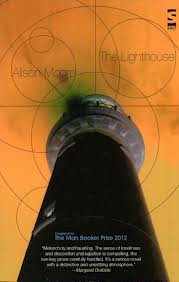
I have two paperback copies and a kindle download. This gives you an idea of how much I enjoyed it. The doubling up of the paperbacks is down to a joyful discounted purchase of the Booker shortlisted books  in 2012. I have yet to read Wolf Hall.

The lighthouse caught, and held, my attention partly because of its sadness and for the emptiness of the main character. His life has fallen apart around him and he sets out on a journey, a walking trip to Germany. It is a journey that appears to mirror his own sense of a loss of direction. The abandonment of his mother, and the disappointment of his ex-wife and father, garner sympathy from the reader through Moore’s cleverly crafted narrative. A chilling and suspenseful read. So much emotion is conveyed through very scant explanation.

I have subsequently read her more recent short story collection, The Pre-War House and Other Stories. I reviewed the collection in previous post.

Review: The Testament of Mary by Colm Tóibín

 images (6)

‘I REMEMBER EVERYTHING. MEMORY FILLS MY BODY AS MUCH AS BLOOD AND BONES. 

This is Mary. A mother whose son was taken from her and lost to the world. A woman who lives now in exile, watched by those who seek to preserve the sanctity of her son’s memory. But Mary’s recollections of his difficult life and tragic death are a truth that few who knew her son now recognize. As the myths grow around her like walks, so Mary clings to the truth, revealing, in a time of turmoil and profound change, her own fragile humanity.’

I was intrigued by Colm Tóibín’s novella, given the controversial subject matter and read it in one sitting – 104 pages in its entirety. A fictional account of Mary’s loss of her son on the cross and of her doubts surrounding the miracles and the disciples, it delves into the nature of her fear and confusion. It is a brave attempt to fill the gaps in one of the greatest stories of history and daring in its openness, in its raw uncovering of the destructive nature of loss and what it can do to a person. The Testament of Mary has a beautiful, almost dream-like quality and the depiction of Mary’s grief, of her anger and distrust, is striking, powerful and at times shocking. Yet I could begin to relate to aspects of her pain and understand some of her crippling doubts. Tóibín’s use of language is poetic and lyrical keeping the reader absolutely engaged. There are times when the mind often drifts as you read but this book draws you in and holds you tightly in its grasp until the author releases his hands with the final words that ‘words’ in themselves ‘matter.’ My only wish would be for greater detail in the scenes to plant the reader in the picture and the events as they unfold, but the book remains firmly inside the mind of Mary as she waits for the inevitable to approach.

There is an otherworldly feel to the narrative and an ethereal quality that links cleverly to the context of the book. An inherent darkness seeps into the words, leaving you with the sense that this could almost have been a psychological thriller. Literary it may be, but it has the power to almost transcend genres through thriller, literary fiction, biographical non-fiction. It is difficult to draw the line. There has been less opposition to the book than might be expected and for good reason; the fact that it is a fictional representation of a biblical story leaves the pages open and ripe for an author of great talent to sensitively explore what it might have been like for a Mother to lose a son in the most graphic and torturous of methods. The detail in the crucifixion scenes is just enough and it is not overwritten. The claim that he was the ‘Son of God’ is not the focus of the book and it is interesting that his name is never used, instead we are taken to the core of a Mother’s memories of her child as a baby and of the cold distance between them now, and her excruciating powerlessness as he is placed into the hands of his enemies.

An utterly absorbing and memorable read. It is not difficult to see why this has been shortlisted for the Man Booker Prize. This is Tóibín’s third Booker nomination. He was awarded the Costa Novel Award in 2009 for Brooklyn and has received numerous other awards and a Frank O’Connor International Short Story Award shortlisting for The Empty Family in 2011. A gifted and enthralling writer. 

Listen to an excerpt of The Testament of Mary narrated by Meryl Streep.

Swimming Home

swimming home

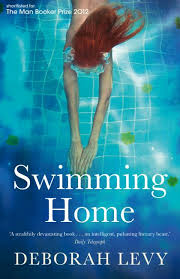
Deborah Levy’s Swimming Home is a book that has been on my to-be-read pile for far too long. I managed to reading it, amongst other books, while I was away last week. Shortlisted for The Man Booker Prize in 2012, I was expecting great things from this book and it did not disappoint.

As he arrives with his family at the villa in the hills above Nice, Joe sees a body in the swimming pool. But the girl is very much alive. She is Kitty Finch: a self-proclaimed botanist with green-painted fingernails, walking naked out of the water and into the heart of their holiday. Why is she there? What does she want from them all? And why does Joe’s enigmatic wife allow her to remain?

Both the unusual cover and the concept grabbed my attention from the start and I knew that this would be an allegorical journey in many ways. Levy’s use of visual constructs and rich symbolism retains a powerful hold over the reader’s experience. The wording is lyrical and enticing, wasting nothing. She casually underplays the devastating story as it reaches an unexpected climax. It has been described as a ‘literary beast’ of a novel and, although initially skeptical, I can understand why; I would agree. Reviews have been mixed, understandably, as her style is highly specific and will not appeal to all. Her power to draw in and to shock is almost a surprise and I found myself rereading parts of the text in disbelief. She uses subtle repetition to great effect and the prose has a circular narrative in that it ends almost where it begins. The outcome? Well, you’ll have to read it and decide what you think. I would highly recommend it to those who enjoy literary fiction and a short, sharp shock. I look forward to reading her newer short story collection, Black Vodka.

Book Review: The Pre-War House and Other Stories

50fac95bde404 (1)

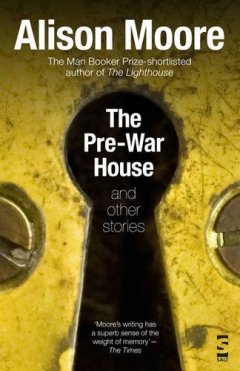
I have eagerly awaited the publication of Alison Moore’s debut collection, The Pre-War House and Other Stories. As regular blog readers know, I am an advocate for short fiction and I read and write as much of it as time allows. It’s a real joy to be able to review this collection of short stories.  I was kindly given an advanced copy by Salt Publishing, for which I am very grateful. The Lighthouse, Moore’s debut novel, was shortlisted for the Man Booker Prize in 2012 and I read it in one sitting. I hoped for the same emotional tension, her attention to detail, and a surprising climax in her short stories, and this collection did not disappoint.

The short stories in Pre-War House are drawn from a selection of magazine and anthology publications over a period of twelve years, alongside new and recently published work. Moore’s stories have been shortlisted for more than a dozen different awards (see below) including the Frank O’Connor International Short Story Award 2013 for this collection.

The stories are evocative and often sinister, honing in on the details of everyday life with extraordinary insight into human nature and the many fears, often unspoken. Moore has a great sense of control over her prose, her language is understated and therein lies the power of her writing. She uses words which evoke a sense danger, of loss or unease.

I had previously read When the Door Closed, It Was Dark, and reading it again provided the same sense of threat and menace through the tightly written sentences as they wound their way towards an uneasy ending. There is something inherently satisfying in reading a story of this quality which makes you catch your breath as you turn the pages.

Overnight Stop left me gripping my seat as I read in disbelief. The plot lends itself to a novel length prose and this is no mean feat for a short story. This piece is a perfect example of Moore’s ability to play with your emotions and draw you in to the scene with frightening reality.

Seclusion lulls you into a false sense of security before packing a punch towards the end. The insight into one life is portrayed with telescopic accuracy.

Sleeping Under the Stars brings in details of Stargazy Pie, Liqourice laces and kirby grips with a layered story of the difficulties of fractured families. The ‘goosepimpled arms’ give a sense of foreboding, and words such as ‘queezy’ and ‘sickening’ provide a parallel for the emotional distress involved in the story.

Many of the themes centre around family, relationships, loss, and uncertainty. Some of the stories create a sense of claustrophobia as the characters become trapped in situations beyond their control. Each piece has its own unique style but the thread weaving through the collection is an intangible sense of anticipation. It is a delicious read and, having read some of the stories a few times, it is something I will keep going back to. A remarkable debut collection which comes highly recommended.

‘Overnight Stop’ (The Lampeter Review issue 7)
‘Sleeping Under the Stars’ (The Nottingham Short Story Anthology 2012)
‘A Small Window’ (The Warwick Review vol.6 no.4)
‘Jetsam’ (Ambit issue 211)
‘Seclusion’ (Paraxis volume 4)’If There’s Anything Left’ (The Yellow Room)
‘It Has Happened Before’ (Shadows & Tall Trees issue 4)
‘Trees in the Tarmac’ (The New Writer issue 112)
‘Sometimes You Think You Are Alone’ (The Screaming Book of Horror, 2012)
‘Small Animals’ (Nightjar Press, 2012)
‘The Yacht Man’ (The New Writer issue 111)
‘The Smell of the Slaughterhouse’ (The New Writer issue 111; Best British Short Stories 2013)
‘Glory Hole’ (The Lightship Anthology: 1)
‘The Egg’ (Murmurations: An Anthology of Uncanny Stories About Birds, 2011)
‘When the Door Closed, It Was Dark’ (Nightjar Press, 2010; Best British Short Stories 2011)
‘The Pre-War House’ (The New Writer issue 103)
‘Static’ (Manchester Fiction Prize 2009)
‘Monsoon Puddles’ (Quality Women’s Fiction issue 43)
‘Helicopter Jean’ (The New Writer issue 53)
‘Wink, Wink’ (Creative Writers’ Network magazine)
‘Humming and Pinging’ (Marches Literary Prize anthology 2000)