Argo: What We Can Learn From Film About Not Overwriting

I watched Argo over the weekend, having seen it win an impressive collection of awards. Among it’s accolades were:

Seven nominations for the 85th Academy Awards, winning three, for Best Film EditingBest Adapted Screenplay, and Best Picture. The film also earned five Golden Globe nominations, winning Best Picture – Drama and Best Director, while being nominated for Best Supporting Actor for Arkin. It won the award for the Outstanding Performance by a Cast in a Motion Picture at the 19th Screen Actors Guild Awards and Best Film, Best Editing, and Best Director at the 66th British Academy Film Awards.

As you can imagine, I had high expectations and the film didn’t disappoint.

Here is a brief synopsis:

In 1979, the American embassy in Iran was invaded by Iranian revolutionaries and several Americans were taken hostage. However, six managed to escape to the official residence of the Canadian Ambassador and the CIA was eventually ordered to get them out of the country. With few options, exfiltration expert Tony Mendez devised a daring plan: to create a phony Canadian film project looking to shoot in Iran and smuggle the Americans out as its production crew. With the help of some trusted Hollywood contacts, Mendez created the ruse and proceed to Iran as its associate producer. However, time was running out with the Iranian security forces closing in on the truth while both his charges and the White House had grave doubts about the operation themselves.

The film is adapted from a true story, written about in the book The Master of Disguise by CIA operative Tony Mendez.

I spent a lot of time wondering how it would translate into a written story (I do this very often when watching films) and one thing stood out to me on several occasions – None of the script was overwritten. There were a small handful of tense or sensitive moments where, as a writer, it would be tempting to fill the space with dialogue, but that didn’t happen. Instead, there were delightful silences where you, the audience, knew exactly what each character was thinking, purely from the situation and from the expressions on their faces.

There was one key moment at the end of the film where, without spoiling the plot for those of you who haven’t seen it, there was a handshake, and so many things could have been said but neither character said a word. The handshake and ensuing silence was far more powerful than any dialogue which would, I expect, have destroyed the scene.

It has been rumbling through my mind for a while, the film and it’s highlights. Most of the highlight were moments where there were no words, no fill-ins from the scriptwriter to destroy the impact. The topic is of a sensitive nature and it could have easily been crushed with careless writing. It was a stark reminder for me not to overwrite, not to fill the moments with words and flowery descriptions. Sometimes, when you are writing, just a snapshot of a character’s movement or their body posture can be enough.

The Best Characters Are Broken

Broken Glass

‘The best characters are broken.’

I came across this quote yesterday and it has stayed with me. I started to think about why this is the case and how the reader identifies with broken characters. The quote was a little nugget in a much longer article by writer Faith Hunter. She writes in the fantasy/thriller genre but this concept travels across all genres of fiction and, I should add, non-fiction.

Why? 

Psychologists suggest there is a part in many of us that is broken and often hidden from the world, a part of us which we are afraid to reveal for fear of other people’s reactions. As children we have no qualms about crying or screaming if something is wrong, or throwing ourselves onto the floor and lying prostrate with fists pounding the carpet. Anyone seen this? Yes, well. Somewhere along the line, though, we are told to temper our responses with phrases like –  ‘don’t cry,’ ‘try to behave,’ ‘big girls/boys don’t shout.’

While this helps to create a society which is relatively restrained (most of the time), it also teaches us to suppress our fears or pain. It tells us that emotions should be dealt with quietly and privately, and not in public. It pushes us into corners where we have to wrestle and fight against feelings of fear, inadequacy, rejection, pain and even phobias. It’s not unlike snake charming gone awry. These are just a few of the murky areas of our lives which we have been taught to just sit on and ignore, in the hope that they will just vanish.

Why do readers need this in a story?

Why do we read books at all? For a vast majority it is a means of escape, a way of entering into an imaginary world where the rules have changed and events are happening to other people, events which stir up emotions in the reader and trigger memories of their own fears. We need to feel that we are not alone and books can provide an intense range of emotions in the reader. The level of which is down to the craftsmanship of the writer.

In a good novel we are taken on a journey with a roller coaster of emotions which vary in intensity throughout the pages. The journey can be frightening and it can be comforting, it call tell us that our fears are universal, it can navigate us through the choppy waters of disbelief, it can heal the deeper parts of our soul and can remind us that all of humanity lives with these bundles of hidden thoughts, and all in the safety and privacy of a collection of words, neatly bound in a cover without us having to leave the house or to communicate these fears.

How can we find the ideas?

As writers we have fears which need to be exploited to form a convincing plot, fears which will leave the reader turning page after page. Some of these fears begin in childhood, others might be more recent, but they are there and they need to be dug up, excavated and displayed in the pages of your books. Readers connect with writers who artfully pull at these strings – strings of challenge, of hopelessness, of a fear of change. Whatever the issues with your key characters, you need to delve into the murky waters surrounding an event and pull out the rawness of the emotions.

If there is no tension or emotion in your story it won’t fly.

Open up the corridors of your inner world and pull out all that lurks in the darkness. You will help your readers to relate to the characters and bring a believable plot to life.

Creating Intriguing Characters

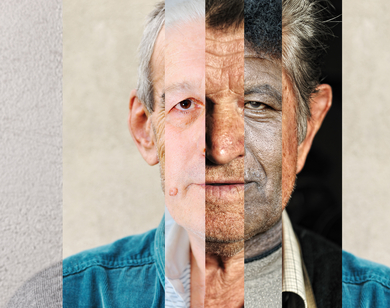
Human male face made of several different people, artistic concept vertical collage

Creating interesting, engaging and intriguing characters can be most of the battle when it comes to writing fiction. It is the characters who draw the reader deep into the story and who make a compelling case for why the reader should care about the the people involved in the story. This is relevant for almost any genre of fiction and some non-fiction, although there may be some exceptions.

So how do you go about creating the kind of people who readers will be unable to leave behind? Some characters will be kind and generous, others spiteful or deceitful, some will resist elements of the plot and its events, others will be dislikeable but their flaws might resonate with the reader by exposing a certain vulnerability.

Think about the people who you have met, seen in films, read about in compelling books, or interacted with in business or by other means. Who do you remember and why? What sort of character traits make a person likeable or dislikeable? What has happened in their life to make them behave in a certain way? There are cultural differences to consider – how does the character’s ethnicity and cultural background shape them as a person?

Dig deep into the each character’s psyche and tease out the details of their life, their surroundings, family, experiences, passions, dislikes and fears. Often a character’s fears, especially that of your protagonist, will be rooted in an event or a set of events which might be familiar to people on a larger scale. Are they afraid of change, restrictions, loss, death, illness? Do they have an inability to make decisions?

Take time to profile your characters – brainstorm, make notes, paste photographs into a notebook or onto a Pinterest board (see my post on using Pinterest to improve your writing). Make sure that you know your characters to the very core and then let them loose in a situation, a setting, a crisis and you will know how they respond and why, you will know the decisions they need to make or are afraid to make.

Can you think of interesting characters you have read about recently? Do you have any tips on creating realistic and engaging characters?

Zadie Smith – Middle-of-the-Novel Magical Thinking

This video was filmed at the New York Public Library. Author Zadie Smith begins with this quote:

‘In the middle of a novel, a kind of magical thinking takes over. To clarify, the middle of the novel may not happen in the actual geographical centre of the novel. By middle of the novel I mean whatever page you are on when you stop being part of your household and your family and your partner and children and food shopping and dog feeding and reading the post—I mean when there is nothing in the world except your book, and even as your wife tells you she’s sleeping with your brother her face is a gigantic semi-colon, her arms are parentheses and you are wondering whether rummage is a better verb than rifle. The middle of a novel is a state of mind. Strange things happen in it. Time collapses.’

Here is a summary of the rest of her talk. I found it inspiring and very true:

You need to work hard and make choices that are meaningful.

By the nature of your sentences, you are expressing a belief about the way you see the world.

Your views will change with time.

Delve deep into the consciousness of the characters.

‘Magical thinking makes you crazy and renders everything possible. Incredibly knotty problems with structure now resolve themselves with inspired ease. See that one paragraph? It only needs to be moved and the whole chapter falls into place, but why didn’t you see it before. You randomly pick a poetry book off the shelf and the first line you reads becomes your epigraph. It seems to have been written for no other reason.’

This talk comes from a longer essay written by Zadie Smith. If you enjoyed it, I invite you  to come back on Thursday of this week and on Monday week, as I will cover some more of her key points for writing.

How To Use Pinterest To Improve Your Writing

board

When I write I have the scenes playing in my mind like a film scene and I need images for inspiration. Whether imagined or actual images, I need to ‘see’ the characters and the setting and buildings. I hit gold when I started to use pinterest as I am a highly visual person. I love art and photography, so this sight has an almost magnetic quality about it for a mind which soaks up the visual world.

I began using pinterest to ‘pin’ my ideas and create the atmosphere that I needed in order to write some of my scenes. I have added a clip of the board for Take Me the Castle to the beginning of this post but you can see the whole board here if you are interested.

You can also use scrivener, but I find pinterest quick and easy to use. There is a plethora of images already posted by others which you can search for, or you can pin your own images from any website by pasting the url, or add your own file.

pin

Why and how does this help?

Some writers use prompts or music to help them to write. Jane Friedman has written a good article on prompts and Roz Morris has a blog about how writers use music to build their stories. If you are a visual person a collection of images can spark new ideas or link a character’s responses to his or her environment. It can help to put you in the scene and to think about how the characters will respond to a cliff edge, or a towering building, or a dark room.

According to neurolearning, ‘brainstorming activities of visual thinkers may be more productive if right hemispheric strategies of brainstorming and organization (mindmapping, doodling, free association, analogies) are undertaken. In fiction writing, often the most powerful writers are good at plumbing the strengths of both the right and left hemispheres.’ As a qualified teacher I can attest to the fact that children who are visual thinkers and learners engage more readily when the right side of their brain is stimulated with images and free drawing and mapping. You might be interested to know that most writers are in fact right brained, they use the right side of their brain to engage creativity more than the left side.

I would encourage you to have a look at pinterest and try pinning some images. I also have a board with writing quotes and information and boards with portraits and travel, which help to get the ideas flowing. Let me know if you have any other ideas for visual inspiration.