I met Natalie when my short fiction piece, North Norfolk Coast, was published online in 1000words at the beginning of July. 1000words publishes flash-fiction of up to 1000 words in length, written in response to an image. I have been impressed with the site and the quality of the work for a while. Natalie’s response to my submission was really professional and friendly, and I have enjoyed reading some of her own fiction (more on her work at the end of the post). I was thrilled when she agreed to an interview, so thank you for joining us, Natalie, and for answering some questions that I think authors often ask, or want to ask.
When and how did 1000words begin, and what inspired you to start gathering flash fiction?
1000words began in 2012 as part of the first National Flash-Fiction Day. I’d just finished an online flash-fiction course with Calum Kerr, the brains behind NFFD, who’d said he was looking for people to organise events, online and off. I’ve always had a secret desire to run my own fiction magazine, so this seemed the perfect opportunity to start one. I also love photography, so what better way was there to blend my two main interests and fulfill an ambition than by starting 1000words?
What is flash fiction, for those who are new to the form, and how is it unique?
There are as many definitions of flash-fiction as there are people writing it, but for me, flash-fiction is simply a very short story. Although at 1000words we accept stories of up to 1000 words in length, I actually prefer reading and writing stories no longer than 500 words. When it comes to flash-fiction I like to be punched in the gut. I like flash-fiction to be short, sharp and to take my breath away.
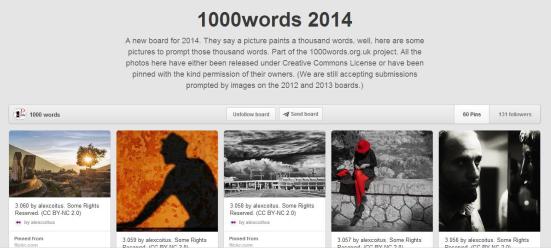
The idea of using an image prompt from the Pinterest page is very creative. How do you decide which images to use?
I go with my instincts. If I see an image and find myself immediately making up a story, I pin the image. I’ve pinned quite a few of my own photos on our Pinterest boards too, as I always have a camera on me and am constantly on the lookout for story ideas.
There is a wonderful range of stories on the site. How do you chose what will be published, and what are you looking for in a piece of fiction?
Again, I go with my instincts. If the opening few lines grab me, I know I’m likely to enjoy the whole piece and will most likely publish it. What I’m really looking for is a consistent narrative voice. It doesn’t have to be a confident voice, but I need to feel as if the narrator is a real person and believes in the story they’re telling. I’m also looking for something special: a surprising simile, a poignant observation, a subverted cliché, an old story told in a new way, or a new story told in an old way. It’s hard to define, but I know it when I see it.
Is there anything that will automatically send work to the rejection pile, and are there any submission tips you can share?
There’s nothing that will automatically send work to the rejection pile. If I decline to publish a story, it’s usually due to a combination of factors such as an inconsistent narrative voice, unnatural sounding dialogue, cliché imagery or plot or over-explaining (not leaving enough to the reader’s imagination). If a story has a lot of grammatical mistakes and doesn’t look as if it’s been proofread properly then I’ll probably turn it down, as it’ll be too much work to prepare it for publication. One of the biggest turn-offs for me, though, are stories with a twist ending where the twist hasn’t been sufficiently foreshadowed or where it’s been so obviously sign-posted that I’ve guessed it before the end. It’s a difficult balancing act, and one I struggle with myself.
Tell us a little about yourself and your own writing?
I’ve always written stories in my head, if not on paper. I remember writing and illustrating a book for my little brother when I was about ten. It was a complete rip-off of the children’s TV series Jamie and His Magic Torch, but I put my heart and soul into it! In my early teens, I graduated to Star Wars fanfiction, but I didn’t write much at all in my late teens and twenties, I was too busy with school, university, work and then babies – I did science A-levels, a degree in Biochemisty, a PGCE in secondary science education, taught for a few years and then gave it all up to raise two lovely children. I’d had depression and anxiety after the birth of my daughter in 2005, and the doctor advised me to find something with which to occupy my brain. Writing seemed like a good idea, so in 2007, after a bit of dabbling, I took The Open University’s Start Writing Fiction Course, and I haven’t really looked back since. I’ve written quite a few short stories, but flash-fiction is where I feel most at home and I’m pleased to say that I’ve had a fair few pieces published here and there. Right now, I’m working on a collection of summer-themed flash-fictions and in September (if I get enough punters) I’ll be teaching my first ever writing course in the adult education department of my local secondary school. Bit scary!
Are there any short fiction authors who are a particular inspiration?
Loads! I have a ‘Recommended Reading’ page on my website where I list lots of my favourite authors and stories, but if I had to name just a few, they’d be: Calum Kerr, Nik Perring, Kevlin Henney, Shirley Golden, Cathy Lennon, Lorrie Heartshorn, Angela Readman, Kurt Vonnegut, Raymond Carver, Elmore Leonard, Annie Proulx and Kate Atkinson. These are the people whose work I rush to read. (That was more than just a few, wasn’t it?!)
Friends of 1000words are flashandzoom, Paragraph Planet and Stories with Pictures. Can you tell us a bit about each of them?
flashandzoom is a photography and poetry project run photographer Jaime Hill and a writing pal of mine, Zoe Mitchell. The aim of the project is to provide a fresh perspective to photography and poetry, and to create art that reaches people on a number of levels. It’s been a bit quiet of late, but what they’ve produced in the past has been beautiful.
Paragraph Planet publishes a 75-word paragraph (fiction and non-fiction) EVERY SINGLE DAY of the year, which is an amazing feat. You can also read author interviews and there’s a sister site called ‘Writing Workout’ where writers can do all sorts of writing exercises. I’ve had a couple of pieces published on Paragraph Planet and intend to send more soon.
Stories and Pictures is a site that brings writers and artists together in collaboration. It’s chock-full of beautiful stories accompanied by beautiful pictures. Some of the stories have been inspired by pictures, and some of the pictures have been inspired by stories. I’ve had a story and a photo published there too.
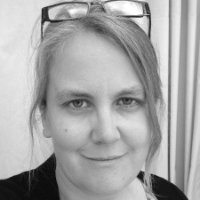
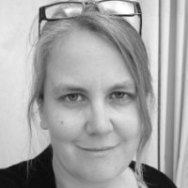 Natalie Bowers, along with Heather Stanley, is the editor and publisher of 1000words online flash fiction magazine. She lives in Hampshire with her husband, two children and a growing collection of ukuleles. Natalie has a degree in Biochemisty, a PGCE in secondary science education, and has taught Science and A-Level Biology. Her short stories have appeared in print and her flash-fiction has been published in various online journals. You can find a list of her publications on her blog, and she is a fellow Ether Books author. You can follow 1000words on Facebook and Twitter.


 F C MALBY
You must be logged in to post a comment.