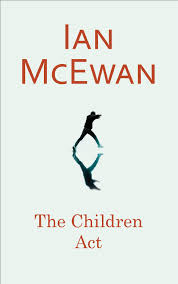
Review: The Children Act, Ian McEwan

download (2)

Fiona Maye is a leading High Court judge, presiding over cases in the family court. She is renowned for her fierce intelligence, exactitude and sensitivity. But her professional success belies private sorrow and domestic strife. There is the lingering regret of her childlessness, and now, her marriage of thirty years is in crisis.

At the same time, she is called on to try an urgent case: for religious reasons, a beautiful seventeen-year-old boy, Adam, is refusing the medical treatment that could save his life, and his devout parents share his wishes. Time is running out. Should the secular court overrule sincerely held faith? In the course of reaching a decision Fiona visits Adam in hospital – an encounter which stirs long-buried feelings in her and powerful new emotions in the boy. Her judgment has momentous consequences for them both.

Difficult to summarise, or to review, McEwan’s book (his 13th novel) draws on his personal experience with the family courts during a difficult divorce and custody battle in the 1990s. He had an uncomfortable interruption at the Cheltenham Literary Festival this year when his ex-wife began shouting about the injunction, which was placed forbidding her to speak about the case. This awkwardness and emotional turmoil is brought out painfully but carefully in the book: the sense of uncertainty and betrayal is beautifully illustrated, touching on emotions of difficulty in all of our lives. His ability to translate the complexities of emotion, and especially the difficulties of vulnerability in relationships, never fails to hold my attention. The novella, On Chesil Beach, was one of his most powerful books, in my opinion, and he uses the same mood, painting a landscape of fear and abandonment. One of the aspects of McEwan’s writing that I most admire is his ability get inside the mind of a character at their most vulnerable. He poses questions in his fiction that might otherwise be difficult to voice.

The main event in the story centres around a seventeen (nearly eighteen year old) son of a Jehovah’s Witness couple. The significance of his age and of the closeness to his eighteenth birthday becomes apparent as we get deeper into the story. The book covers themes of religion, personal faith and human rights law, and the legal aspect of the book was really interesting. Without showing much bias, he forces the reader to come to their own conclusions about the right or wrong or the family’s belief systems, and raises questions about how or why we come to the various and necessary decisions in our lives. I felt for each character for different reasons, and am left with a sense of having lived the lives of many of the characters.


35 Beautiful and Insightful Quotes about Short Stories

                                     I.

How to Mix Voices Like Annie Proulx

“In a rough way the short story writer is to the novelist as a cabinetmaker is to a house carpenter.” – Annie Proulx

II.

“A good short story crosses the borders of our nations and our prejudices and our beliefs. A good short story asks a question that can’t be answered in simple terms. And even if we come up with some understanding, years later, while glancing out of a window, the story still has the potential to return, to alter right there in our mind and change everything.” ― Walter Mosley

III.

“Find the key emotion; this may be all you need know to find your short story.”
– F. Scott Fitzgerald

IV.

“It’s possible, in a poem or short story, to write about commonplace things and objects using commonplace but precise language, and to endow those things – a chair, a window curtain, a fork, a stone, a woman’s earring – with immense, even startling power.” – Raymond Carver

V.

“Short stories consume you faster. They’re connected to brevity. With the short story, you are up against mortality. I know how tough they are as a form, but they’re also a total joy.” – Ali Smith

VI.

“I would also suggest that any aspiring writer begin with short stories. These days, I meet far too many young writers who try to start off with a novel right off, or a trilogy, or even a nine-book series. That’s like starting in at rock climbing by tackling Mt. Everest. Short stories help you learn your craft.” – George R.R. Martin

VII.

“A short story I have written long ago would barge into my house in the middle of the night, shake me awake and shout, ‘Hey, this is no time for sleeping! You can’t forget me, there’s still more to write!’ Impelled by that voice, I would find myself writing a novel. In this sense, too, my short stories and novels connect inside me in a very natural, organic way.” – Haruki Murakami

VIII.

“A short story is confined to one mood, to which everything in the story pertains. Characters, setting, time, events, are all subject to the mood. And you can try more ephemeral, more fleeting things in a story – you can work more by suggestion – than in a novel. Less is resolved, more is suggested, perhaps.” – Eudora Welty

IX.

“When you read a short story, you come out a little more aware and a little more in love with the world around you.” – George Saunders

X.

“You become a different writer when you approach a short story. When things are not always having to represent other things, you find real human beings begin to cautiously appear on your pages.” – Zadie Smith

XI.

“Write a short story every week. It’s not possible to write 52 bad short stories in a row.” – Ray Bradbury

XII.

Neil Gaiman Writing Tips

“A short story is the ultimate close-up magic trick – a couple of thousand words to take you around the universe or break your heart.” – Neil Gaiman

XIII.

“I love short stories because I believe they are the way we live. They are what our friends tell us, in their pain and joy, their passion and rage, their yearning and their cry against injustice.” – Andre Dubus

XIV.

“If there is a magic in story writing, and I am convinced that there is, no one has ever been able to reduce it to a recipe that can be passed from one person to another. The formula seems to lie solely in the aching urge of the writer to convey something he feels important to the reader. If the writer has that urge, he may sometimes but by no means always find the way to do it.” – John Steinbeck

XV.

“The great thing about a short story is that it doesn’t have to trawl through someone’s whole life; it can come in glancingly from the side.” – Emma Donoghue

XVI.

“A good [short story] would take me out of myself and then stuff me back in, outsized, now, and uneasy with the fit.” – David Sedaris

XVII.

“With a novel, which takes perhaps years to write, the author is not the same man he was at the end of the book as he was at the beginning. It is not only that his characters have developed—he has developed with them, and this nearly always gives a sense of roughness to the work: a novel can seldom have the sense of perfection which you find in Chekhov’s story, The Lady with the Dog.” – Graham Greene

XVIII.

“Short stories are fiction’s R & D department, and failed or less-than-conclusive experiments are not just to be expected but to be hoped for.” – Walter Kirn

XIX.

“A short story must have a single mood and every sentence must build towards it.”
– Edgar Allan Poe

XX.

“Most stories we tell in real life are under 500 words. You’re at a party, everyone has a glass of wine, and suddenly you have the floor. You throw out your little story like a grenade. ‘Once I knew a guy who…’ And if you have any social graces at all, you probably keep it under 500. So my advice would be this: Don’t get all up in your head thinking short-short stories have to be poetry without the line breaks. Don’t put on your beret. Just tell a story, an actual story. Quick, while they’re still listening.” – Rebecca Makkai

XXI.

“When seriously explored, the short story seems to me the most difficult and disciplining form of prose writing extant. Whatever control and technique I may have I owe entirely to my training in this medium.” – Truman Capote

XXII.

Michael Swanwick

“A short story…can be held in the mind all in one piece. It’s less like a building than a fiendish device. Every bit of it must be cunningly made and crafted to fit together perfectly and without waste so it can perform its task with absolute precision. That purpose might be to move the reader to tears or wonder, to awaken the conscience, to console, to gladden, or to enlighten. But each short story has one chief purpose, and every sentence, phrase, and word is crafted to achieve that end. The ideal short story is like a knife–strongly made, well balanced, and with an absolute minimum of moving parts.” – Michael Swanwick

XXIII.

“I don’t think I would ever want to be a writer of detective stories – but I would like to be a detective and there is a large deal of detection in the short story.” – Mary Lavin

XXIV.

“Great short stories and great jokes have a lot in common. Both depend on what communication-theorists sometimes called “exformation,” which is a certain quantity of vital information removed from but evoked by a communication in such a way as to cause a kind of explosion of associative connections within the recipient.” – David Foster Wallace

XXV.

Roger Selazny

“One of my standard — and fairly true — responses to the question as to how story ideas come to me is that story ideas only come to me for short stories. With longer fiction, it is a character (or characters) coming to visit, and I am then obliged to collaborate with him/her/it/them in creating the story.” – Roger Zelazny

XXVI.

“In short stories there’s more permission to be elliptical. You can have image-logic, or it’s almost like a poem in that you can come to a lot of meanings within a short space.” – Karen Russell

XXVII.

“Short fiction is the medium I love the most, because it requires that I bring everything I’ve learned about poetry – the concision, the ability to say something as vividly as possible – but also the ability to create a narrative that, though lacking a novel’s length, satisfies the reader. – Ron Rash

XXVIII.

“Short stories can be rather stark and bare unless you put in the right details. Details make stories human, and the more human a story can be, the better.” – V. S. Pritchett

XXIX.

“Short stories do not say this happened and this happened and this happened. They are a microcosm and a magnification rather than a linear progression.” ― Isobelle Carmody

XXX.

“We get so many people saying short fiction is not economical, that it doesn’t sell; but there are so many of us enjoying writing it and reading it. So it’s wonderful to be around people who love short fiction too – it’s like hanging around with my tribe.”
– Junot Diaz

XXXI.

“Everything has to be pulling weight in a short story for it to be really of the first order.” – Tobias Wolff

XXXII.

“Not that the story need be long, but it will take a long while to make it short.” – Henry David Thoreau

XXXIII.

“I want my stories to be something about life that causes people to say, not, oh, isn’t that the truth, but to feel some kind of reward from the writing, and that doesn’t mean that it has to be a happy ending or anything, but just that everything the story tells moves the reader in such a way that you feel you are a different person when you finish.”  – Alice Munro

XXXIV.

“I’ll give you the whole secret to short story writing. Here it is. Rule 1: Write stories that please yourself. There is no Rule 2.” – O. Henry

XXXV.

“I’m not interested in writing short stories. Anything that doesn’t take years of your life and drive you to suicide hardly seems worth doing.” –Cormac McCarthy


This article is reblogged from Aerogramme Writers’ Studio.

Publication in Spontaneity Magazine

waterlooconcourse-by-Mark-Charlton-1

One of my short stories, A Question in a Gallery, has just been published in Issue 5 of Spontaneity Magazine. It was written in response to this image of Waterloo Concourse by photographer Mark Charlton, also published in Spontaneity. Spontaneity is a new arts journal which seeks to link prose to visual art, poetry and music, and is one of the most original journals I have read in recent years. Dip into their pages and see what you find. It’s truly inspirational.

A Question in a Gallery

‘Mind the gap, please.’ The voice sounds cool, void of emotion.

I push through the doors, the signs for St Paul’s Station lining the walls as though I might miss my stop. I have managed to avoid the rush hour, having taken the day off work. The air is thick with anticipation, or maybe it’s fear. I don’t know.

I weave through the tiled corridors and find the bottom of the escalators. There are more signs – the St Paul’s wording replaced with To Street, like an instruction on a board game. Posters pull me into a world of colour and cabaret. A woman holds the hands of two small children, as they pass me travelling in the opposite direction. They fight over who will hold the moving handrail. Her face remains unchanged, as though they do not exist…

Continued at Spontaneity.

A Review: He Wants, Alison Moore

he wants


Retired teacher Lewis Sullivan always imagined living by the sea.

He lives instead in the Midlands village in which he was born. His grown-up daughter visits every day, bringing soup. He does not want soup. He frequents his second-favourite pub, where he can get half a shandy, a speciality sausage and a bit of company.

When a childhood friend appears on the scene, Lewis finds his life and comfortable routine shaken up.

In the wake of Moore’s award-winning first novel, The Lighthouse, and her debut short story collection, The Pre-War House (which I reviewed here), my expectations were high and this book did not disappoint. With Moore’s typically sparse plot, her attention to the minute detail of everyday occurrences, and her use of quiet tension, I sunk into this and did not resurface until I reached the end. At 182 pages, it is a short novel but needs no further chapters; its impact lies, in part, in its brevity and in its silences.

I appreciated John Oakey’s clever cover design, and the irony of the brightness of the yellow against the protagonist’s rather dull existence. It is possible that the colour yellow is scattered throughout the text for this very reason. Lewis Sullivan’s reserve and quiet desperation is painful at times, but he also resists change in the same way that a child might stamp his feet. Although, Lewis’s determination to keep a routine existence is done quietly and without a fuss. His occasional need to break out or to experience something new, something shocking, touches on the natural curiosity in all of us, and reminds us of the idea that there is always more beyond the borders of our existences. There is something inherently Freudian about the focus on Lewis’s loss, his inhibition and self-absorption.

Moore’s skill lies in lulling the reader into a comfortable, but temporary, sense of experiencing the ordinary, before she shocks the reader with an aggressive and threatening outside force through language which makes the character feel uncomfortable, or a dry expression and a sense of foreboding. Without giving away the ending, the whole story builds up to an unexpected climax, leaving you replaying the story to see where the clues may have been buried in the pages, if at all. Lewis Sullivan’s routine existence, with daily visits from a daughter with whom he shows no real connection, is shaken up when his old pal, Sydney, resurfaces, causing unexpected disruption to Lewis’s days. The fact that Sydney is also a far-flung destination is not lost on the attentive reader.

The book title is followed through with chapter headings beginning with an ominous, He does not want…, He wants…, or He wanted to… There is a combined sense of anticipation, regret, fear and uncertainly in each chapter – with much of the tension rising from what is left unsaid, in the unspoken sentences – in as much as his life is made up of the things he did not do and the places he did not visit. And then there is the matter of the dog who is weaved through the pages, a dog whose ownership is unclear. At one point we find ourselves in the company of the two characters and the dog in the kitchen, and it is unclear for a while to whom both the dog and the kitchen belong: “The man, who has been looking at him, looks at him some more and then says, ‘Your house?’ ‘Yes,’ replies Lewis. ‘You are in my house. This is my kitchen. You are sitting in my wife’s chair at my kitchen table. I thought for a moment that this was my dog.'” In the following lines Lewis wonders if he is being burgled. I can’t help thinking of Goldilocks and the Three Bears as we wonder about the intruder. There is an almost surreal element to the book, a sense of other-worldliness.

The themes of religion and eternity are well expressed with their uncertainties and extremes, in particular in the chapter,  He wants to fly, where we are drawn back in time to Lewis’s father taking him to see Billy Graham in Manchester at the age of eighteen. His concerns about baptism focus on whether or not a person would need to be clothed or naked, and whether it would require a clean pair of pants. He lists some of the Thou Shalt Nots of the Bible, with which many are familiar, in a way that may threaten to close his life in even further.

The narrative is beautifully layered, with generational links and well-planned time frame jumps. So many elements of the book feel familiar, yet much is also unexpected. Themes of loneliness, memory and loss are unfolded with a deep originality. Lewis is, at times, an unreliable narrator and I sense that Moore enjoys this element of surprise. This book is not for those who want a fast paced thriller, but there are dark aspects to He Wants and an intensity of emotion that will pull you in until the last page.

I’m off to buy myself a new suit and travel the world!

Transatlantic Anthology: The very best of Litro fiction.

litro

I’m thrilled to be able to share the news that one of my short fiction pieces has been published in the US in the Litro Anthology, Transatlantic. I am in the company of some wonderful authors and will be excited to read this in its entirety. The collection will be published in the UK next spring.

SYNOPSIS

Transatlantic: The Litro Anthology collects some of the best writing to have passed through the pages of Litro magazine, including stories by Anthony Doerr, Sean Beaudoin, Nikesh Shukla, Lucie Whitehouse and Jenn Ashworth. Litro has always taken a global view of the literary world, and this collection is no exception. There are stories from authors on both sides of the Atlantic, spanning locations as far apart as Ithaca and Nairobi – and even the surface of the moon. What connects them is the strength of their voices, and the vibrant originality of their storytelling. Transatlantic contains disturbed choristers and post-apocalyptic survivalists, aspiring rock stars and morally bankrupt nuclear power plant workers – but more importantly, it contains some of the most exciting and unique new voices to have appeared in modern fiction over the last few years.