North Norfolk Coast

Just as I had posted the previous publication news, I discovered that another of my short stories has just been published online. North Norfolk Coast has been published at 1000 Words:

coast

Extract:

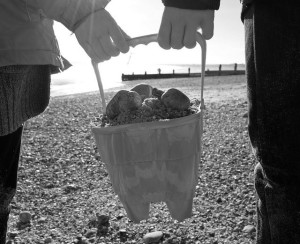
Days were spent with her brother, Donald, on the beaches of the North Norfolk coast, with its wild winds and salt air. They built sand castles before the sun set; before the waves swept over the turrets, dragging them back into the sea. She could hear her father’s voice.

‘You’ll catch your death if you don’t put a sweater on, girl. It’s getting cold.’

He spoke as though he was still fighting from the trenches. She wondered how death could be caught, if at all. The swell of the waves grew with each crash, pounding the shore and devouring the castles with their flags. The moats, engulfed with water at high tide, turned her thoughts to the river, which had burst its banks in an early January. The thought frightened her, perhaps more than her father’s unkind words.

You can read the rest at 1000 Words.

Clipboards and White

One of my short story has just been published in Litro, a London Literary Magazine. You can read it here.

WHITE-TILES-620x465

Extract:

The starched white sheets crinkle beneath my thighs. The walls are white; clinical. The door is pale and open. Beyond it, the muffled voices of people in white travelling along the corridor. I see flashes of clipboards, glasses, and white; maybe jackets. I am not sure why I am here. My head is woolly and my feet numb. Looking through the window, which is higher than usual, there is a meadow of greens and splashes of yellow. Beyond that nothing but sky; grey mainly. I need to wash my hands but they refuse to move, lying heavily, tingling, as though dipped in iced water. I was told to lie prostrate. It’s the drugs, they said, just rest.

My mind never rests. One. Two. Three. The tiles above the sink are unsymmetrical. Four. Five. Six. There is no middle groove where the grouting should lie. Seven. The fourth tile should not be in the middle. The lack of symmetry makes me feel uncomfortable and unsettles a sense of order, or disorder, in my mind. I remember, maybe earlier, a doctor in the house, an ambulance, a cup of coffee, a dog and Sandra, in no particular order. Why do I remember Sandra last? Where is she? Continued on the Litro website.


Q&A with Rebecca Bradley: What’s Your First Draft Like? – F. C. Malby

I have been interviewed in a Q&A on First Drafts over at Rebecca Bradley’s blog:

When you decide to write something new, what is the first thing you do?

I just begin to write and see where it takes me. It’s that simple. I begin to write before even planning. I’m not a keen planner and I find I need something written down before I can flesh out the rest. I also don’t research until later. I try to get into the feel of the characters and the voice, and create a sense of place in my mind. So in a way it’s like launching myself off a diving board. I don’t scan the water, test the temperature or step in carefully. I just go. It might seem reckless, but I rarely rewrite the beginnings…


Read the rest of the interview here: What’s Your First Draft Like? – F. C. Malby.

Writing Process Blog Tour

I have been invited by author Rebecca Bradley to answer some questions about my current writing as part of a writing process blog tour. You can read her answers on her blog.

So here are my responses to the following questions:

What are you currently working on?

I am working on the ending of my second novel. The first was historical fiction, and set in 1980s/1990s Prague. It was a fictional take on the impact of the fall of communism on the lives of the Czech people, and the ensuing changes. This one is entirely different. It’s a thriller, set in Vienna, and was inspired by a trip to an auction house in the city during the annual Long Night of Museums over a year ago, which you can read about here and here. I stood next to a Canaletto painting, which was said to be expected to fetch ten million euros at auction. So many thoughts surfaced, from who would pay that much for one work of art and where would it end up, to imagine if I just lifted it and walked away with a painting. Crazy, I know, but such is the imagination of a writer! And from there, a whole story began to unravel. Researching art theft has been fascinating and I particularly enjoyed reading insights from the founder of the FBI Art Crime Team, Robert Wittman. His memoir, Priceless, is really worth a read. In it, he discusses how he went undercover to rescue some of the world’s most valuable stolen art treasures, and he highlights the need for greater expertise in the area of the theft of cultural property. Several of my short stories have been published online and won various competitions, so I am also polishing a collection for publication.

canaletto

How does your work differ from others of its genre?

I read a lot of literary fiction and I really dislike all the genre segregation and the debates surrounding what makes good writing. In my view good writing is good writing regardless of its genre. Does the genre categorisation make literary fiction genreless? Nobody seems to agree. I don’t believe that any one type of writing is better than another. I’m happy about the rise of the short fiction form and hope that all forms and genres can be equally celebrated. My current novel is written in the first person, present tense, which many would say is tough and risky, but I think it works and it has certainly held my attention for long enough to continue with the story. It helps the reader to get inside the mind (and fears) of the protagonist, which would be difficult from another perspective. It increases the tension. It is also set in Europe, and in a city I know well enough to include the minute details and the feel of the place.

Why do you write what you do?

Well, you’ve seen the variety – historical fiction, thrillers, short stories – and it probably reflects a highly varied taste in reading, but as far as the current work is concerned I find thrillers really intriguing in terms of what makes them work, especially psychological thrillers. I have been hooked by many great writers over the years and in a way they have fed into what I am currently writing. I also read a lot of short stories and am passionate about writing short fiction. You’ll find several on my website if you are interested.

How does your writing process work?

It always starts with an idea, which is followed by several vivid scenes. Once I can link them together I can start to plot and plan the story. I do quiet a lot of research, despite the fact that I write fiction, and I draft and re-draft, often adding in new scenes or scrapping parts which don’t quite work. You have to be unafraid of being ruthless. Readers will want to stop reading at points where you don’t edit properly. With the first book I cut out an entire family (who really had no place in the story) and several chapters. I once read that if you take every other word out of a text, the story still makes sense. Try it. It will show you how many unnecessary words can be used which could have been cut. Maybe I should reread this post! I work at an empty table with a strong coffee and some water. I don’t always feel hungry when I write, especially when I get caught up in the flow of the story. I take breaks to move around but I try to keep set time for writing and to treat it seriously. I guard my writing time and often snatch evenings to write when I can.

coffee

I’ll now pass the baton on to Fiona Melrose, Michelle Flatley, Colette McBeth and Jon Rance.


#bookadayuk Hooked you into reading: The Fairy Tales of Hans Christian Andersen and The Brothers Grimm

For those of you who have been following the #bookaday posts, I’ve been up in the Alps for a week. I’m back and refuelled, and will pick up with the posts and get back to writing. We drove the length of the Grossglockner Pass, which is the highest and one of the most beautiful roads in Europe. Here are a few photos before I write about what hooked me in to reading. It seems fitting that the photos are of Europe, the home of the writers I want to talk about.

P1180861

P1180792

P1180594

I was influenced by so many great authors throughout my childhood. While I enjoyed Enid Blyton, Judy Blume and Noel Streatfeild early on, what hooked me in to reading was primarily fairy tales. I loved Hans Christian Andersen’s The Princess and the Pea and, although I wouldn’t necessarily subscribe to the Happy Ever After endings, there was something magical about the idea of anyone being able to feel a pea beneath layers of mattresses. Children often want to believe the unbelievable, don’t they? Think Peter Pan, The Lion, the Witch and the Wardrobe; or, in my case, The Lochness Monster, the Abominable Snowman and the Tooth Fairy. The first two exist, don’t they? Anything implausible, I believed in it. Such was my hopeless and incorrigible imagination. The thing is children want to believe in unreality, they want a world beyond the real and the plausible. And I think adults sometimes look for the same thing. It’s why we read fiction.

pea

And then there were the Brothers Grimm’s fairy tales: Rapunzel, Hansel and Gretel, Cinderella. I devoured them all, utterly absorbed in another world. Hansel and Gretel grabbed my attention for the suspense as the children become lost in the woods. I liked the idea of a house made of sweets, and was always captivated by images of the roof. I have started to make a European gingerbread house at Christmas, a tradition in Germany which comes from this story.

In Germany, there’s a rhyme that’s said about Gingerbread Houses that comes directly from the story of Hansel and Gretel:

Knusper, knusper, knäuschen,
wer knuspert an meinem Häuschen?
Der Wind, der Wind,
das himmlische Kind.

English Translation:

Nibble, nibble, gnaw
Who is nibbling at my little house?
The wind, the wind
The heavenly child.

house

I’ll also throw in Joseph Jacob’s Jack and the Beanstalk. A giant at the top of a beanstalk? Really? These imaginary worlds are a wonderful escape from the real world and teach children about the far reaches of the imagination. And you are never too old to read them.

Einstein said, “If you want your children to be intelligent, read them fairy tales. If you want them to be more intelligent, read them more fairy tales.” While I am certainly no genius, I find his quote interesting because it suggests a link between the imagination and the intellect. What are your thoughts?

einstein