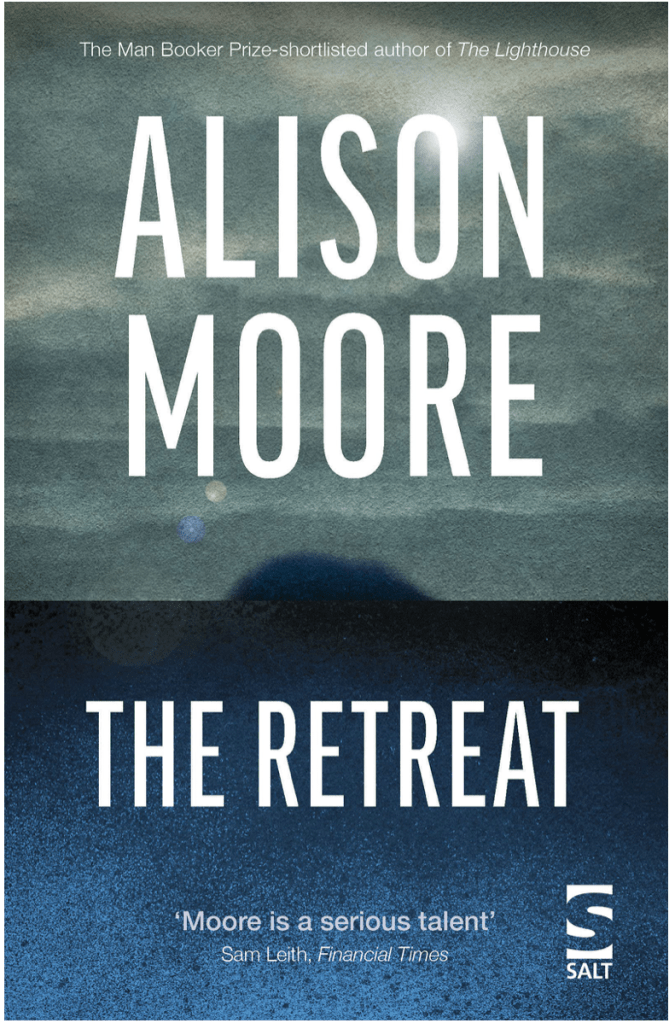
Review: The Retreat, Alison Moore

SALT Publishing, 2021

Since childhood, Sandra Peters has been fascinated by the small, private island of Lieloh, home to the reclusive silent-film star Valerie Swanson. Having dreamed of going to art college, Sandra is now in her forties and working as a receptionist, but she still harbours artistic ambitions. When she sees an advert for a two-week artists’ retreat on Lieloh, Sandra sets out on what might be a life-changing journey. 

Since reading Alison Moore’s Man Booker shortlisted novel, The Lighthouse, and subsequently her collection, The Pre-War House and Other Stories, her work has drawn me in with its tight prose and an unnerving sense of foreboding. She has a gift for honing in on fine detail, memory and doubt, creating a sinister unease. There is tension even in the simplest of details and a layered story, where realities shift and doubt creeps in. An other worldliness fills her writing in a way that leaves you questioning and searching for what might be and what might not.

“Sandra wants to be inspired, just like Angie was inspired by the chapel and wrote that poem that everyone said was beautiful. She wants to paint something that she can be proud of, something the others will admire, something she could bear to hand on a wall.”

A sense of isolation is created so well in the mind of Sandra, a thread that runs through many of her characters and books. In The Retreat, this is thrown into the fore as the chapters alternate between what is going on in the mind of Sandra against a narrative that weaves in the actions of the other characters, some of whom the reader will begin to detest. She writes with subtlety, each sentence punching with the weight of a skilled storyteller.

“Carol had understood that the students had arranged to shoot the whole film on the island, sleeping in the house, which had running water and electricity and so on – but something had not worked out, although Carol is not clear what that something was.”

As the chapters shift between Carol, who is alone in a seemingly haunted house on another island and trying to write a novel, and Sandra, who becomes increasingly ostracised by the other artists in the sparse house that they are staying in for an artists’ retreat, many of Carol and Sandra’s thoughts repeat and expand, reflecting the minds of introverts that Moore cleverly creates. You feel an increasing sense of disconnect and longing in Sandra, as she walks to a spot each day to paint the island where Carol is staying, at one point finding someone else in her spot. You expect, and almost hope, the two will meet.

“She wonders what the hell she is doing here, naked at night on the rocks; she is no longer sure that she wants to jump, but she is here now, and she will do it.”

So much of the power of this novella lies in the details: the missing glove, the disregard of Sandra’s needs by her fellow artists, the sounds that Carol hears in the night, the misplaced objects in both of their realities. It’s a gripping book that I read in one sitting on the day that it arrived! Moore creates something that leaves you trying to grasp what is just out of reach. The weight of the story will resonate with you far beyond the end of the pages.

Alison Moore’s short stories have been published in various magazines, journals and anthologies, including Best British Short Stories and Best British Horror, and broadcast on BBC Radio. The title story of her first collection, The Pre-War House, won the New Writer Novella Prize; her second collection, Eastmouth and Other Stories, will be published in autumn 2022.

Her first novel, The Lighthouse, was shortlisted for the Man Booker Prize and the National Book Awards, winning the McKitterick Prize. Both The Lighthouse and her second novel, He Wants, were Observer Books of the Year. She recently published her fifth novel, The Retreat, and a trilogy for children, beginning with Sunny and the Ghosts.

Born in Manchester in 1971, she lives in a village on the Leicestershire-Nottinghamshire border with her husband, son and cat. She is an honorary lecturer in the School of English at the University of Nottingham and a member of the National Association of Writers in Education.

Find her at https://www.alison-moore.com

A Review: He Wants, Alison Moore

he wants


Retired teacher Lewis Sullivan always imagined living by the sea.

He lives instead in the Midlands village in which he was born. His grown-up daughter visits every day, bringing soup. He does not want soup. He frequents his second-favourite pub, where he can get half a shandy, a speciality sausage and a bit of company.

When a childhood friend appears on the scene, Lewis finds his life and comfortable routine shaken up.

In the wake of Moore’s award-winning first novel, The Lighthouse, and her debut short story collection, The Pre-War House (which I reviewed here), my expectations were high and this book did not disappoint. With Moore’s typically sparse plot, her attention to the minute detail of everyday occurrences, and her use of quiet tension, I sunk into this and did not resurface until I reached the end. At 182 pages, it is a short novel but needs no further chapters; its impact lies, in part, in its brevity and in its silences.

I appreciated John Oakey’s clever cover design, and the irony of the brightness of the yellow against the protagonist’s rather dull existence. It is possible that the colour yellow is scattered throughout the text for this very reason. Lewis Sullivan’s reserve and quiet desperation is painful at times, but he also resists change in the same way that a child might stamp his feet. Although, Lewis’s determination to keep a routine existence is done quietly and without a fuss. His occasional need to break out or to experience something new, something shocking, touches on the natural curiosity in all of us, and reminds us of the idea that there is always more beyond the borders of our existences. There is something inherently Freudian about the focus on Lewis’s loss, his inhibition and self-absorption.

Moore’s skill lies in lulling the reader into a comfortable, but temporary, sense of experiencing the ordinary, before she shocks the reader with an aggressive and threatening outside force through language which makes the character feel uncomfortable, or a dry expression and a sense of foreboding. Without giving away the ending, the whole story builds up to an unexpected climax, leaving you replaying the story to see where the clues may have been buried in the pages, if at all. Lewis Sullivan’s routine existence, with daily visits from a daughter with whom he shows no real connection, is shaken up when his old pal, Sydney, resurfaces, causing unexpected disruption to Lewis’s days. The fact that Sydney is also a far-flung destination is not lost on the attentive reader.

The book title is followed through with chapter headings beginning with an ominous, He does not want…, He wants…, or He wanted to… There is a combined sense of anticipation, regret, fear and uncertainly in each chapter – with much of the tension rising from what is left unsaid, in the unspoken sentences – in as much as his life is made up of the things he did not do and the places he did not visit. And then there is the matter of the dog who is weaved through the pages, a dog whose ownership is unclear. At one point we find ourselves in the company of the two characters and the dog in the kitchen, and it is unclear for a while to whom both the dog and the kitchen belong: “The man, who has been looking at him, looks at him some more and then says, ‘Your house?’ ‘Yes,’ replies Lewis. ‘You are in my house. This is my kitchen. You are sitting in my wife’s chair at my kitchen table. I thought for a moment that this was my dog.'” In the following lines Lewis wonders if he is being burgled. I can’t help thinking of Goldilocks and the Three Bears as we wonder about the intruder. There is an almost surreal element to the book, a sense of other-worldliness.

The themes of religion and eternity are well expressed with their uncertainties and extremes, in particular in the chapter,  He wants to fly, where we are drawn back in time to Lewis’s father taking him to see Billy Graham in Manchester at the age of eighteen. His concerns about baptism focus on whether or not a person would need to be clothed or naked, and whether it would require a clean pair of pants. He lists some of the Thou Shalt Nots of the Bible, with which many are familiar, in a way that may threaten to close his life in even further.

The narrative is beautifully layered, with generational links and well-planned time frame jumps. So many elements of the book feel familiar, yet much is also unexpected. Themes of loneliness, memory and loss are unfolded with a deep originality. Lewis is, at times, an unreliable narrator and I sense that Moore enjoys this element of surprise. This book is not for those who want a fast paced thriller, but there are dark aspects to He Wants and an intensity of emotion that will pull you in until the last page.

I’m off to buy myself a new suit and travel the world!

#bookaday Have more than one copy: The Lighthouse

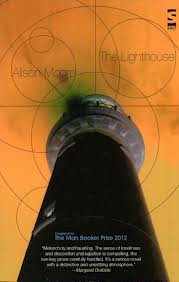
lighthouse


I have two paperback copies and a kindle download. This gives you an idea of how much I enjoyed it. The doubling up of the paperbacks is down to a joyful discounted purchase of the Booker shortlisted books  in 2012. I have yet to read Wolf Hall.

The lighthouse caught, and held, my attention partly because of its sadness and for the emptiness of the main character. His life has fallen apart around him and he sets out on a journey, a walking trip to Germany. It is a journey that appears to mirror his own sense of a loss of direction. The abandonment of his mother, and the disappointment of his ex-wife and father, garner sympathy from the reader through Moore’s cleverly crafted narrative. A chilling and suspenseful read. So much emotion is conveyed through very scant explanation.

I have subsequently read her more recent short story collection, The Pre-War House and Other Stories. I reviewed the collection in previous post.

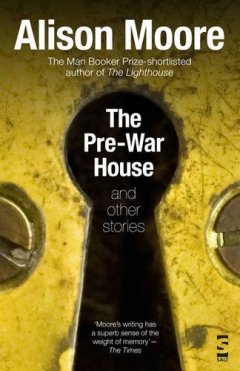
Book Review: The Pre-War House and Other Stories

50fac95bde404 (1)

I have eagerly awaited the publication of Alison Moore’s debut collection, The Pre-War House and Other Stories. As regular blog readers know, I am an advocate for short fiction and I read and write as much of it as time allows. It’s a real joy to be able to review this collection of short stories.  I was kindly given an advanced copy by Salt Publishing, for which I am very grateful. The Lighthouse, Moore’s debut novel, was shortlisted for the Man Booker Prize in 2012 and I read it in one sitting. I hoped for the same emotional tension, her attention to detail, and a surprising climax in her short stories, and this collection did not disappoint.

The short stories in Pre-War House are drawn from a selection of magazine and anthology publications over a period of twelve years, alongside new and recently published work. Moore’s stories have been shortlisted for more than a dozen different awards (see below) including the Frank O’Connor International Short Story Award 2013 for this collection.

The stories are evocative and often sinister, honing in on the details of everyday life with extraordinary insight into human nature and the many fears, often unspoken. Moore has a great sense of control over her prose, her language is understated and therein lies the power of her writing. She uses words which evoke a sense danger, of loss or unease.

I had previously read When the Door Closed, It Was Dark, and reading it again provided the same sense of threat and menace through the tightly written sentences as they wound their way towards an uneasy ending. There is something inherently satisfying in reading a story of this quality which makes you catch your breath as you turn the pages.

Overnight Stop left me gripping my seat as I read in disbelief. The plot lends itself to a novel length prose and this is no mean feat for a short story. This piece is a perfect example of Moore’s ability to play with your emotions and draw you in to the scene with frightening reality.

Seclusion lulls you into a false sense of security before packing a punch towards the end. The insight into one life is portrayed with telescopic accuracy.

Sleeping Under the Stars brings in details of Stargazy Pie, Liqourice laces and kirby grips with a layered story of the difficulties of fractured families. The ‘goosepimpled arms’ give a sense of foreboding, and words such as ‘queezy’ and ‘sickening’ provide a parallel for the emotional distress involved in the story.

Many of the themes centre around family, relationships, loss, and uncertainty. Some of the stories create a sense of claustrophobia as the characters become trapped in situations beyond their control. Each piece has its own unique style but the thread weaving through the collection is an intangible sense of anticipation. It is a delicious read and, having read some of the stories a few times, it is something I will keep going back to. A remarkable debut collection which comes highly recommended.

‘Overnight Stop’ (The Lampeter Review issue 7)
‘Sleeping Under the Stars’ (The Nottingham Short Story Anthology 2012)
‘A Small Window’ (The Warwick Review vol.6 no.4)
‘Jetsam’ (Ambit issue 211)
‘Seclusion’ (Paraxis volume 4)’If There’s Anything Left’ (The Yellow Room)
‘It Has Happened Before’ (Shadows & Tall Trees issue 4)
‘Trees in the Tarmac’ (The New Writer issue 112)
‘Sometimes You Think You Are Alone’ (The Screaming Book of Horror, 2012)
‘Small Animals’ (Nightjar Press, 2012)
‘The Yacht Man’ (The New Writer issue 111)
‘The Smell of the Slaughterhouse’ (The New Writer issue 111; Best British Short Stories 2013)
‘Glory Hole’ (The Lightship Anthology: 1)
‘The Egg’ (Murmurations: An Anthology of Uncanny Stories About Birds, 2011)
‘When the Door Closed, It Was Dark’ (Nightjar Press, 2010; Best British Short Stories 2011)
‘The Pre-War House’ (The New Writer issue 103)
‘Static’ (Manchester Fiction Prize 2009)
‘Monsoon Puddles’ (Quality Women’s Fiction issue 43)
‘Helicopter Jean’ (The New Writer issue 53)
‘Wink, Wink’ (Creative Writers’ Network magazine)
‘Humming and Pinging’ (Marches Literary Prize anthology 2000) 

Hemmingway’s Tip Of The Iceberg: Omit What the Reader Knows

iceberg3

If a writer of prose knows enough of what he is writing about he may omit things that he knows and the reader, if the writer is writing truly enough, will have a feeling of those things as strongly as though the writer had stated them. The dignity of movement of an ice-berg is due to only one-eighth of it being above water. A writer who omits things because he does not know them only makes hollow places in his writing.
—Ernest Hemingway in Death in the Afternoon[1

This quote from Hemmingway’s, Death in the Afternoon, is a timely reminder that most of what the reader picks up from a really good piece of prose is submerged. Writers sometimes go to great lengths to make sure that the reader understands every detail and assumes a lack of understanding. Writing can, in this instance, lose it’s subtlety and and crush the flow of the words. You can feel what a good writer is implying without the words actually reaching the page. A good book is charged with these undercurrents and the reader can dig down and grasp emotions and ideas which are never actually written.

To give an example, yesterday I read the Costa Short Story Award winner Avril Joy’s beautiful piece, Millie and Bird. I won’t give anything away but the key theme is always implied, never stated, and deftly written in the hands of a writer who knows her craft. Her story is both lyrical and compelling. Those of you who have been following know that I am currently immersed in short stories (both reading and writing) and I was particularly struck by this one. A well deserving winner, I would say.

Alison Moore’s, The Lighthouse, also follows a strong theme of rejection and loneliness without it ever being stated. The reader is swept away by the desperation of the protagonist’s situations in both his past and present.

I particularly like Hemmingway’s description of the dignity of an iceberg’s movement. Remembering that those critical seven eights of its mass are under water should serve as a warning not to push everything up to the surface or to write all the words into the frame of your picture.