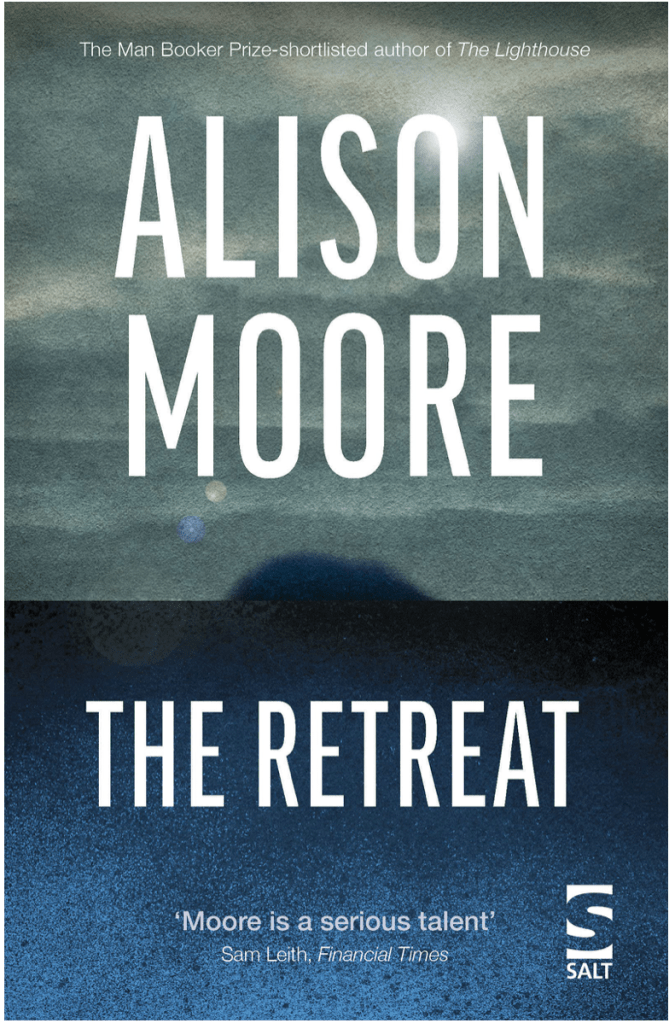

Review: The Retreat, Alison Moore

SALT Publishing, 2021

Since childhood, Sandra Peters has been fascinated by the small, private island of Lieloh, home to the reclusive silent-film star Valerie Swanson. Having dreamed of going to art college, Sandra is now in her forties and working as a receptionist, but she still harbours artistic ambitions. When she sees an advert for a two-week artists’ retreat on Lieloh, Sandra sets out on what might be a life-changing journey. 

Since reading Alison Moore’s Man Booker shortlisted novel, The Lighthouse, and subsequently her collection, The Pre-War House and Other Stories, her work has drawn me in with its tight prose and an unnerving sense of foreboding. She has a gift for honing in on fine detail, memory and doubt, creating a sinister unease. There is tension even in the simplest of details and a layered story, where realities shift and doubt creeps in. An other worldliness fills her writing in a way that leaves you questioning and searching for what might be and what might not.

“Sandra wants to be inspired, just like Angie was inspired by the chapel and wrote that poem that everyone said was beautiful. She wants to paint something that she can be proud of, something the others will admire, something she could bear to hand on a wall.”

A sense of isolation is created so well in the mind of Sandra, a thread that runs through many of her characters and books. In The Retreat, this is thrown into the fore as the chapters alternate between what is going on in the mind of Sandra against a narrative that weaves in the actions of the other characters, some of whom the reader will begin to detest. She writes with subtlety, each sentence punching with the weight of a skilled storyteller.

“Carol had understood that the students had arranged to shoot the whole film on the island, sleeping in the house, which had running water and electricity and so on – but something had not worked out, although Carol is not clear what that something was.”

As the chapters shift between Carol, who is alone in a seemingly haunted house on another island and trying to write a novel, and Sandra, who becomes increasingly ostracised by the other artists in the sparse house that they are staying in for an artists’ retreat, many of Carol and Sandra’s thoughts repeat and expand, reflecting the minds of introverts that Moore cleverly creates. You feel an increasing sense of disconnect and longing in Sandra, as she walks to a spot each day to paint the island where Carol is staying, at one point finding someone else in her spot. You expect, and almost hope, the two will meet.

“She wonders what the hell she is doing here, naked at night on the rocks; she is no longer sure that she wants to jump, but she is here now, and she will do it.”

So much of the power of this novella lies in the details: the missing glove, the disregard of Sandra’s needs by her fellow artists, the sounds that Carol hears in the night, the misplaced objects in both of their realities. It’s a gripping book that I read in one sitting on the day that it arrived! Moore creates something that leaves you trying to grasp what is just out of reach. The weight of the story will resonate with you far beyond the end of the pages.

Alison Moore’s short stories have been published in various magazines, journals and anthologies, including Best British Short Stories and Best British Horror, and broadcast on BBC Radio. The title story of her first collection, The Pre-War House, won the New Writer Novella Prize; her second collection, Eastmouth and Other Stories, will be published in autumn 2022.

Her first novel, The Lighthouse, was shortlisted for the Man Booker Prize and the National Book Awards, winning the McKitterick Prize. Both The Lighthouse and her second novel, He Wants, were Observer Books of the Year. She recently published her fifth novel, The Retreat, and a trilogy for children, beginning with Sunny and the Ghosts.

Born in Manchester in 1971, she lives in a village on the Leicestershire-Nottinghamshire border with her husband, son and cat. She is an honorary lecturer in the School of English at the University of Nottingham and a member of the National Association of Writers in Education.

Find her at https://www.alison-moore.com

I’ve Joined the Linen Press Family

I’m thrilled to be able to share the news that I’ve been signed by Linen Press, who I really respect and admire. We are looking forward to releasing my second novel, a psychological thriller about the art underworld, in early 2023.

“Linen Press is a small, independent publisher run by women, for women. We are now the only indie women’s press in the UK.

Our bar of exceptional writing is raised with each new publication and I’m fiercely proud of our talented authors.

Our policy is to encourage and promote women writers and to give voice to a wide range of perspectives and themes that are relevant to women. We display and rejoice in the differences in female creative voices.

We publish books that are diverse, challenging, and surprising. The collective background of our writers is a multi-coloured patchwork of cultures, countries, ages and writing styles.”

Established 2005  •  Finalist 2015 Women In Publishing Pandora award  •  Shortlisted 2019 Most Innovative Publisher Saboteur Awards.

Questions From New Writers

I met an aspiring write yesterday, who asked lots of questions about the craft of writing, and wondered whether beginning a novel was a viable option after quitting a high-flying city job. I remember asking similar questions, back in 2007, when I moved abroad and gave up a teaching job that I loved. Moving from London to Vienna stirred up all sorts of ideas in my mind and, as I said to the person yesterday, there is something about moving to a different place, and living in a different culture, that somehow frees your mind and inspires lots of creative ideas. There are lots of questions from the writing community on Twitter today and, if you follow the hashtag #WritingCommunity, you’ll see many of these. There are so many questions and so many good books to you to get you started, and to help hone your craft.

  1. My first piece of advice to anyone wanting to begin writing is to read widely, both within and outside your genre, especially outside your genre – it’s easy to just focus on what you want to write – and read as much as you write, spend as much time reading as you do writing.
  2. Read as many books on the craft of writing that you can get your hands on. Find your local library, as there are lots of useful books that you can borrow. You don’t need to buy them all, or do a book swap with another writer. I’ll add some of the books that I’ve found helpful at the end of the post. It’s by no means an exhaustive list.
  3. Sign up for writing courses. The Avon Foundation have lots of wonderful writing courses and many authors offer course, as well. Learn as much as you can.
  4. Don’t be afraid to experiment. You may be fiction writer – a poet, a novelist or a short story writer – or you might prefer creative non-fiction writing (memoir, autobiography/biography, essays, literary journalism, journaling, or topics like food or travel writing, self-development, art or history). Within fiction there are so many genres; read as widely as you can.
  5. Don’t give up. You will have hard days were you want to quit. It will get hard. If writing was easy, there would be many more authors with published work. Even the most gifted writers hit a wall at some point. Push through it.
  6. Set yourself targets, if this works for you. When I began, I sat down to write from 9am – 6pm (with breaks) and gave myself 3 months to get around 35,000 down on paper. After this length of time, I would assess whether or not I had enough to continue and a good enough story to write a whole novel. It worked, I kept going, and I finally finished my first book.
  7. Find a writing partner or a writing group. If you can’t, or it doesn’t suit you, tap into the writing community online. Twitter is a good place to start and will be really helpful, in terms of keeping up to speed with the industry. It’s a great way of networking, finding support, and following publishing trends. I have been contacted by authors, readers, editors, agents and publishers this way. It’s invaluable.

These are some of the books that have helped me along the way, although, Meander, Spiral, Explode is a new acquisition, so I’ll write a review when I’ve read it. Which books have helped you? Can you recommend any others?

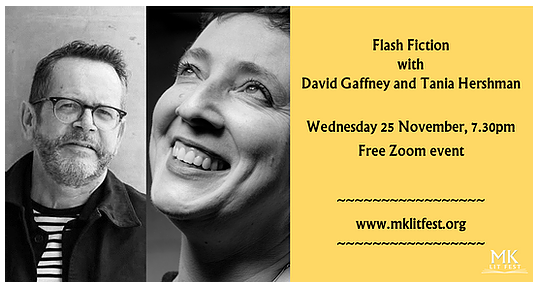
Flash Fiction Evening with David Gaffney and Tania Hershman

The Milton Keynes Literary Festival moved online this year, with a series of events for their autumn program, which culminated in a wonderful evening of flash fiction readings from David Gaffney and Tania Hershman and a Q&A session of questions from participants. Most, not easy to answer, but, as Tania mentioned, there are no rules. We talked about what flash fiction is, or what it might be, and about permission to leave things out, to be daring.

It was good to see familiar faces, and meet new ones. David Gaffney swept us up into the world of his clever graphic novel, The Three Rooms in Valerie’s Head, which began as a performance, based on several of his micro-fictions, and is the title of one of my favourite stories in his collection, More Sawn-Off Tales. In amongst this brilliant collection of 150 word stories, The Three Rooms in Valerie’s Head describes the men she hides in the cellar. “Sometimes she would bring three of four ex-boyfriends up from the cellar and arrange them into scenes – a trad-jazz band, or a dispute around a pool table – and she would move their jaws and make them speak in scratchy voices.” He draws us into the world of Valerie’s life of inept lovers and weird obsessions.

Thought-provoking lines from Everything’s West Of Something began, mid-action, with a vase flying through the air. “You can discover everything about your girlfriend by tossing a breakable object towards her.  Is she poised? Confident in her judgements? Does she seem willing to take responsibility for someone else’s actions? Is she comfortable with spontaneity? What is her attitude to risk, debt, transgression, sin, guilt? How does she experience the passing of time? Does she appear to believe in an afterlife? An interventionist god? Ghosts, fate, predestination?”

All Mod Cons was another wonderful reading, about Jake, who “invented a prescription glass windscreen for his car so that he could drive without wearing his corrective lenses. He enjoyed the feeling of freedom – no plastic pads digging into his nose – and it had the added advantage that car thieves couldn’t drive the vehicle unless they happened to have the same degree of myopia.”

We discovered the way that stories formed as he listened and observed details of every day life, with Potato Smiles evolving from an overheard conversation between a couple, where the woman had inadvertently been looking at the children’s menu, had never heard of potato smiles, and ended up ordering them with her steak! These are the nuggets of information that listeners savour, the moments that fuel and form a story.

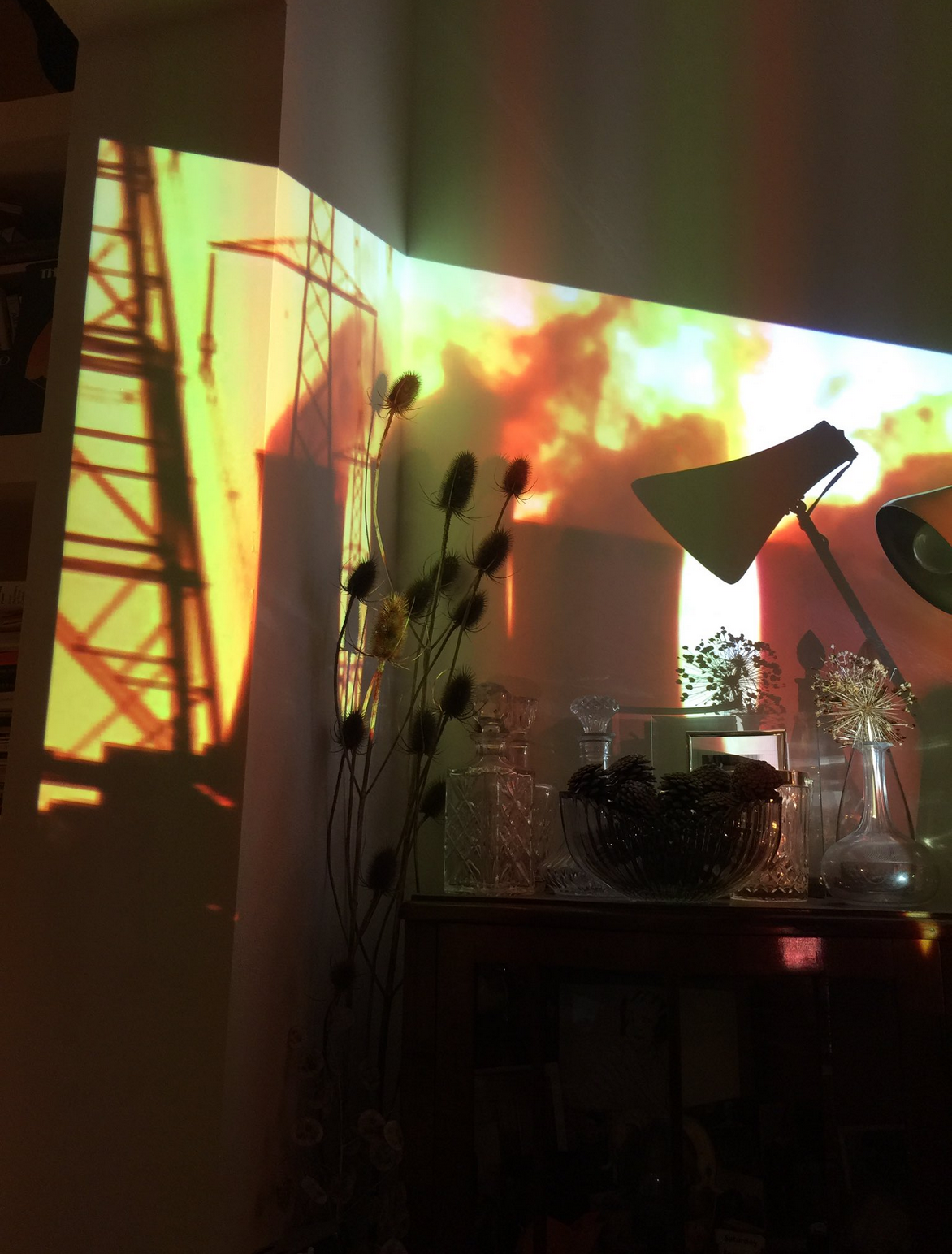
He talked about inspiration drawn from Lydia Davis’ writing as a short story author. As he read a 150-word flash fiction piece about Eggborough Power Station, a slide show was projected on to the wall behind. This was a work of art in itself. The stories were varied, and, as always, utterly captivating. You can find David’s books at Salt and elsewhere.

Photo credit: Sarah-Clare Conlon

Tania Hershman treated us to readings from her collections, The White Road and Other Stories, My Mother Was an Upright Piano and Some of Us Glow More Than Others, as well as stories from many other places. She has an almost hypnotic style of reading, drawing you into a scene and holding you there, momentarily. Listen to her read a selection of work on SoundCloud. Her writing, often based on Science, is bold, quirky and gives a brutally honest insight into human nature and nature itself. Tania’s Science Journalism background, along with a Writer in Residence year in a lab, feeds into every fibre of her writing. She read two of my favourite stories:

Vegetable Mineral took us into some snappy and insightful dialogue, keeping us hooked to the end. “When you came back with the post, you held the letters out to me as if the red ink would burn through you like acid. ‘Let’s run away,’ I said. ‘Barbados, Brighton, Bermuda, Brooklyn.’ ‘Only B’s?’ you said, and slumped onto the couch. ‘Today is brought to you by the letter B,’ I said. ‘Animal,’ you said. ‘Domesticated?’ I said as I shoved the bills down the back of the armchair.’”

How to be Here, took us on a journey to a riverbank. “Hover, over exactly that spot on the river, half way between the locks and listen. After an hour, century or minute, land on this bank, wait, in long grasses and inhale.” Tania’s stories leave you clasping hold of the final few words, willing them to stay and tell you more. You can find Tania’s books on her page at Bookshop.org.

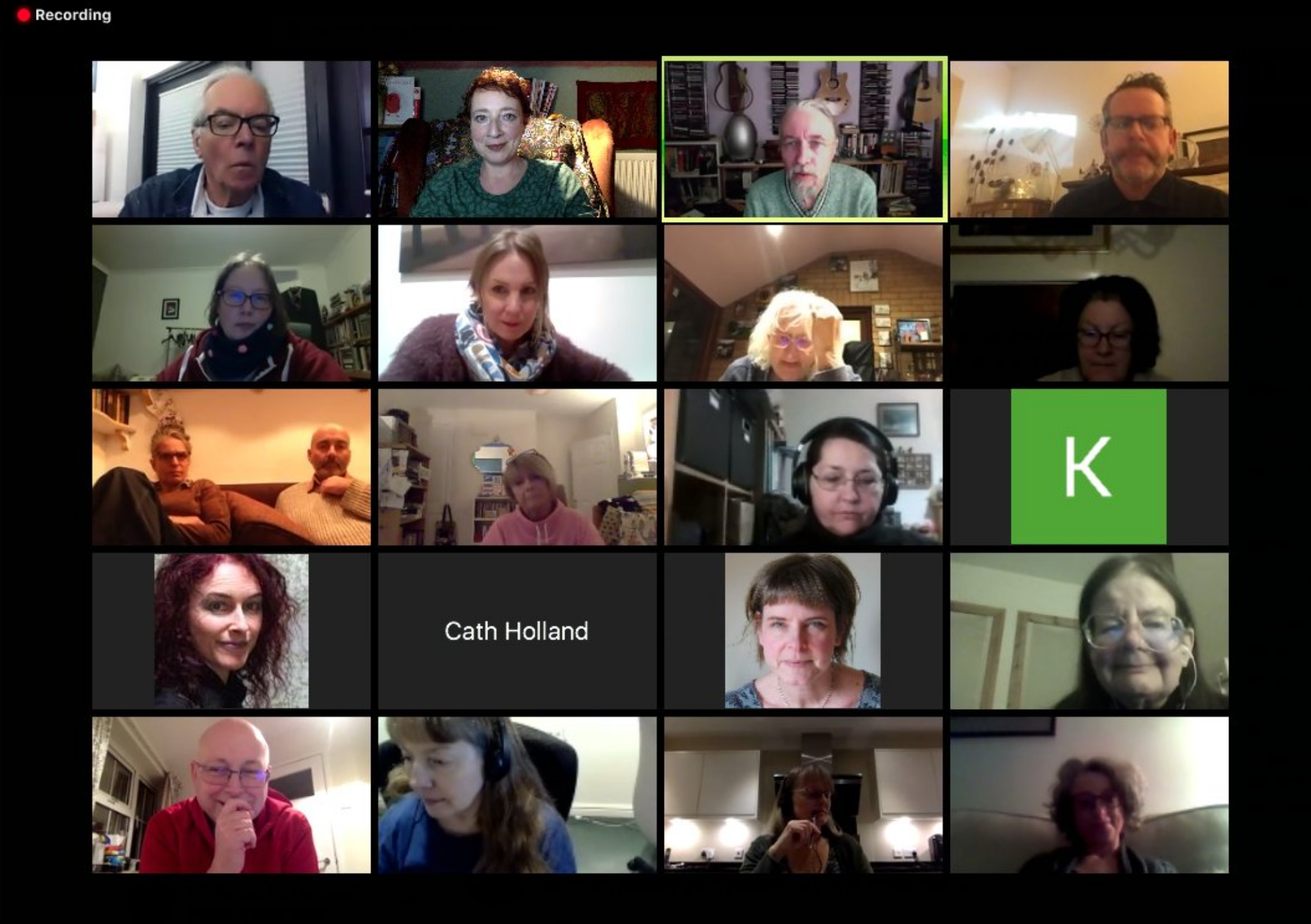
Sipping from an enviably beautiful cup, Tania answered questions about story length and how to balance narrative with dialogue. She talked about a 800 word story, which took two and a half years to write, and when asked about story length, we learned that David has been asked by editors to expand his work at times, whereas Tania often cuts down her writing, culling the words and reforming a story. Both talked about the feel and shape of a story, and felt that no two writers work the same way, and no two stories are created by any specific process. She discussed her hybrid writing, the freedom of form, and the idea of losing labels. We talked about the importance of permission to be freer with what you write, to take risks.

Photo credit: Tania Hershman

I have, by no means, covered all the stories we heard, but I hope this gives a flavour of the evening. A recording of the session will be available on YouTube within the next few weeks and I’ll add a link here for you to watch. Thank you to the Milton Keynes Literary festival for organising this event, and to Dave Wakely for chairing. Next time, we’ll all bring cake!

Author Interview with Vineetha Mokkil

  1. Who or what inspired you to write short stories and when did you begin writing?

All the writers I read and digested inspired me to write. I was a voracious reader as a child. I started writing when I was in middle school. Some of those stories were written for competitions held at school and some stayed on the pages of my notebooks. I’ve loved books ever since I can remember. Reading stories was such a pleasure and a fascinating voyage of discovery—of other lives and worlds—and I couldn’t resist the temptation of trying my hand at writing them. I was enthralled as a reader and I wanted to see if I could write stories to recreate that immersive and magical experience for my readers.

  1. How has living in various places – New York, Delhi and Taos affected your writing? Do you think travel helps to inspire your work?

Every place I’ve lived in or visited shapes my writing in particular ways. The energy of a place—inspiring, soothing, manic or comatose—rubs off on me. The essence of a place stays in my heart long after I say goodbye. The people I meet and the stories they tell, the sights, sounds, skies, and hidden histories of a place all spark my fiction. Travel is inextricably linked to my process. New places jumpstart my imagination. The memories they gift me are fertile ground for stories to germinate.

  1. Do you create a structure for your stories before you begin or are they more fluid?

I tend to write short stories and flash fiction in a fluid way. I have a basic idea of the flow of the story, but it’s not strictly structured before I begin. Whereas with my novel, which I’m currently working on, I found that I had to create a solid structure before I started.

  1. What advice would you give to writers wanting to submit work to literary journals?

Get your story into the best shape possible. Rewrite, refine, edit and polish vigorously before you submit. Keep at it inspite of rejections. Appreciate the feedback editors give you and incorporate it into your work. Acceptances will eventually come your way.

  1. How has winning writing competitions affected your journey as an author?

Writing competitions come with strict deadlines and they force me to sit down at my desk and finish a story on time. Competitions make me a more disciplined writer in this sense. Winning a competition makes me feel my hard work is being appreciated. That’s a wonderful boost for a writer. It gives you reason to believe in yourself and your art and to carry on writing in a world which is largely indifferent to creative endeavours.

  1. Can you tell us about your collection, A Happy Place, and your route to publication with Harper Collins?

I didn’t start out with a collection in mind. The stories were written one at a time. The title story was published in the Santa Fe Writers’ Project Journal. My eternal gratitude to the editors for that acceptance! Then, a few more of my stories got published in literary journals and magazines, and that gave me the confidence to consider putting together a collection. Once I had enough stories, the hunt for an agent started. It was not easy. Some agents loved my writing, but they were running scared of taking on short stories. It took a lot of effort and patience to find an agent who believed in the collection’s possibilities. She sent it out to several publishers and I was thrilled when HarperCollins said yes to it.

  1. Who are your favourite short story authors?

It’s a long list. To name a few: Chekhov, O. Henry, TC Boyle, Anita Desai, Lucia Berlin, Anne Enright, EL Doctorow, Akil Kumarasamy, Chimamanda Adichie, KJ Orr, Deborah Eisenberg.

  1. What do you think is the essence of a good piece of short fiction?

Telling detail, tension, humour, nuance, startling imagery, and the ability to make a word resonate in different registers at the same time.

  1. What are you currently reading and which book would you take to a desert island, and why?

I am currently devoting all my time to working on my novel, though it’s a tough challenge to resist the call of my very attractive to-read pile. The last book I read and was bowled over by was The Friend by Sigrid Nunez, an incredibly perceptive and well-written novel about friendship, loyalty, loss, and grief. My desert island pick would be Michael Ondaatje’s The English Patient. The copy I own is falling apart because I’ve re-read it so many times. This novel surprises me every time I read it. It is so lyrical, insightful, wise, and immense in scope—I’d be delighted to be marooned on an island with it.

 Vineetha Mokkil is the author of the short story collection, A Happy Place and other stories (HarperCollins), which was listed as one of the Ten Best Works of Fiction by The Telegraph. She was shortlisted for the Bath Flash Award June 2018, shortlisted for the Desi Writers Lounge Short Story Contest 2018, and is the winner of the New Asian Writing Short Story Competition 2018. She was a nominee for Best Small Fictions 2019. Her fiction has appeared in Barren, Cosmonauts Avenue, Fictive Dream, The Best Asian Short Stories 2018 (Kitaab, Singapore), GravelJellyfish Review, Quarterly Literary Review Singapore and chosen for the Longform fiction pick-of-the-week.

You can find Vineetha on Twitter @VineethaMokkil and her books on her Amazon author page