If The World Stopped Reading I Would Still Be Writing

Waterfall in the Rosenlaui ravine (Switzerland...
Waterfall in the Rosenlaui ravine (Switzerland) Français : Une cascade dans le ravin de Rosenlaui, en Suisse. (Photo credit: Wikipedia)

I hear many authors complain of time constraints, low income from books, isolation from a workplace or other people, writer’s block and many other issues and, while I understand these, I also want to scratch my head and ask whether writing is the best use of their time. Writing IS hard and it IS time consuming but here’s the truth: If the world stopped reading I would still be writing.

If people no longer read books, my fingers would continue to hover over the keyboard each morning in quiet anticipation, waiting to tap out new sentences and create different worlds. I wrote travel diaries and poetry long before I began to write my first novel. I didn’t write for people to read these, and I hope they never will, I wrote for my own pleasure.

I love writing. My mind is constantly churning over ideas, my eyes and ears observing the small details of each day, absorbing conversations and snatched moments of intimacy between other people: a hand on a shoulder, a kind expression, an angry response. All of life and its rich experiences feed into my subconscious to be unearthed when required.

I store up a bank of thoughts and ideas continually. They may come from a painting or a rock concert, a quiet conversation or a crowded street, a film or from the strings of a violin in an orchestra, an early sunrise or a pain-filled conversation. These experiences shape me but they also shape my writing. We are influenced by what we read but much more so by first-hand experiences. Much of my writing has been fueled by travel to foreign lands and I currently live abroad. The richness of different cultures has expanded my vision of life and people. My words are fueled by the relationships I have and by the chance encounters and words from the lips of strangers.

I need to write because it is how I find meaning in life. It helps me to communicate on a much deeper level than any spoken word. I love the nature and impact of words and the way sentences can repel and attract; reel a reader in and push them back. I get a thrill from the details of a scene or from a wild response from a character. I inhabit the minds of other characters with the buzz of a homicide detective close to finding the perpetrator of a crime. I feel the emotions of injustice, loss, elation, fear and longing, all through the mind of a fictional character placed in an unstable situation.

The ability to change a person’s mind or to open them up to a new world or a new thought is unmatched, other than through a work of fiction. I know that there can be dry periods and difficulties with a plot or in editing a manuscript, but these are my overriding thoughts on the craft of putting words to paper. I understand that there are times when you want to give up or if you wonder what you are doing or whether the path will lead you into brambles or into a deep ravine. This is often temporary and it is important for me to focus on the positives and on the reasons for writing in the first instance. The privilege of hearing a reader say that they loved your story and couldn’t put the book down is wonderful, but the truth is, even without it I would keep writing.

So When Are You Going To Write A Proper Book, Then?

I am pleased to welcome the Director of National Flash Fiction Day, Calum Kerr, for a guest post on the short fiction form. His new collection, Lost Property, brings together four brand new pamphlets of flash fiction, featuring Singsong, Soaring, Burning and Citadel. The collection contains 83 stories that move from the hilarious to the sinister and demonstrates the unique nature of ultra-short fiction.
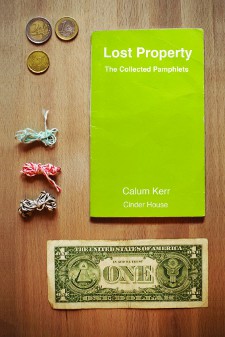
lostpropertyfrontsm

If you are a writer of flash-fiction, short-stories, possibly poetry and maybe even non-fiction, this is a question which may be familiar to you. The person posing the question might be a complete stranger, maybe at some reading or signing event, but is more likely to be a friend or even a relative. You proudly show them your collection of stories or poems, or your book on how to knit cartoon characters, learn economics or install a Linux system on your PC, and they glance through it, nod appreciatively, and then they work their way towards the question.

“So. Well done. This looks good, doesn’t it?” is the opening move.

“Yes. I’m very pleased with it. I think it’s come out very nicely,” is your response.

“Must have been a lot of work.”

“Yes. But enjoyable. Apart from the editing, ha ha…”

“Ha ha, yes.” They nod and look through the book again, then up at you. “So…” they start, and this is where you should stop them, because you know what’s coming next.

“It is a proper book. It has a cover. It has loads of words in it. I did research and everything. People will buy and read it – okay, not in JK Rowling numbers, maybe, but some of them. It has an ISBN number and can be bought from Amazon and those funny old places that people used to go into. You know, bookshops.” Is what you want to say. But you don’t. Instead you let them continue.

“So… when are you going to write a proper book, then?” they ask, and you somehow restrain yourself from swinging for them.

Because, of course, they don’t mean to say that your collection or non-fiction opus is not a ‘proper’ book. They mean ‘when are you going to write a novel’. That’s what it’s all about, after all, isn’t it? Collections of things are nice, but they’re just little stories or poems, not a good chunky page-turner. Non-fiction books are useful, but you don’t settle down on the sofa on an autumnal afternoon to read them. They live on shelves until you have occasion to reach for them. No, they’re talking about the All-Powerful Novel and the place it holds in the public imagination as the pinnacle of writing and the thing that every writer is surely aiming for.

And this is the problem for writers, especially of flash-fiction or short stories. Because each of the small parts looks inconsequential; trivial. There might be many of them, and they might make up a 200 page collection containing 60-70,000 words, but still, you can see the joins; you can see where the writer started and stopped. Not like the seamless flow of a novel (which was surely written in a single, sleepless week of endless typing). And, of course, you are writing prose fiction, so surely you must be working your way up from these little things to try and join the big boys with their ‘proper’ books.

Now, don’t get me wrong, many flash-fiction and short story writers do have aspirations to be novelists, or at least have found an idea coming to them which is too big to cover in just a few hundred or few thousand words, and so are working towards a much longer piece. But that does not mean that they have finally, in some indefinable way, graduated to the big leagues. They have not left behind their childish play with those tiny tales and taken the brave step to write longer. They are simply following their muse where it takes them, and sometimes your muse takes you longer.

But all of those same flash-fiction and short story writers who are dabbling in the world of novels, at least those I know, still love and respect the short form. They are not what we write because we can’t manage the long things. They are the things we write because there is a value to a short story or a flash-fiction, an intensity, a chance at experimentation, and a specific purpose that you simply can’t achieve in the novel.

We don’t write stories because we are waiting for our turn to write a ‘proper’ book. We write stories because they need to be written, and because we love what they can do that all of your ‘proper’ books can’t.

So next time someone looks at your collection of flashes, poems, or your non-fiction work and seems about to ask that fateful question, stop them, point to the cover and ask them: “So, when are you going to read a proper book, then?”

calum-200x180   Calum Kerr is a writer, editor, lecturer and director of National Flash-Fiction Day in the UK. He lives in Southampton with his wife – the writer, Kath Kerr – their son and a menagerie of animals. His new collection of flash-fictions, Lost Property, is now available from Amazon, or direct from the publisher, Cinder House.
The Influence of Film on Writing

The impact of art and film on my writing is, in part, due to the fact that I am a visual person, and when I write I imagine every scene as a film shot or a photographic image. Creativity fuels ideas and triggers thoughts which help me to write. See posts on Writing, Art and Outlining and follow the links at the end of this post. Some of my free time (which, as is the case for many of you, is limited)  is spent in galleries or watching films. I love the big screen effect and recently enjoyed The Great Gatsby in 3D, but I also regularly download films from iTunes to watch when I can.  I used to go to as many exhibitions as I could in London and in Vienna I go to both photographic and art exhibitions from time to time.

I wanted to write about the influence of film on writing because I believe it is important to look at mediums other than books, which affect the way we think and develop ideas. I have a Pinterest board with my music and film influences if you are interested but I wanted to touch on two films, in particular, that have had a lasting impact on me, both of which cover themes that now run through much of my work: The Lives of Others and Rabbit-proof Fence.

The Lives of Others:

This film is a beautifully crafted story written by a debut German filmmaker set in 1984 East Germany. Released in March 2006, it garnered a record breaking 11 award nominations, including a Golden Globe nomination for Best Foreign Language Film. The plot revolves round the monitoring of East Berlin by secret agents during the communist era of the Eastern Bloc. Although fiction, it is a chilling account of the intricacies of spy techniques used at the time and the destruction of trust and relationships. I watched this whilst writing about the effects of communism on the Czech Republic in my debut novel. The film gave me the impetus to keep going and helped me to create the sense of distrust and destruction within every day lives and relationships. It is a film that will stay with me for a long time to come. Its power lies in the detail and the clever plot twist towards the end. It leaves you with a sense of hope that, despite dire human circumstances, there is an inherent good to be found in ordinary people.

Rabbit-proof Fence:

This film is set in 1931 and is based on the true story of an author’s mother in the book, Follow the Rabbit-proof Fence, covering events of  ‘the forgotten generation’ of Aboriginal children in Australia. Released in 2002, the film follows three girls who have been ripped apart from their mother by authorities and taken to the Moor River Native Settlement. They escape and walk for nine weeks along 1,500 miles of the rabbit-proof fence, the longest in the world, to return to their community in Jigalong. A tracker is sent after them and tension runs high as they try to cover their tracks and throw the tracker off scent. The impact of this film lies in the separation of the children from their families and the injustice of their removal. What struck me was the endurance and tenacity of the children, their ability to remain untraced and to keep going as they trek through some of the most barren landscape. Peter Gabriel’s soundtrack adds to the impact and the heart-rending scenes along the way. I have added the long and the short trailers. The longer trailer is much better, but if you are pressed for time at least watch the second shorter one. It really is one not to be missed.

Both of these films, and many more, have influenced my writing in ways that are both seen and unseen. Themes of dislocation, injustice and separation run through the films and through many of my short stories, as well as the novel and my current work in progress. The impact of film on your writing, if you allow it, can be immense, giving you new perspectives on themes, plot, characters and, at a deeper level, on the difficulties in the lives of people in different situations, highlighting what the human spirit can achieve to overcome adversity. That, I believe, is the very essence of a good story. Both of these films are based on true stories or historical situations, but films of all genres can influence your style of writing and your thought processes.

Here are a few links to articles I have written that have been inspired by art, music or film:

Argo: What We Can Learn From Film About Not Overwriting

5 Top Tips for Finding Inspiration

What Do Authors Have in Common with Orchestra Conductors?

I.P. Flash Fiction Piece

Here is my short fiction piece from the Flash Flood Journal

FRIDAY, 19 APRIL 2013
I.P. by F.C. Malby
The cardboard shielded his body from the shock of the pavement beneath his thighs. His trousers alone could not force out the early morning frost. Joe could see his breath disappearing into the daylight with the traffic and the bustle of people, all with places to reach, jobs to begin; lives filled with family, and co-workers. He filled his life with these once. Now it was full of strangers in the street, bodies sleeping on old bits of packaging. Discarded.

She always walked across the street from the bank, eyes focused on the coffee shop behind him. He waited for anyone to notice his hat between his toes – upturned, hopeful.

‘Joe,’ she said as she reached him, ‘can I get you a coffee?’

‘I’ve had one. Thanks.’

She leaned in towards him – her hair curled in bronze spirals, her suit pressed and the brightest of reds – and quietly placed some notes into the hat. Small coins usually clinked as they landed but she gave him notes.

It wasn’t the fresh pressed suits, or the bronzed locks, or the fact that she gave him money that made an impression. She made eye contact. She always offered him coffee. He said no.

As she turned to open the glass panelled door, her bracelet dropped onto the cardboard beneath him, nestling into the crinkled edges like a baby bird sheltering from a storm. He lifted it up but she was gone. In the next few moments the door became jammed open with the force of large numbers of suits either pushing in to the shop for a hot shot of caffeine, or trying to escape with an un-spilled cup. Fish swimming upstream.

Joe looked down at the bracelet, now shimmering in his hand. The initials, I.P., caught the light: Isabel Parker. He remembered his mother’s bracelet because his father had tucked it away into a handkerchief, deep into the recesses of his bedside drawer, and he remembered the look on his mother’s face when he gave it to her, wrapped in red ribbon neatly circling a black box with the silver embossed swirls of a jeweller’s finest.

Isabel Parker didn’t recognise him each morning when she leaned in to give him some notes, and why would she? Separated from each other when they lost their parents, Joe remembers the journey to his new home with the sharpness of an icy dawn.

‘It’s for the best,’ a stranger in a suit had told him. ‘You’ll see your sister when you’re settled.’
He didn’t, not until the day when she first walked into the coffee shop. He had recognised her immediately but he couldn’t share his identity out of shame. Their lives had spiralled in different directions and time had passed. Seeing her each morning was enough.
She emerged from the commotion holding a gingerbread man and a shot of espresso. He handed her the bracelet. Leaning down towards him, she clasped his hand, smiled, then turned away and vanished into the crowds.

FlashFlood Admin at 02:00
Share

1 comment:

Andy19 April 2013 12:56
Great! I love the feeling you create between the characters. I’ve had dealings with a few homeless people, and some of them are rough diamonds. One in particular said his father owned a number of casinos, but I reckon it was one of his ‘taller’ stories.

Writing, Art and Outlining

Nicholas by Rubens

       Rubens’ son, Nicholas, 1916.

          Elephant by Rembrandt

        Rembrandt’s Elephant, 1637.

I took the opportunity to see an exhibition at the Albertina Gallery in Vienna at the weekend. It is part of the Hofburg Palace and was built during the Hapsburg dynasty. The building itself is beautiful and the exhibitions are varied and interesting. While also viewing an exhibition of black and white landscape photos and an Impressionist exhibition, it was this temporary exhibition of Rubens and Rembrandt which caught my eye and got me thinking about outlining. 

I love art and can happily while away hours in galleries given the opportunity. I have painted a great deal in the past, but setting up a canvas and oils takes time and space so I haven’t painted for a while. These drawings are a collection of 170 pieces of Dutch art and were penned or (penciled) at over a period of time, but in the 1900s, drawing was becoming an art form in its own right, as opposed to being used as a preparation for larger paintings.

Outlining is an important part of the writing process and, as I wandered around the gallery gazing at the drawings, I was struck by the similarities between the two forms: Writing and Art.

Writing and Outlining

Many would argue that writing needs an outline, although not every writer works this way, and that it is an important part of the process of your work. I recently wrote a post on structure and plotting.

Outlining your work can be really helpful and speed up the process of novel writing, avoiding the need for major editing towards the end. An outline is a sketch, if you like, for the finished painting and an image of how your story will hang together, how it will look in the final stages, with its cover.

Art and Outlining

Although these sketches in the exhibition were mixture of both drawings in their entirety and preliminary sketches for a finished painting, I thought about how an outline is needed in both cases. If you look closely as many impressionist paintings, you will see the outline drawn or painted onto the canvas before the layers of oil paints are added with a brush or a pallet knife.

This process is similar to the layering effect of writing a book. You begin with the bare bones and the image in your mind, and then go back and add detail, scene setting, character idiosyncracies, plots twists and, in some cases, flashbacks.

The similarities between outlining in art and writing interweave in a way that clarified the process for me in writing.

Do you outline? If so, what are your methods and do you have a clear idea in your mind of where you are going? Can you see the finished picture?