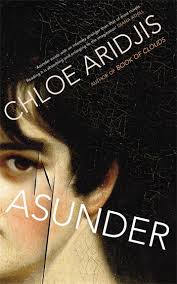
Asunder by Chloe Aridjis: A Review

download (1)

I was recommended this book by a friend and am so grateful to have read it. The rich language and the palpable tension in the narrative kept me turning the pages in one sitting until I reluctantly reached the end. It is a book I will go back to and reread at some stage. The similarity with what I am currently writing was also striking, so the read was timely.

“They call us guards, warders, invigilators, room keepers, gallery assistants. We are watchmen, sentinels, but we don’t polish guns, shoes or egos. We are custodians of a national treasure, a treasure beyond value stored behind eight Corinthian columns of a neoclassical façade, the dreams of the ancients stuccoed to our building.”

Marie’s job as a museum guard at the National Gallery in London offers her the life she always wanted, one of invisibility and quiet contemplation. But amid the hushed corridors of the Gallery surge currents of history and violence, paintings whose power belie their own fragility. There also lingers the legacy of her great-grandfather Ted, the warder who slipped and fell moments before reaching the suffragette Mary Richardson as she took a blade to one of the gallery’s masterpieces on the eve of the First World War.

After nine years there, Marie begins to feel the tug of restlessness. A decisive change comes in the form of a winter trip to Paris, where, with the arrival of an uninvited guest and an unexpected encounter, her carefully contained world is torn apart.

The book has a depth to it that pulled me in immediately. There is a magical darkness to her prose and the author’s descriptions and sharp eye for detail were compelling. It is powerfully and creatively written through the eyes of Marie, the museum guard. Her world and her insights into the people and places around her give you a sense of claustrophobia and of the parallels between the fragility of life and of the valuable paintings in the gallery. I have a particular interest in art and have spent many happy hours in various galleries around the world, so her research into the technical aspects of the topic were interesting.

A passage I really enjoyed describes the character’s feelings as she lies in a bed in Paris in the home of a couple who have recently separated and left the flat empty. There is a sense of the reader intruding on the intimacy of the the lives of the unknown couple:

“Yet almost immediately this darkness began to curdle into something viscous and heavy. As I lay in bed I began to speculate about the couple who’d slept in my spot for who knows how many years. I tried to imagine their faces, their bodies, their voices, whether they slept on their sides, stomachs or backs, whether intertwined or at separate ends of the bed, about whatever moments, fraught or transcendent, they’d lived out where I lay, what conversations, what passion or frustration. I began to worry I might inherit their dreams, that I’d find myself in ragged environments populated by ragged figures without knowing how to fend them off.”

There is something very abstract about Aridjis’ writing. She creates a world that is both surreal, yet very real. There is something of Nabakov in her style and she hones in on the idea of destruction and decay brilliantly, without overwriting.

This is an absolute must-read for anyone who enjoys literary fiction and the world of art. There is a strong psychological element to the story which gives it wide appeal. This book almost flew below the radar and I am so glad not to have missed it.
Interview with Strange Alliances

This is just a quick post to let you know that my interview with Elaine Aldred is over at her blog, Strange Alliances: F.C. Malby. Literally Engaged With Her Writing. We discuss my teaching experience in the Czech Republic just after the fall of communism, and various aspects of writing and publishing.

Many thanks to Elaine for taking the time to interview me. She is a wonderful support to writers and her backlist of author interviews is well worth the read. Do leave comments and feel free to ask any questions.


Short Story Writing

writing

I am in the thick of writing short stories and I really enjoy the punch that you can use to mould a high-impact piece of writing. Last night I read the new issue of Paraxis, a wonderful online publisher of short stories, and I was impressed by the range of prose delivered and the tension created in each short story. This current issue 04 is a publication of the works of both developing and established writers and the combination gels in a surprisingly smooth run of stories:

Seclusion

by Alison Moore

Looking out of Broken Windows
by Dan Powell

Saving Face
by Emma Seaman

The Rat-catcher
by Lorrie Hartshorn

Defacement
by Stuart Snelson

The House in the Woods
by Emily Cleaver

Dan Powell’s metaphorical cracked window panes were still on my mind this morning. The other stories had a similarly disturbing effect. Good writing, writing which lasts, leaves you feeling changed, it forces you to see the world through a different lens and nowhere more so than through a short piece of fiction.

My personal preference is for literary fiction, as that is what I immerse myself in when I read and write, but I was given Ian Rankin’s collection of short stories, Beggars Banquet, for Christmas. In a disturbing and gripping set of stories he covers stories of Edinburgh’s underworld to startling effect. It is important to read outside your genre and read widely, so my repertoire of books is expanding. There was an interesting review of Rankin’s collection on Amazon from a reader who does not usually read short stories who said it was like reading a whole novel in a short story.

This is the essence of the the short story. It should be a complete story in somewhere under 5,000 words. Many are a good deal shorter, but never lacking in impact, never leaving the reader wondering about the rest of the story, apart from to search for meaning and to think about where the characters have been and how they will be impacted by an event or a ending.

Fish Publishing, who publish anthologies of the works of international emerging writers and poets, describes the writing of short stories as being, ‘a glance at the miraculous. Joyce used a religious word. He called his stories ‘epiphanies’. A good short story is almost always about a moment of profound realization. Or a hint of that. A quiet bomb. There is a record by the American singer Tori Amos called Little Earthquakes. That’s a good metaphor for a short story. Often, a good short story will be a little earthquake.’

In an Introduction to the 1997 Fish Anthology, Dog Days & Other Stories,
Joseph O’Connor says this about the writers of this genre:

What kind of strange creature is a short story writer? I must confess that I don’t know. A high priest or priest of art? A wounded soul who can’t understand the real world and thus feels a need to re-invent it? A moralist? A Spinner of yarns? An entertainer? A prophet? Probably all of these things. Possibly none.

The single fact I can be sure about is this: writers are watchers. The one and only thing they have in common is an ability to look at the everyday world and be knocked out by it. Stopped in their tracks. Startled. Gobsmacked.

In an Introduction to the 2003 Fish Anthology, Feathers and Cigarettes & Other Stories, Pat McCabe quotes Frank O’Connor in saying that the form is as close as you could get to the lyric poem:

Henry Thoreau said that it didn’t have to be long but it would take a long while if you wanted to make it short. What was he saying this about? About the form we know as the ‘short story’. Everyone over the years has had something to say on the subject. For V S Pritchett it was an athletic form. If you got a good start you could sprint to the end, unlike the nineteenth-century novel. For Frank O’Connor, it was the closest you could get to the lyric poem, in that the novel requires far more logic and far more knowledge of circumstances, whereas a short story can have the sort of detachment from circumstances that lyric poetry has.

Katherine Ann Porter wrote her stories in one sitting. Or so she said. But then writers say all sorts of things. Another thing that was said about the form – and I think it’s a good one – can be attributed to William Trevor. That it’s the ‘art of the glimpse’. Meaning that if the novel is like an intricate Renaissance painting, the short story tends more towards impressionism. It is an explosion of truth and its strength ought to lie in what it leaves out as much as what it puts in, if not more.

As an aside – Just after I finished writing this post I discovered Charles May’s post on The Secret Life of the Short Story. In it, he discusses the work of  Alice Munro and William Trevor, two of the greatest short story writers in the world today. Munro has been compared to Chekhov. You can read a post on Chekhov’s short stories if you are interested.