
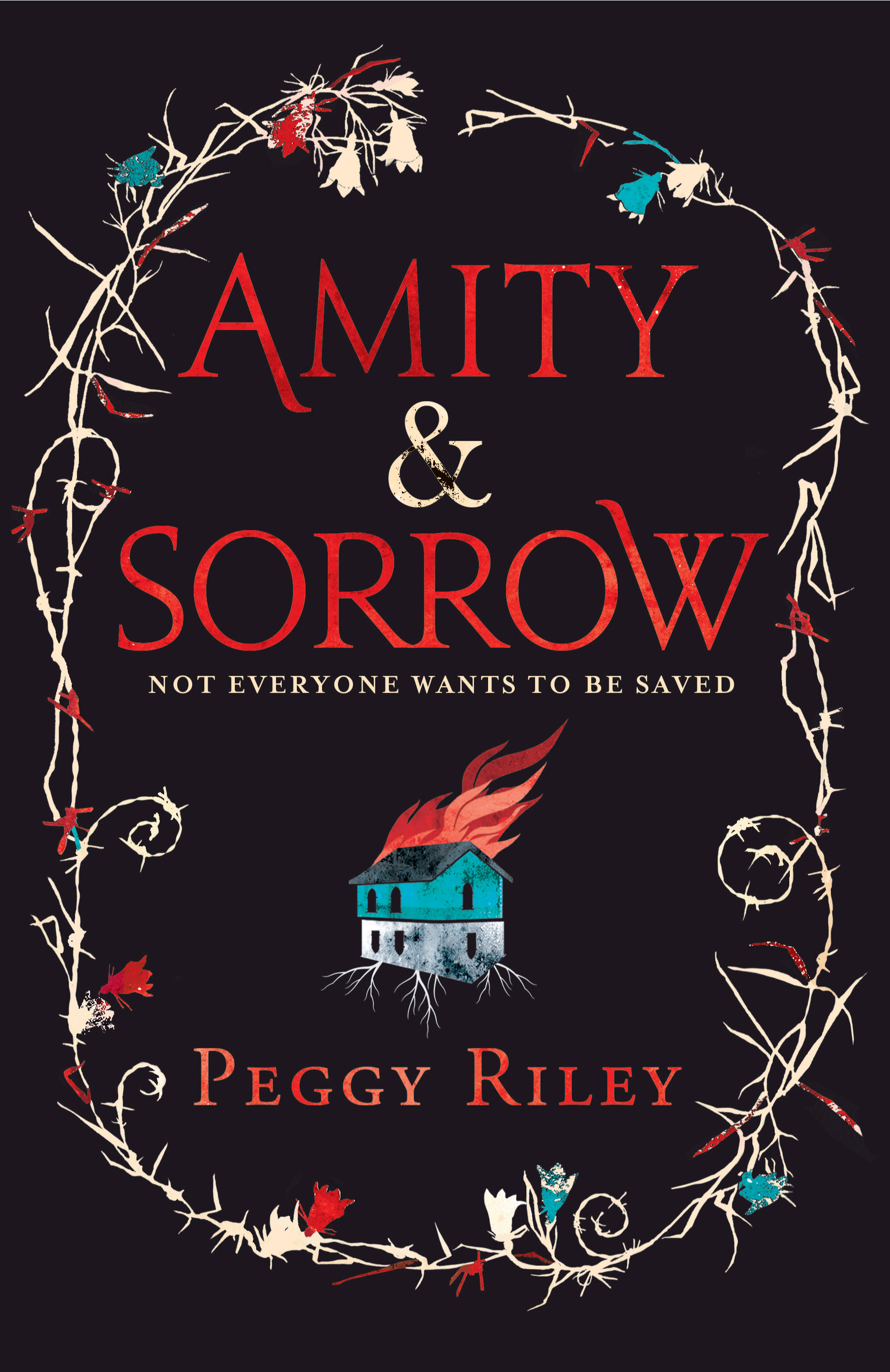
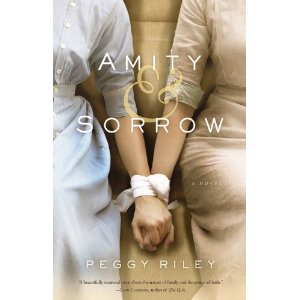
In the wake of a suspicious fire, Amaranth gathers her children and flees from the cult where her children were born and raised. Now she is on the run with no one but her barely-teenage daughters, Amity and Sorrow, neither of whom have ever seen the outside world, to help her. After four days of driving without sleep, Amaranth crashes the car, leaving the family stranded at a gas station, unsure of what to do next. Rescue comes in the unlikely form of a downtrodden farmer, a man who offers sanctuary when the women need it most.
I am currently reading this and I highly recommend Peggy’s novel for it’s rich language and high tension. It is an intriguing story which is beautifully written, never missing a single detail.
Your book, Amity and Sorrow, will be released on 28 March. How does it feel to let your first story go out into the world and what are your hopes for the reader?
I’ve been lucky in that Tinder Press has been sending galleys out for quite a while now, and Little, Brown offered 100 copies of the book on Goodreads. So, I’ve had plenty of feedback from readers, but I suppose they are the kinds of readers who are used to reading and feeding back. It feels exciting – and scary – to think of the book sitting in shops, spine to spine with all the other books. I would be very pleased if people saw it, picked it up and thought – hmm, that sounds good – and then took a chance on it.
Can you tell us about your planning stages of writing and how you put the ideas into a clear succession?
I don’t know if there is a clear succession! I start with place first, where the story will take place. Then I look at the arc of the book, to get a sense of “how long” the story will be, over how many days or months or years. Then I see what characters emerge from the place and the story and I spend a lot of time writing from their points of view to find out which ones I will follow most closely. You have to have the right character for the job! Chapters come from the characters’ choices, of what they need to accomplish to get them to the end of the story – which often turns out not to be the end of the story that will work for the character. I try to keep it all as open as possible, to see what comes. And then I rewrite, over and over. I’m a big rewriter.
You have said that, ‘There is only one way to write a book – your way.’ Can you tell us how your writing process differs from the books of advice that writers keep stacked away on their shelves?
I mean that advice is great, but it doesn’t do the writing. All these writing books – and I have a shelf of them, too – are great reminders of the complexity of the process, of how many balls we’re keeping in the air at different stages in the writing. They remind us that writing is a craft, that there are specific tools for specific jobs. They offer comfort at dark moments. But, ultimately, it’s just you and your own blank page. The choices you make, the impulses of your imagination, the itches your writing wants to scratch – that we have to find and discover for ourselves and to find our own methods, rather than making someone else’s try to fit.
Your writing covers themes of religion. Do you have any religious or spiritual influences which have fed into your writing?
I was not raised to be religious and I’m still not. But I am a spiritual querent, a seeker. I’m interested in how and why we believe, and my writing often goes in that direction. I’m interested in great believers and handmade faiths, in our impulse to change the world and build new Edens. I’m interested in how our own humanness gets in the way of our higher ideals.
You were a writer-in-residence at a young offender prison. It must have been an interesting time for you as a writer, can you tell us a little about your experiences with this and what you learned? What were the challenges and the high points?
It was the very best job and I am grateful to have had the support of the Arts Council, Writers in Prison, and the Prison Service over four years. Prisons are hard, grim places, but every morning, stepping through the main gate, I just got this overwhelming wash of love and compassion. I can’t explain it – that isn’t the kind of person I am. I just felt overwhelmed by the enormity of the task inside, for the offenders and for the officers, to find new ways of working together and to change. The purpose of prison now is to rehabilitate and to cut down reoffending. I learned a few tactics for working with challenging behavior and within the strict structure of a big system like a prison. I learned that a lot of people don’t want to write or to read, that you can only offer what you do and see who responds. I learned to carry a sound system up and down the stairs on old Victorian wings, so that I could work with the men in their own environment on days when they were in lock down.
I was let into their lives, their hearts and minds. I was able to assist their attempts to communicate and to be honest with themselves. I witnessed the birth of a lot of very tender, very heartfelt poetry and lyrics, and learning that they could communicate in that way was very empowering for the men – and for me. Mostly, I learned how human we all are, how very fragile, how very hurt we are. Any one of us could make a series of disastrous and dangerous mistakes and end up in prison.
You are also a playwright. How do you find that writing scripts differs from writing novels and short stories?
I received some great training as a playwright and I probably still plan all my writing as a playwright, whether I’m writing drama or not. The forms have quite a lot in common, actually. There isn’t much “telling” in a play and relationships are revealed through dialogue and conflict, as we seek to do in fiction. All characters have their own stories, their own sense of themselves, so that at any moment any character could rush downstage and say, “Everyone here is a liar. Listen to me.”
There are some drawbacks to fiction. Fiction narrows story through point of view, usually conveying story through a character’s eyes or mind. Fiction isn’t as democratic as a play. You can choose, as an audient, where to look on stage, no matter what the director lights. As a reader, you can only look where the writer lets you. You can’t look inside the book or behind the book unless the writer lets you.
A novel affords a writer (and reader) the luxury of time and possibility. A novel can go anywhere at any moment, whereas drama is often limited by its own physical environment, its rules and expectations, its budgetary constraints in terms of how many characters you can have, how many locations. Of course, there are always exceptions. Epic plays and theatre marathons seek to create the immersion that readers experience, but these often feel “narrated”; it is much harder to slip under the skin of a character you watch rather than read. And as novels are longer, they have the space and time to allow stories and characters to go deeper, to allow their changes to occur more subtly.
By and large, plays run under two hours with an interval. A play is usually 85 – 120 pages. When I wrote my first draft of Amity & Sorrow, I didn’t know if I had 300 pages in me. I’d never had the luxury of so much paper, so many words. Lastly, it’s very hard to put a bed onstage; being flat, it’s hard for an audience, and I seem to like writing scenes in bedrooms. (You can stand the bed up on its end, of course, and staple the pillows down, but gimmicks are rather distracting for an audience. They might spend all their time worrying about the pillows or looking for the wires and miss a character’s crisis. Gimmicks are fun, though.)
What have you taken away with you from your days as a festival producer and as a bookseller?
As a producer, I often included talks and readings in my programming. I am aware that people want to connect with writers and with the books they love. Writing and reading are solitary activities and festivals allow us to interact communally and spontaneously. As a bookseller, I arranged many signings and readings in my family’s shop. I’ve seen huge queues and great excitement for visiting writers. I’ve stood in an empty shop with a stack of books and a disappointed writer, when no one came. Being a bookseller reminds me how many books there are in the world and how many writers, hoping to be read. And I’ll never forget the thrill of finding the perfect book to hand sell, being able to pop it into a customer’s hand and say, “You’ll love this. Trust me.” But woe betide you if they don’t – they’ll never trust you again.
What do you enjoy most outside your writing time?
Taking a chair and a bottle of wine down to the beach with husband to watch the sun go down. I also quite like pulling weeds.
And, lastly, you are currently working on editing your next novel, can you tells us about the book?
Of course! It’s set in the women’s internment camp on the Isle of Man during WW2. I was commissioned to write a play there about eight years ago now, and the story stayed with me. The play I wrote was site-specific and promenade, moving through the village with a series of scenes before real locations. As a novel, I’m focusing on fewer characters and the story has become deeper and richer, much, much darker.
What do you enjoy reading and why?
I have my old favourites, of course, and I love to find new writers. I’m looking to get lost in a book, same as everyone. I find it hard to read while I’m writing, so I’m hoping to have a bit sprint of reading in the summer, once my own book is done.
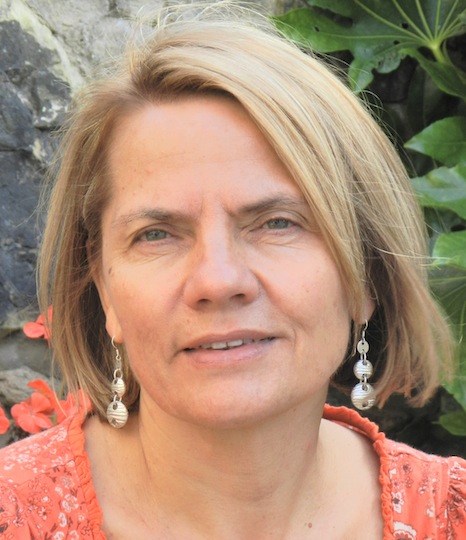
 Peggy Riley is a writer and playwright. She won a Highly Commended prize in the 2011 Bridport Prize and was published in their anthology. Her short fiction has been broadcast on BBC Radio and published in Mslexia Magazine and as an app on Ether Books. Her plays have been commissioned and produced off-West End, regionally, and on tour. She has been a festival producer, a bookseller, and writer-in-residence at a young offender prison. Peggy also runs workshops for writers and readings with authors. Originally from LA, Peggy now lives in Kent.





 F C MALBY
You must be logged in to post a comment.