The joy of bookshops and finding signed author copies

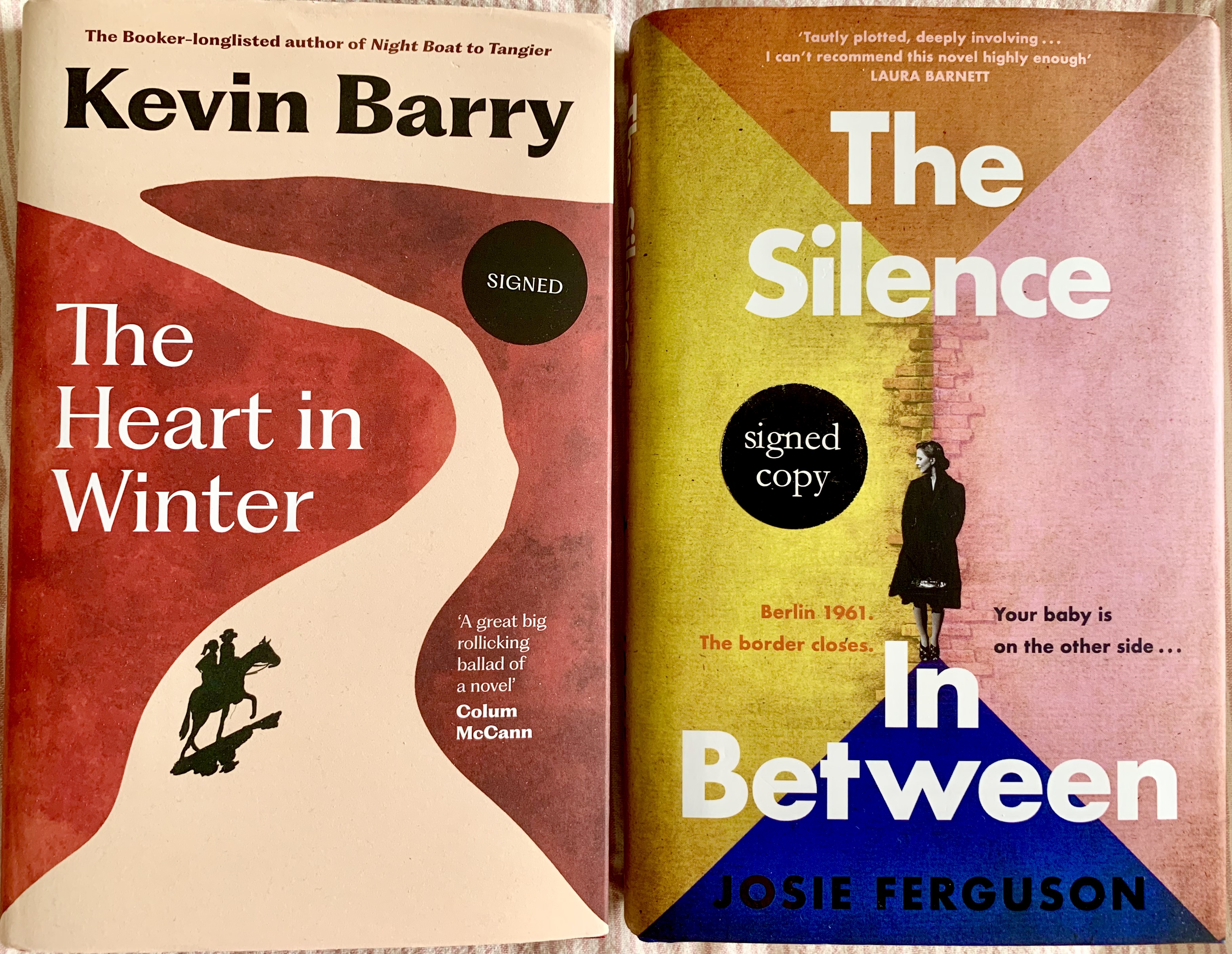
I spent some time in Waterstones at the weekend. It’s a place I’ve always loved – the scent of books, the anticipation of finding new titles, the peace, the labyrinth of bookshelves. There are so many wonderful bookshops, both large and small, to peruse the shelves and find new books. These two new titles were a lovely surprise.

The scent of books, the anticipation of finding new titles, the peace, the labyrinth of bookshelves.

I love Kevin Barry’s work, but hadn’t heard about this new title, The Heart in Winter, released on 6 June and set in 1891 Montana. Butte is a city rich in copper mines and immigrant Irish workers. The story centres around Tom Rourke, a young poet and ballad maker. As he feels his life is heading nowhere, and struggling with alcohol, Polly Gillespie arrives in town as the new bride of the devout mine captain, Long Anthony Harrington. Tom and Polly steal a horse and head out west through the badlands of Montana and Idaho. This is described as a ‘ballad of a novel’ and ‘a glorious haunted yarn.’

A ‘ballad of a novel’ and ‘a glorious haunted yarn.’

Josie Ferguson’s The Silence In Between, released on 20 June and shortlisted for the Waterstone’s Debut Fiction Prize, is a historical debut novel about a family separated by the Berlin Wall. It piqued my interest because my debut novel, Take Me to the Castle, also centres around the political changes in Eastern Europe through the 1990s. Lisette is in hospital with her baby boy. The doctors tell her to go home and get some rest, that he’ll be fine. When she wakes up and a wall has divided the city in two and her child is on the other side. Lisette is trapped in the east, while her newborn baby is unreachable in the west. With the streets in chaos and armed guards ordered to shoot anyone who tries to cross, her situation is desperate. I can’t wait to begin reading this.

When she wakes up and a wall has divided the city in two and her child is on the other side.

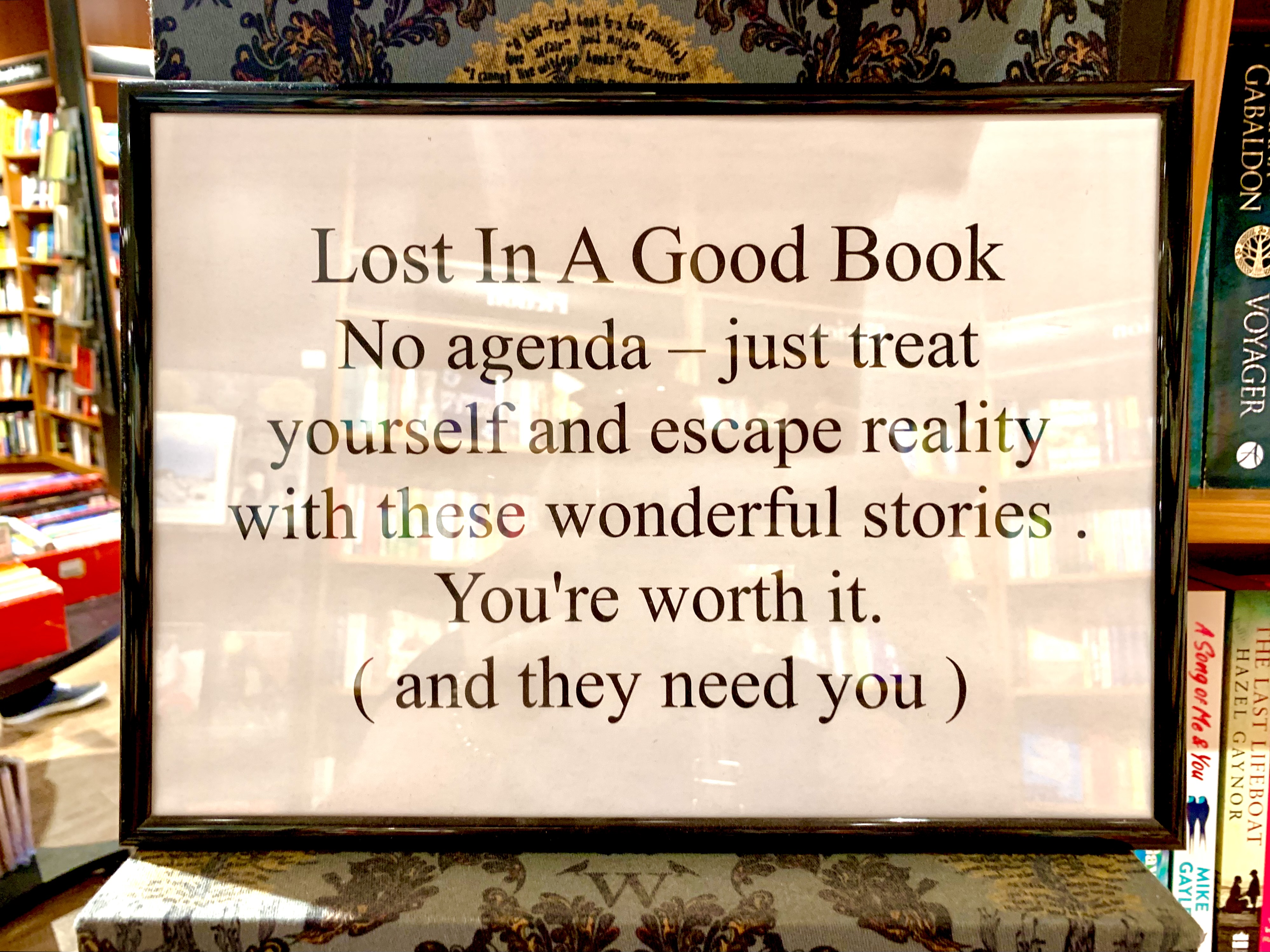
Another thing I love about bookshops is the sometimes quirky and lovingly-written notes from the booksellers themselves. This one, caught my eye as I entered and drew me to the first bookshelf. Lost In A Good Book, No agenda – just treat yourself and escape reality with these wonderful stories. You’re worth it (and they need you). The last part reads like a L’Oreal add and is tough-in-cheek. I love these personal touches.

Lost In A Good Book, No agenda – just treat yourself and escape reality with these wonderful stories. You’re worth it (and they need you).

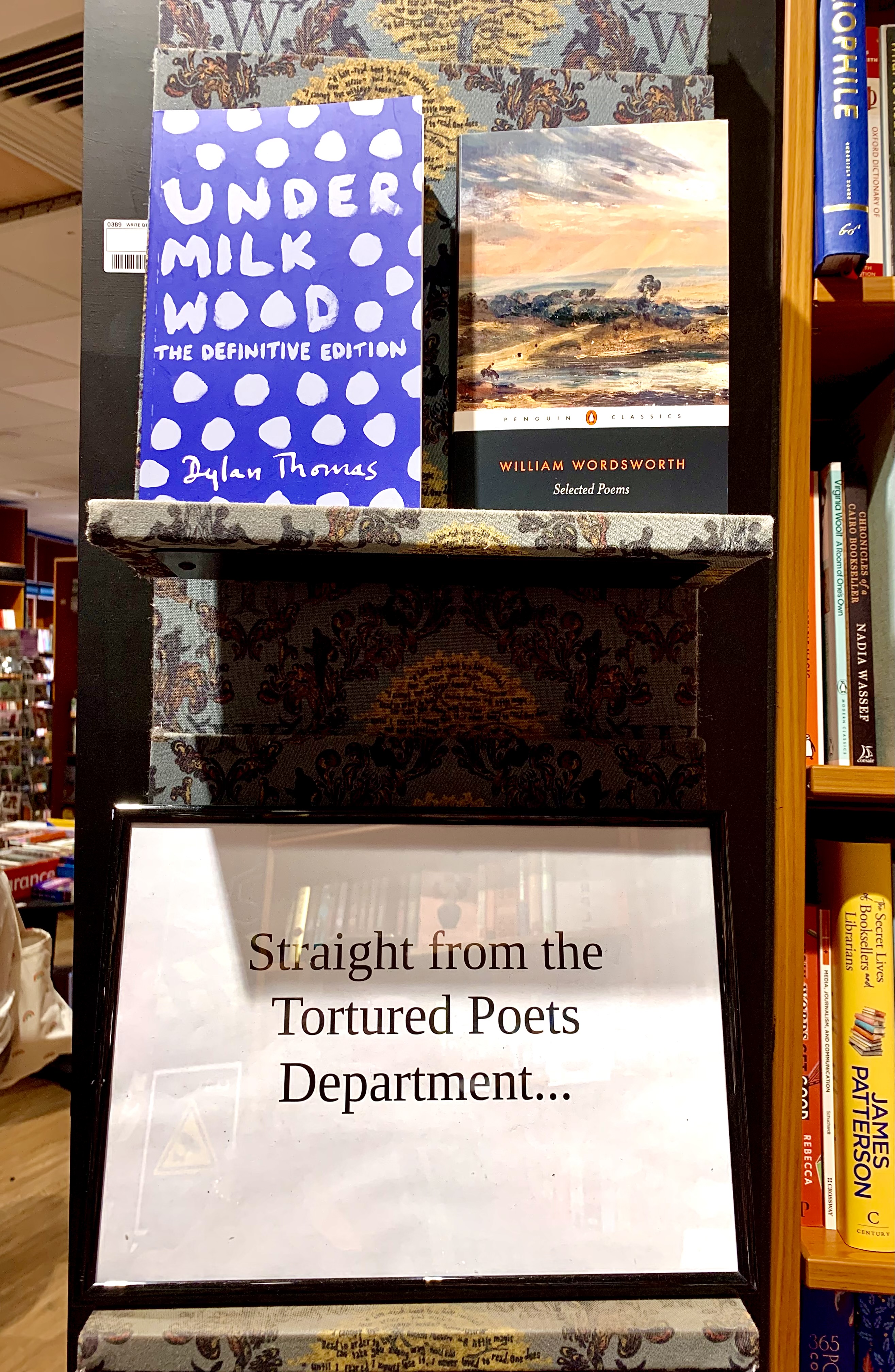
And then there’s this…Straight from the Tortured Poets Department…. Perfectly written and positioned below these two great classics by Dylan Thomas and William Wordsworth!

Straight from the Tortured Poets Department

Which signs have you seen in bookshops recently, and what do you love about bookshops? Have you seen my recent blog post about two wonderful bookshops in Italy? Don’t miss these.

Two European Bookshops You Need to Know About

There are two fabulous bookshops in Europe that you might not know about. Both are in Italy, one is in Rome and one is in Florence.

GUINTI ODEON, FLORENCE

The first bookshop is the Giunti Odeon. Yes, you read that right. It’s a cinema with a built-in bookshop. What an amazing combination of culture from the world of books and film! The Giunti Odeon, or GO remains a cinema, showing films in Italian and English, but it also has a bookshop which is open 7 days week until the end of the film each night. The bookshop contains over 25,000 books, which fill the whole of the ground floor, including the foyer.

The cinema opened in 1922 in Palazzo dello Strozzino. It is one of the most stunning Renaissance palazzos in Florence with an Art Déco interior and sculptures by Antonio Maraini and tapestries by Matilde Festa Piacentini. Cinema Teatro Savoia, as it was known, hosted world-class film premieres, theatre performances and musicals. It was reopened after WWII and renamed Cinema-Teatro Odeon and has hosted Louis Armstrong and Kate Winslet.

In 2023, the Odeon partnered with publishing house Giunti Editore. It was then renovated and reopened in November 2023. The stalls have been redesigned, with the original detail remaining intact, as required by the city’s fine arts department – fountains, tapestries, ornate columns, terrazzo floors, glass dome, gilded lettering and heavy golden drapes. No less than 200 armchairs have been placed in the mezzanine gallery, where cinema goers remain undistracted by the bookshop below.

OPEN DOOR BOOKSHOP, ROME

The second gem of a bookshop is in Rome. The Open Door Bookshop sells second-hand books, and has been in Trastevere for more than forty years. Its name is both a wolcome to book lovers and a reflection of an open mind and a curiosity for learning. The bookshop sells “the unusual and even the bizarre.” Finding a book is a “treasure hunt among old, antiquarian and even new books”.

The contents of the bookshop vary on any given day and if you are looking for a specific book, they will try to find a copy! They also take second-hand books that people want to pass on. There is a good selection of books ranging from contemporary and genre to classics and Italian, French and Spanish. The cluttered nature of the bookshelves and the scent of second-hand books are enticing. It’s a literary Aladdin’s cave!

Photo credits: The Florentine, Open Door Bookshop, Amber Paulen.

Two forthcoming Book Releases in 2024

I have some exciting news! There are two new books being released this year, both include my short stories. As an author, it’s such an amazing feeling when your work is about to be released into the hands of readers around the world. I love hearing reader feedback and discovering what resonates with individuals.

Since the release of my first novel in 2012, I have had a second novel published, a short story anthology (soon-to-be two) and work published in three anthologies (soon-to-be four) I have also had many stories and poems published in literary journals worldwide and some competition winners. I was asked to read for a writing competition for a journal and have given readings and led writing workshops. It never gets odd. I still love writing and engaging with readers.

The first book is my second collection of short stories, A Place of Unfinished Sentences.

The sentences we leave unfinished, questions surrounding sudden loss, a decision on a train. This second collection covers themes of relationships and memory, exploring what happens when memory fails. It looks at beginnings and endings, weaving through themes of generations, family, uncertainty, and what happens when experiences change us.

“F C Malby’s stories capture characters teetering on the edge of precipices in their lives, sometimes literal, sometimes metaphorical, as they decide whether or not to take a leap of faith into the unknown. These intense, beautifully realised and ice-sharp stories momentarily suspend us over an Everestian abyss.” Jonathan P Taylor, author and Senior Lecturer in Creative Writing, University of Leicester

The second book that I want to share with you will be published by Pens of the Earth, who are launching a collection of stories, poems and environmental articles on 21st October 2024. My short story, Prolific, will be in with many others with all profits from book sales going to the Solent Seagrass Restoration Project.

Book Pile

This morning, I’m dipping into some poetry and short stories from a few of my favourite authors. The advice I was given when I began writing was, read as much has you write. Over the years I’ve come to see the importance of this and the need for balance.

Ian McEwan, in an interview, said that he reads for several hours a day and it’s good to read a range of fiction, especially outside your genre. Although, today I’m focusing on poetry and short fiction. I’ve written quite a bit of both, recently, but I haven’t had time for much reading. I’m currently studying for a Masters in Theology, so it’s a juggling act. I finished ‘Reservoir 13’ by Jon McGregor this week. I need some time before I review it, as I have so many thoughts on it.

Today, I’m looking at these beauties by Claire Keegan, whose book, ‘Small Things Like These,’ was my favourite read of 2022. I then read ‘Foster,’ which was also an intensely beautiful, if a little melancholic, read. I’ve reviewed it on this blog. These are stand alone short stories, The Forester’s Daughter and So Late in the Day. I also want to read Alison Moore’s Eastmouth and Other Stories. I really enjoy her short fiction and her novels. One of my favourite stories for sheer tension and beautiful writing was ‘When the Door Closed, It Was Dark,’ originally published by Nightjar Press and in the collection, Pre-War House and other Stories, but Salt Publishing.

Wendell Berry’s poems are meditations on relationships and belonging, and Daunisha Laméris’ poetry is vibrant and atmospheric. I haven’t started Homesickness by Colin Barrett, but I enjoy his short fiction. His newest book, Wild Houses, will be published by Jonathan Cape in 2024. Now, time to read…..

Woman in Gold

There has been much in the news in recent years regarding Nazi looted art from Europe during the Holocaust. It is also the subject of my thriller, DEAD DROP, published by Linen Press in October 2022. You can find out more in a conversation and Q&A with my publisher. Over 600,000 pieces were stollen from Jewish families, collectors and museums in countries that were occupied. It began in 1933 in Germany with the seizure of Jewish property and belongings and continued on during the Anschluss, where Austria was annexed by the Nazis in 1938. Around twenty percent of the art in Europe was looted by Nazi soldiers and, today, more than 100,000 pieces are still missing and have not been returned to their owners, or families. Efforts to recover paintings and other items have been stepped up through new art restitution laws.

Last night, the BBC aired the 2015 film, Woman in Gold, which follows the true story of Maria Altman, the niece of Adele Block-Bauer, who is the subject of Gustav Klimt’s portrait, Woman in Gold, which hung in the Belvedere Palace Gallery in Vienna, Austria. Altman fled to America with her husband, forced to leaving her parents behind, and the film depicts flashbacks to the arrival of Nazi soldiers in Vienna and the looting of art and property. The details, like her father playing the cello and the memory of Maria being given her aunt’s favourite necklace (also worn in the portrait), makes the film all the more poignant. Maria and her young lawyer fight for ten years for the paining to be returned, taking their case to the Supreme Court in America.