If The World Stopped Reading I Would Still Be Writing

Waterfall in the Rosenlaui ravine (Switzerland...
Waterfall in the Rosenlaui ravine (Switzerland) Français : Une cascade dans le ravin de Rosenlaui, en Suisse. (Photo credit: Wikipedia)

I hear many authors complain of time constraints, low income from books, isolation from a workplace or other people, writer’s block and many other issues and, while I understand these, I also want to scratch my head and ask whether writing is the best use of their time. Writing IS hard and it IS time consuming but here’s the truth: If the world stopped reading I would still be writing.

If people no longer read books, my fingers would continue to hover over the keyboard each morning in quiet anticipation, waiting to tap out new sentences and create different worlds. I wrote travel diaries and poetry long before I began to write my first novel. I didn’t write for people to read these, and I hope they never will, I wrote for my own pleasure.

I love writing. My mind is constantly churning over ideas, my eyes and ears observing the small details of each day, absorbing conversations and snatched moments of intimacy between other people: a hand on a shoulder, a kind expression, an angry response. All of life and its rich experiences feed into my subconscious to be unearthed when required.

I store up a bank of thoughts and ideas continually. They may come from a painting or a rock concert, a quiet conversation or a crowded street, a film or from the strings of a violin in an orchestra, an early sunrise or a pain-filled conversation. These experiences shape me but they also shape my writing. We are influenced by what we read but much more so by first-hand experiences. Much of my writing has been fueled by travel to foreign lands and I currently live abroad. The richness of different cultures has expanded my vision of life and people. My words are fueled by the relationships I have and by the chance encounters and words from the lips of strangers.

I need to write because it is how I find meaning in life. It helps me to communicate on a much deeper level than any spoken word. I love the nature and impact of words and the way sentences can repel and attract; reel a reader in and push them back. I get a thrill from the details of a scene or from a wild response from a character. I inhabit the minds of other characters with the buzz of a homicide detective close to finding the perpetrator of a crime. I feel the emotions of injustice, loss, elation, fear and longing, all through the mind of a fictional character placed in an unstable situation.

The ability to change a person’s mind or to open them up to a new world or a new thought is unmatched, other than through a work of fiction. I know that there can be dry periods and difficulties with a plot or in editing a manuscript, but these are my overriding thoughts on the craft of putting words to paper. I understand that there are times when you want to give up or if you wonder what you are doing or whether the path will lead you into brambles or into a deep ravine. This is often temporary and it is important for me to focus on the positives and on the reasons for writing in the first instance. The privilege of hearing a reader say that they loved your story and couldn’t put the book down is wonderful, but the truth is, even without it I would keep writing.
So When Are You Going To Write A Proper Book, Then?

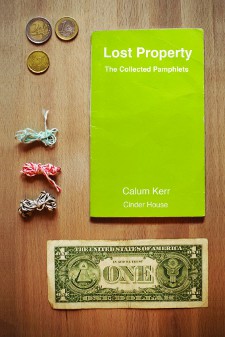
I am pleased to welcome the Director of National Flash Fiction Day, Calum Kerr, for a guest post on the short fiction form. His new collection, Lost Property, brings together four brand new pamphlets of flash fiction, featuring Singsong, Soaring, Burning and Citadel. The collection contains 83 stories that move from the hilarious to the sinister and demonstrates the unique nature of ultra-short fiction.

lostpropertyfrontsm

If you are a writer of flash-fiction, short-stories, possibly poetry and maybe even non-fiction, this is a question which may be familiar to you. The person posing the question might be a complete stranger, maybe at some reading or signing event, but is more likely to be a friend or even a relative. You proudly show them your collection of stories or poems, or your book on how to knit cartoon characters, learn economics or install a Linux system on your PC, and they glance through it, nod appreciatively, and then they work their way towards the question.

“So. Well done. This looks good, doesn’t it?” is the opening move.

“Yes. I’m very pleased with it. I think it’s come out very nicely,” is your response.

“Must have been a lot of work.”

“Yes. But enjoyable. Apart from the editing, ha ha…”

“Ha ha, yes.” They nod and look through the book again, then up at you. “So…” they start, and this is where you should stop them, because you know what’s coming next.

“It is a proper book. It has a cover. It has loads of words in it. I did research and everything. People will buy and read it – okay, not in JK Rowling numbers, maybe, but some of them. It has an ISBN number and can be bought from Amazon and those funny old places that people used to go into. You know, bookshops.” Is what you want to say. But you don’t. Instead you let them continue.

“So… when are you going to write a proper book, then?” they ask, and you somehow restrain yourself from swinging for them.

Because, of course, they don’t mean to say that your collection or non-fiction opus is not a ‘proper’ book. They mean ‘when are you going to write a novel’. That’s what it’s all about, after all, isn’t it? Collections of things are nice, but they’re just little stories or poems, not a good chunky page-turner. Non-fiction books are useful, but you don’t settle down on the sofa on an autumnal afternoon to read them. They live on shelves until you have occasion to reach for them. No, they’re talking about the All-Powerful Novel and the place it holds in the public imagination as the pinnacle of writing and the thing that every writer is surely aiming for.

And this is the problem for writers, especially of flash-fiction or short stories. Because each of the small parts looks inconsequential; trivial. There might be many of them, and they might make up a 200 page collection containing 60-70,000 words, but still, you can see the joins; you can see where the writer started and stopped. Not like the seamless flow of a novel (which was surely written in a single, sleepless week of endless typing). And, of course, you are writing prose fiction, so surely you must be working your way up from these little things to try and join the big boys with their ‘proper’ books.

Now, don’t get me wrong, many flash-fiction and short story writers do have aspirations to be novelists, or at least have found an idea coming to them which is too big to cover in just a few hundred or few thousand words, and so are working towards a much longer piece. But that does not mean that they have finally, in some indefinable way, graduated to the big leagues. They have not left behind their childish play with those tiny tales and taken the brave step to write longer. They are simply following their muse where it takes them, and sometimes your muse takes you longer.

But all of those same flash-fiction and short story writers who are dabbling in the world of novels, at least those I know, still love and respect the short form. They are not what we write because we can’t manage the long things. They are the things we write because there is a value to a short story or a flash-fiction, an intensity, a chance at experimentation, and a specific purpose that you simply can’t achieve in the novel.

We don’t write stories because we are waiting for our turn to write a ‘proper’ book. We write stories because they need to be written, and because we love what they can do that all of your ‘proper’ books can’t.

So next time someone looks at your collection of flashes, poems, or your non-fiction work and seems about to ask that fateful question, stop them, point to the cover and ask them: “So, when are you going to read a proper book, then?”

calum-200x180   Calum Kerr is a writer, editor, lecturer and director of National Flash-Fiction Day in the UK. He lives in Southampton with his wife – the writer, Kath Kerr – their son and a menagerie of animals. His new collection of flash-fictions, Lost Property, is now available from Amazon, or direct from the publisher, Cinder House.

Blogging for Writers

blog

My earlier post about blogging received a huge amount of interest and it appears to be a subject close to the hearts of many readers. I promised to come back to it, so I’d like to start with a post on blogging for writers. I’m aiming to look at blogging for readers in a separate post.

Many people warn against blogging about writing, or blogging at all if you write fiction. I would disagree, for the following reasons:

I have gained a huge insight into writing and publishing from a range of authors who blog about the process of writing, editing or publishing. I have learned about both self-publishing and traditional publishing. Some agents and agencies also blog and their comments can be really helpful in finding your way through the rabbit warren that is the publishing industry.

Drawing in other writers who understand the process, and can support you, is essential. I would go so far as to say it as essential as gaining readers. Writing can be an isolating business and blogging can help you to connect with others with a certain level of freedom. I have gained so much from the comments on this blog from other writers, and by following blogs written by writers.

It limbers you up and keeps your words flowing. The process of writing for a blog is very different to the process of novel writing and it can teach you things that you won’t necessarily learn from writing your manuscript.

Reader responses are immediate and interactive. I would say that this is one of the biggest joys of writing blog posts. I really enjoy the comments and suggestions. I like to meet new blog readers and discover new blogs and books. The debates which are sometimes struck up from a particular topic can be really invigorating and will challenge your various perceptions.

Although you can blog about your subject area – crime, if you are a crime writer; relationships, if you write women’s commercial fiction; a specific area of expertise if you write non-fiction – I find that blogging about writing helps me to formulate ideas and to share what I have learned with others who are travelling along the same path.

I find that readers are also interested in finding out about the writing process and I receive emails from people who are just starting out or who would love to write but are nervous about putting their ideas down onto paper. Some readers are just interested in how writers tick and like to know what goes on behind the pages.

Any thoughts? Do any of you find blogging about writing helpful?

Author Interview with Matt Haig

The Humans
From your experience of journalism, as well as novel writing, has one fed in to the other in any way?

Journalism teaches you to be economical with words. It tells you not to be too self-indulgent.

What do you most like to read and are there any books you have read recently that have stood out or changed you?

I read all kinds of stuff. I have been re-reading Graham Greene recently. I studied him at university. Did a whole module on him. I think, from the outside, my books are nothing like his, but I consider him my greatest influence.

What have been the most difficult things to write about and why?

There is some mathematics in my new novel, and I had to look like I knew what I was talking about, so I researched, and I quickly saw how so many mathematicians go crazy.

You have said that The Humans, your new book, is the one work you would most like to be remembered for. Although you have written several other books, what has given you confidence in this project in particular?

Because I totally cut loose. A part of me used to play the game. You know, I used to be trying to be highbrow, or taken seriously, and that somehow got in the way. With this, I knew it was probably going to be published whatever (as my last book did quite well) so I just went for it. Comedy, science-fiction, sentimentality – all those illegal things.

What advice would you give to new writers on their path to publication?

Be brutal with your writing. Don’t let yourself have it easy. And then be persistent, and thick-skinned, for everything that follows.

What do you enjoy doing outside writing and reading?

Being with my kids, toast and peanut butter, running, holidays. I am not into fancy things, but I am into fancy holidays.

If you could meet any well-known figure, living or dead, who would it be and why?

Emily Dickinson, without a doubt. Amazing mind, intriguing person. She’d be too shy to open her front door though, so that’d be a problem.

Matt Haig

Matt has written novels, screenplays, children’s novels and worked as a journalist, collaborating with The Guardian, The Sunday Times and The Independent. He has won a range of awards, including the Yorkshire Young Achievers ‘Achievement in the Arts’ Award in 2009, and his novels have been translated into 29 languages. The film rights for his first novel, The Last Family in England (2004), have been sold to Brad Pitt’s production company. His previous novel, The Radleys, won an ALA Alex Award in America, has been shortlisted for the Portico prize and nominated for the Carnegie Medal. It won the TV Book Club Summer Read. He was born in Sheffield, Yorkshire in 1975. Since then he has lived in Nottinghamshire, Ibiza and London. He studied English and History at Hull University and then did an MA at Leeds, and now lives in York with author Andrea Semple and their two children.

www.matthaig.com

How To Write A Compelling Pitch and Synopsis

latest-news-headlines

I have always feared the dreaded pitch and synopsis. The idea of condensing your work down to a short description (your synopsis) or an even more minute few sentences (your pitch) fills me with dread. If you worry that you will risk losing the essence of your work, read on.

I read a post recently on twitter by author, psychologist and fiction reviewer, Lucy Beresford. It challenged me to really pick out the key idea, the very core of a story. Her post was on twitter and she said this:

“Hone that 3-sentence pitch. Know your book, pitch around the ifs, describe plot, sprinkle gold-dust.”

While I’m not sure that I have gold dust anywhere around the house to sprinkle, I do have some cake sprinkles and some silver balls for cupcake decorating! Seriously, though, her words revolutionised the way I saw the dreaded pitch and synopsis.

Agents and publishers talk about the elevator pitch – what you would say about your book in the minutes that you might share during an elevator ride with them – but the idea remained elusive, a concept just out of reach.

Beresford’s words PITCH AROUND THE IFS made perfect sense yet, through all the writing and publishing advice I have read both in print and online, I have never heard the idea that the ifs are the very heart of the pitch – the what ifs, the hows, the whys. Leaving your reader with questions, rather than mere statements of fact, builds suspense and anticipation. It creates a compelling main idea or a set of ideas which, until the book is read, remain unanswered.

So, this morning I set to work on a short synopsis of my current work-in-progress and put the questions down on paper. The difference between my initial synopsis and today’s revision is the difference between an abstract for an academic paper and a news headline for an act of crime. Although both are necessary for different purposes, a news headline should (in theory) leave you wanting to read the whole article, it should be a teaser. Find a sysnopsis of your favourite films and books and try to work out what makes it compelling.

I should add here that the longer synopsis, which an agent would want to read, is less about the ifs and more an outline of your story (plot spoilers included), but this would be a different post entirely.

Do you have any synopsis or pitch writing tips? Have you read any particularly good ones?

If you would like to follow my writing tips or connect with me on twitter, you can find me here @fcmalby