How To Use Pinterest To Improve Your Writing

board

When I write I have the scenes playing in my mind like a film scene and I need images for inspiration. Whether imagined or actual images, I need to ‘see’ the characters and the setting and buildings. I hit gold when I started to use pinterest as I am a highly visual person. I love art and photography, so this sight has an almost magnetic quality about it for a mind which soaks up the visual world.

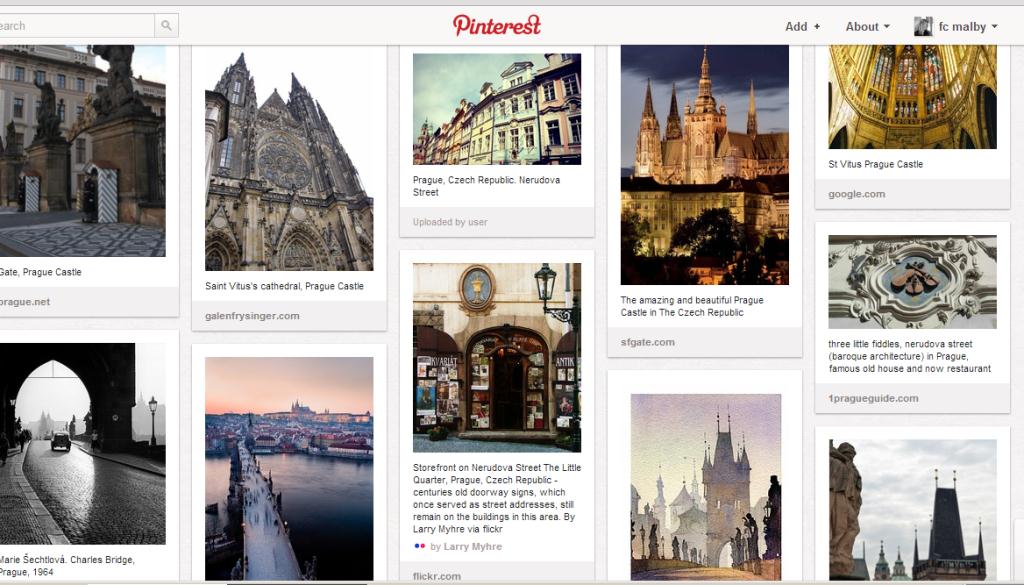
I began using pinterest to ‘pin’ my ideas and create the atmosphere that I needed in order to write some of my scenes. I have added a clip of the board for Take Me the Castle to the beginning of this post but you can see the whole board here if you are interested.

You can also use scrivener, but I find pinterest quick and easy to use. There is a plethora of images already posted by others which you can search for, or you can pin your own images from any website by pasting the url, or add your own file.
pin

Why and how does this help?

Some writers use prompts or music to help them to write. Jane Friedman has written a good article on prompts and Roz Morris has a blog about how writers use music to build their stories. If you are a visual person a collection of images can spark new ideas or link a character’s responses to his or her environment. It can help to put you in the scene and to think about how the characters will respond to a cliff edge, or a towering building, or a dark room.

According to neurolearning, ‘brainstorming activities of visual thinkers may be more productive if right hemispheric strategies of brainstorming and organization (mindmapping, doodling, free association, analogies) are undertaken. In fiction writing, often the most powerful writers are good at plumbing the strengths of both the right and left hemispheres.’ As a qualified teacher I can attest to the fact that children who are visual thinkers and learners engage more readily when the right side of their brain is stimulated with images and free drawing and mapping. You might be interested to know that most writers are in fact right brained, they use the right side of their brain to engage creativity more than the left side.

I would encourage you to have a look at pinterest and try pinning some images. I also have a board with writing quotes and information and boards with portraits and travel, which help to get the ideas flowing. Let me know if you have any other ideas for visual inspiration.

Writing and the Attention Economy

This is a post from http://damiengwalter.com/

It was so good that I thought it was worth sharing. Valuable advice for writers…

eye

As a writer you are asking for the most valuable commodity your readers have. Time. Each of us gets a finite portion. No sum of money can buy us any more. And the demands on it are ever greater.

The novel evolved at a period in history when the constituency of its readers had much more time to waste. Karl Marx would dub them the ‘bourgeoisie’, the section of society who owned the means of production, so profited vastly from industry in the 18th and 19th centuries. The middle and upper classes had time on their hands and little to do with it. The novel became one of the most popular ways of being idle.

The bourgeoisie no longer exists in quite the same way, and it and the proletariat both have innumerable ways of occupying whatever free time is left from work. Yes, there are dozens of forms of entertainment. Films, music, games, sports. But there are also more and more ways for people to invest their time in improving themselves. Is your book really going to compete with the vast range of information available to me for free on Wikipedia? Or the infinite social networks accessible through Facebook and Twitter?

Information of all kinds is becoming a post-scarce resource. While the time it takes to absorb information becomes scarcer and scarcer. And yet many writers still behave as though their product was scarce and the time of readers unlimited. Writing two novels, four novellas and ten short stories a year is great productivity. But completely counter-productive in an attention economy. Because if I read one story by you and its any less than excellent, I’m very unlikely to read another. Your first novel is very important to you, but as a commodity in the attention economy its almost certainly worth less than the value of my time to read it. Which is why the vast majority of material written and published every day on the internet disappears without a trace.

The philosopher and mathematician Blaise Pascal once wrote, “I did not have time to write you a short letter, so I wrote you a long one.” As a writer working in the attention economy you should take Pascal’s remark as the first rule of your professional life. Take the time to write a short letter to the world. Churning out fiction can give you the comforting illusion of progress. No doubt you’ll find one market or other to publish it. But think about the writing you really love and value enough to come back to again and again. How long do the best authors take to create their work? Why should you aim to be anything less than the best? Every word you write is asking for the gift of the reader’s time. Make sure it’s worth it.

5 Ways to Optimise your Facebook Author Page

Today is the last post of my blog tour for ‘Take Me to the Castle.’ Join me over at 30 Day Books, hosted by Laura and Brandon, for a guest post on how to optimise your author Facebook page to interact with readers and share your news, reach more people to join your mailing list and add book giveaways. You’ll learn about the admin panel which gives you information on reader demographics…

http://www.30daybooks.com/optimize-facebook-author-page/

Writer’s Block: 5 Top Tips for Finding Inspiration

#ds139 "Writer's Block"

There are those who say ‘Don’t look for inspiration, just write.’ What about the days when you are stuck with a scene that feels clunky or one of your characters doesn’t seem consistent or exciting enough. Maybe you are are about to embark on a new book, a first book, a short story, or a poem…and the list goes on. Finding ideas for blog posts can sometimes be difficult when many key topics have been covered from all angles.

Here are 5 top tips:

Go for a walk. Get out and stretch your legs. Writing can keep you pinned to a chair for longer than you realise and the exercise alone will get the blood circulating to your brain. Einstein came up with the Theory of Relativity while riding a bike. Emerson said of Thoreau: ‘The length of his walk uniformly made the length of his writing. If shut up in the house, he did not write at all.’ Haruki Murukami runs 10K a day when in writing mode and says, ‘Physical strength is as necessary as artistic sensitivity.’ The Neuroscience of Imagination is a really interesting article on this topic.

See a film. It is a good idea to see films which stretch your imagination, especially if it is a difference genre to your own writing. The visual stimulus and the way the characters are played out often spark ideas for characterisation or scene setting and plot momentum.

Read. Read as much as you can of as many different genres as you can get your hands on. Ian McEwan writes all morning and reads all afternoon. Some agents recommend reading at least as many words as you write each day! With the rise of ereaders it is quick and easy to access a vast range of books.

Pick up a paper if you want to find inspiration from non-fiction.

Dip into a short story if you want a short burst of inspiration. They are packed full of description and swift characterisation. See my recent post on short stories.

Head to a cafe. Go somewhere which is guaranteed to be full of people! You are most probably writing about people, so study them. Watch people’s body language, the way they dress, how they talk. Go and write or meet a friend and observe. You’ll be amazed by how much it helps. I was writing a difficult scene in my novel in a cafe. The scene involved a particular character and, by chance, a guy with similar features and mannerisms to my character sat down at a table nearby. Needless to say the scene was wrapped up by the time I had finished my coffee. It was a complete coincidence but you never know who will walk by or sit down and inspire a particular character in your writing.

Go to a gallery. Or a football match, or any thing that you enjoy and find inspiring. I love art galleries and there is something about art which, for me, crosses over into writing and ideas. I see a painting and think of a story behind the image or wonder about the life of the artist. The biographies on the wall often inspire ideas about a different time frame or issue.

So, go and be inspired then come back and tell us what it is that helps you to get around writer’s block. Do you have any tips for inspiration?


Developing Conflict and Tension

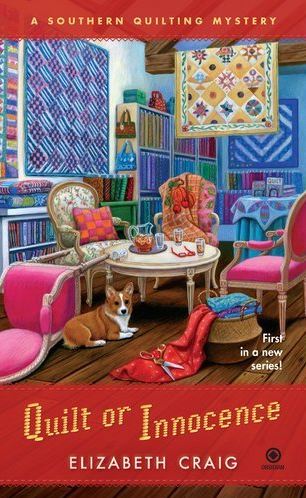
Today’s guest post is written by Elizabeth Craig who writes the Memphis Barbeque series for Penguin/Berkley (as Riley Adams), the Southern Quilting mysteries (2012) for Penguin/NAL, and the Myrtle Clover series for Midnight Ink.

She blogs daily at Mystery Writing is Murder, which was named by Writer’s Digest as one of the 101 Best Websites for Writers for 2010, 2011, and 2012. Her most recent releases are Quilt or Innocence (June 2012) , Hickory Smoked Homicide (a November 2011 release), and A Dyeing Shame a Myrtle Clover mystery (December 2011).  Her next release will be February 5, 2013–Knot What it Seams.

Elizabeth is active in the online writing community.  She shares writing-related links on Twitter as @elizabethscraig and posts on craft and the publishing industry on her blog, Mystery Writing is Murder. She and Mike Fleming of Hiveword also manage the Writer’s Knowledge Base–a free search engine to help writers find resources.

Developing Conflict and Tension in Our Story

Conflict is one of the elements of an interesting story.  As much as we love our characters, if everything goes smoothly for them, then it’s hard to keep our readers reading.  After all—if it’s just an ordinary day for our protagonist, then we really don’t have much of a story.

A few tips for developing conflict and tension:

Quickly introduce conflict into your story.  If it’s delayed too long, the reader might start flipping ahead through the set-up and back story to see where the story really gets started.

Use both larger conflicts and smaller ones.  A lower level of conflict can be easily maintained by introducing tension in our story.  Maybe we’ve got a character who lost his job and is struggling to make ends meet.  He finally snares a job interview—and it’s for his dream job.  His car breaks down on the way to the interview. He was in a hurry when he left, and forgot his phone.  This approach can resonate with readers, too—it’s realistic and relatable. It can also give us an opportunity for us to display a character’s personality to our readers…when we show how the character reacts to the problem.

Provide conflict through other characters.  Here we do need to watch our character motivation and know our character and what matches his personality.  Who rubs our character the wrong way and why can tell us a lot about the protagonist as well as the other character.  We could bring in an ex-wife, an overprotective father, an annoying neighbor, or a backstabbing co-worker.  Every time we have a scene with one of the troublesome characters, we have the opportunity for tension.

Use both internal conflict and external conflict. What are our character’s inner demons?  What’s our character fighting with himself over?  Consider how his internal conflict can shape the story and his reaction to events. What external conflict prevents him from obtaining his goal?

Raise the stakes to create a faster pace.  Raising the stakes and making the conflicts and outcomes increasingly dire for the protagonist is one way to increase our story’s pace and keep readers turning pages.

Try to delay resolution. One thing that’s been difficult for me as a writer is delaying resolution of the protagonist’s problems.  I’m a problem-solver in life and I want to solve my character’s problems, too.  But letting problems spiral out of control and allowing them to gnaw at my protagonist can add excitement and tension to a story.

Give readers some breathing room.  Some of this is personal taste, but as a reader, I really enjoy having breaks in the tension and conflict.  This break can be accomplished through humor, or a subplot that’s moving along the path to resolution when hope in the main plot seems to be lost.

Make the protagonist’s external conflict and internal conflict collide.  What if our character had to sacrifice what’s most important to him in order to accomplish his main goal?  What if he’s got to face his inner demons to save the world?

Tension and conflict are two ways to keep readers turning pages.  What tips have you got for developing them in a story?

Writer’s Knowledge Base–the Search Engine for Writers

Twitter: @elizabethscraig